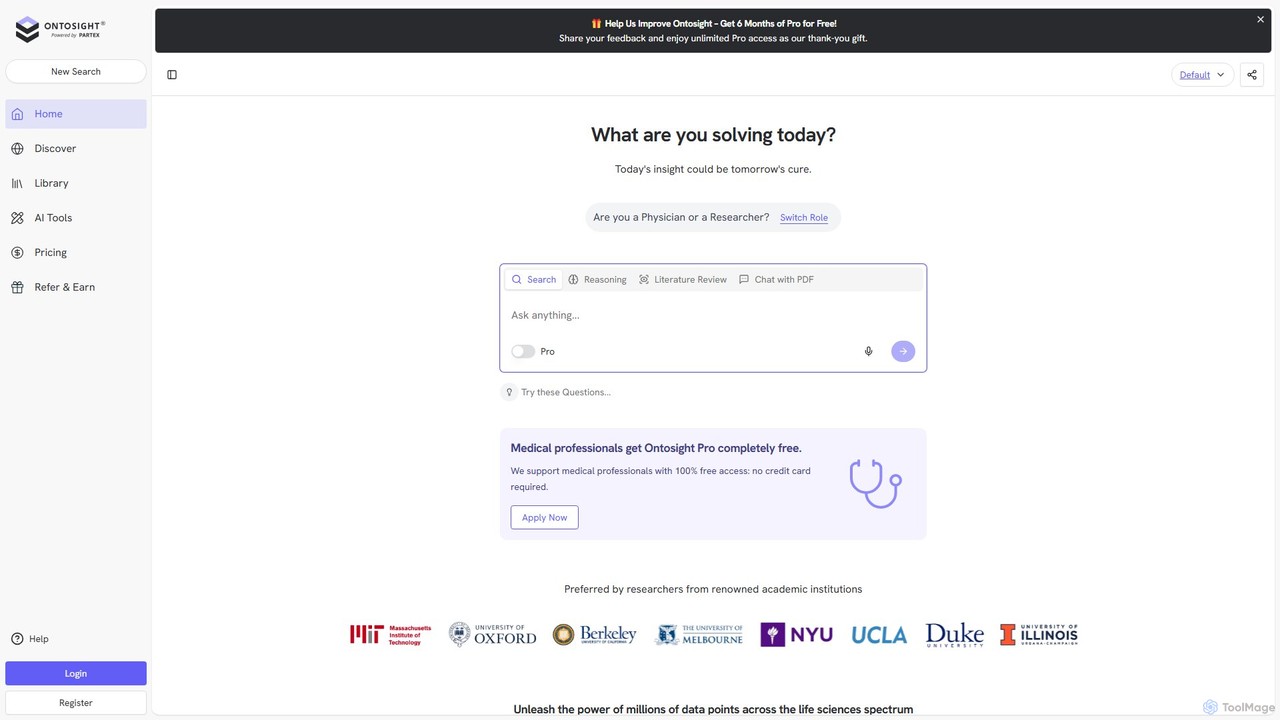
AMiner is an AI-powered academic search and technology intelligence platform from Tsinghua University. It provides access to a massive database of over 330 million papers and 135 million scholars. Featuring AI-driven tools like semantic search, one-click summarization, scholar profiling, and trend analysis, AMiner helps researchers and institutions accelerate scientific discovery.

Benchling is a cloud-based R&D platform for life sciences, using AI to accelerate scientific discovery. It unifies Electronic Lab Notebook (ELN), LIMS, and molecular biology tools to centralize data, streamline workflows, and enable collaboration for biotech and pharmaceutical research.
Product overview
AMiner Product overview
AMiner is an AI-powered academic search and technology intelligence platform from Tsinghua University. It provides access to a massive database of over 330 million papers and 135 million scholars. Featuring AI-driven tools like semantic search, one-click summarization, scholar profiling, and trend analysis, AMiner helps researchers and institutions accelerate scientific discovery.
Benchling Product overview
Benchling is a cloud-based R&D platform for life sciences, using AI to accelerate scientific discovery. It unifies Electronic Lab Notebook (ELN), LIMS, and molecular biology tools to centralize data, streamline workflows, and enable collaboration for biotech and pharmaceutical research.
Detailed feature comparison
| Feature | AMiner | Benchling |
|---|---|---|
| Primary category | Analytics | Analytics |
| Added | 2025-08-03 | 2025-08-09 |
| Pricing | Freemium | Freemium |
| Official website | www.aminer.cn | benchling.com |
| Product type | Website | Website |
| Performance data | ||
| User rating | Not verified | Not verified |
| Comments | 0 | 0 |
| Monthly visits | 281.6K | 1.5M |
| Monthly growth | -3.9% | -6.3% |
| Favorites | 114 | 122 |
| Details | View details | View details |
AMiner vs Benchling monthly traffic
Compare AMiner and Benchling by monthly reach, traffic trend, visit depth, top regions, and acquisition sources.
How to interpret the traffic data
In the AMiner vs Benchling monthly traffic comparison, AMiner currently shows 281.6K visits and Benchling shows 1.5M; Benchling has about 5.5 times the visible traffic of AMiner, an absolute difference of about 1.3M visits. This reflects visible reach, not feature quality or paid users.
Both tools provide verified traffic details, so monthly trends, visit depth, regions, and acquisition sources can be compared on the same basis.
AMiner monthly traffic:
Latest traffic
Monthly traffic trend
- 2025/9: 406.4K Monthly visits
- 2026/1: 364.9K Monthly visits
- 2026/2: 263.6K Monthly visits
- 2026/3: 324.6K Monthly visits
- 2026/4: 293.1K Monthly visits
- 2026/5: 281.6K Monthly visits
Top regions
Top 5 countries/regions
| Country/region | Percentage | Traffic |
|---|---|---|
| 🇨🇳China | 74.37% | 209.4K |
| 🇺🇸United States | 15.79% | 44.5K |
| 🇭🇰Hong Kong | 6.51% | 18.3K |
| 🇹🇼Taiwan | 2.06% | 5.8K |
| 🇩🇪Germany | 1.27% | 3.6K |
Traffic sources
| Source type | Percentage | Traffic |
|---|---|---|
| Direct | 86.58% | 243.8K |
| Referral | 13.31% | 37.5K |
| 0.11% | 310 |
Search keywords
Benchling monthly traffic:
Latest traffic
Monthly traffic trend
- 2025/9: 1.5M Monthly visits
- 2026/1: 1.4M Monthly visits
- 2026/2: 1.5M Monthly visits
- 2026/3: 1.6M Monthly visits
- 2026/4: 1.6M Monthly visits
- 2026/5: 1.5M Monthly visits
Top regions
Top 5 countries/regions
| Country/region | Percentage | Traffic |
|---|---|---|
| 🇺🇸United States | 76.24% | 1.2M |
| 🇩🇪Germany | 7.44% | 114.8K |
| 🇬🇧United Kingdom | 6.77% | 104.5K |
| 🇨🇦Canada | 5.58% | 86.1K |
| 🇯🇵Japan | 3.97% | 61.3K |
Traffic sources
| Source type | Percentage | Traffic |
|---|---|---|
| Direct | 78.59% | 1.2M |
| Referral | 15.5% | 239.2K |
| 5.91% | 91.2K |
Search keywords
Usage comparison
Compare the core capabilities of AMiner and Benchling
AMiner Core features
Benchling Core features
Use cases
AMiner Use cases
Benchling Use cases
AMiner vs Benchling:In-depth comparison and selection guidance
First decide whether the products solve the same kind of need
This in-depth AMiner vs Benchling comparison uses only the product records, taxonomy, audience, traffic, and community signals available on this page. AMiner is primarily listed under “Analytics”, while Benchling is primarily listed under “Analytics”, so the first decision is whether your actual task matches their recorded scope.
The structured fields currently show these decision-relevant differences: Monthly visits (AMiner: 281.6K; Benchling: 1.5M); Monthly growth (AMiner: -3.9%; Benchling: -6.3%); Favorites (AMiner: 114; Benchling: 122); Website (AMiner: www.aminer.cn; Benchling: benchling.com); Added (AMiner: 2025-08-03; Benchling: 2025-08-09). These facts are more useful for selection than brand visibility alone.
What market visibility and monthly traffic mean
In the AMiner vs Benchling monthly traffic comparison, AMiner currently shows 281.6K visits and Benchling shows 1.5M; Benchling has about 5.5 times the visible traffic of AMiner, an absolute difference of about 1.3M visits. This reflects visible reach, not feature quality or paid users.
Both tools provide verified traffic details, so monthly trends, visit depth, regions, and acquisition sources can be compared on the same basis.
If public market visibility is an important first-pass criterion, investigate Benchling first. The final choice should still follow taxonomy, use case, and a real trial because higher traffic does not prove broader capabilities or better workflow fit.
Product positioning, use cases, and roles
AMiner and Benchling currently overlap in shared categories: Analytics; shared tags: AI for science. This can place both on the same shortlist, but it does not prove equal implementation, depth, or cost.
AMiner's unique categories/tags are Summarizer, Academic Search, academic research, citation analysis, knowledge graph, literature review, paper search, and research assistant; Benchling's are Research, Data Management, Biotechnology, biotechnology, data management, drug discovery, ELN, and life sciences. These unique fields are the strongest differentiators: validate the product whose recorded scope matches the task instead of following traffic alone.
What ratings, comments, and favorites can tell you
AMiner has no verified rating, 0 comments, 114 favorites, and 127 likes;Benchling has no verified rating, 0 comments, 122 favorites, and 123 likes。
Neither product has enough rating or comment samples for a credible reputation ranking.
Selection guidance by actual need
When to evaluate AMiner first
Put AMiner on the priority trial list when the task aligns with “Analytics” and especially Summarizer, Academic Search, academic research, citation analysis, knowledge graph, and literature review. This follows recorded positioning and does not imply unlisted capabilities are absent.
AMiner also currently records: pricing is freemium, product type is website, 281.6K verified monthly visits, no verified user rating. Verify any hard requirement around price, platform, or reach before trial, and do not let sparse review data substitute for testing.
When to evaluate Benchling first
Put Benchling on the priority trial list when the task aligns with “Analytics” and especially Research, Data Management, Biotechnology, biotechnology, data management, and drug discovery. This follows recorded positioning and does not imply unlisted capabilities are absent.
Benchling also currently records: pricing is freemium, product type is website, 1.5M verified monthly visits, no verified user rating. Verify any hard requirement around price, platform, or reach before trial, and do not let sparse review data substitute for testing.
How to validate the recommendation before deciding
The available data describes positioning, public visibility, and community signals, but it cannot prove output quality, speed, integration effort, privacy, or long-term cost in your workflow. Before deciding, run the same representative tasks in AMiner and Benchling, then record completion time, accuracy, manual corrections, and the real paid threshold. A like-for-like trial turns this comparison into a defensible adoption decision.
Comparison FAQ
How should I choose between AMiner and Benchling?
Where does this comparison data come from?
What do unknown fields mean?
Related AI tools

Elicit
Elicit is an AI research assistant designed to automate and accelerate the literature review process. It helps researchers find relevant papers, summarize key findings, extract data, and synthesize information from a vast database of over 125 million academic articles. Elicit streamlines time-consuming tasks, enabling users to analyze more evidence with greater accuracy and speed.
Academia
SciSummary
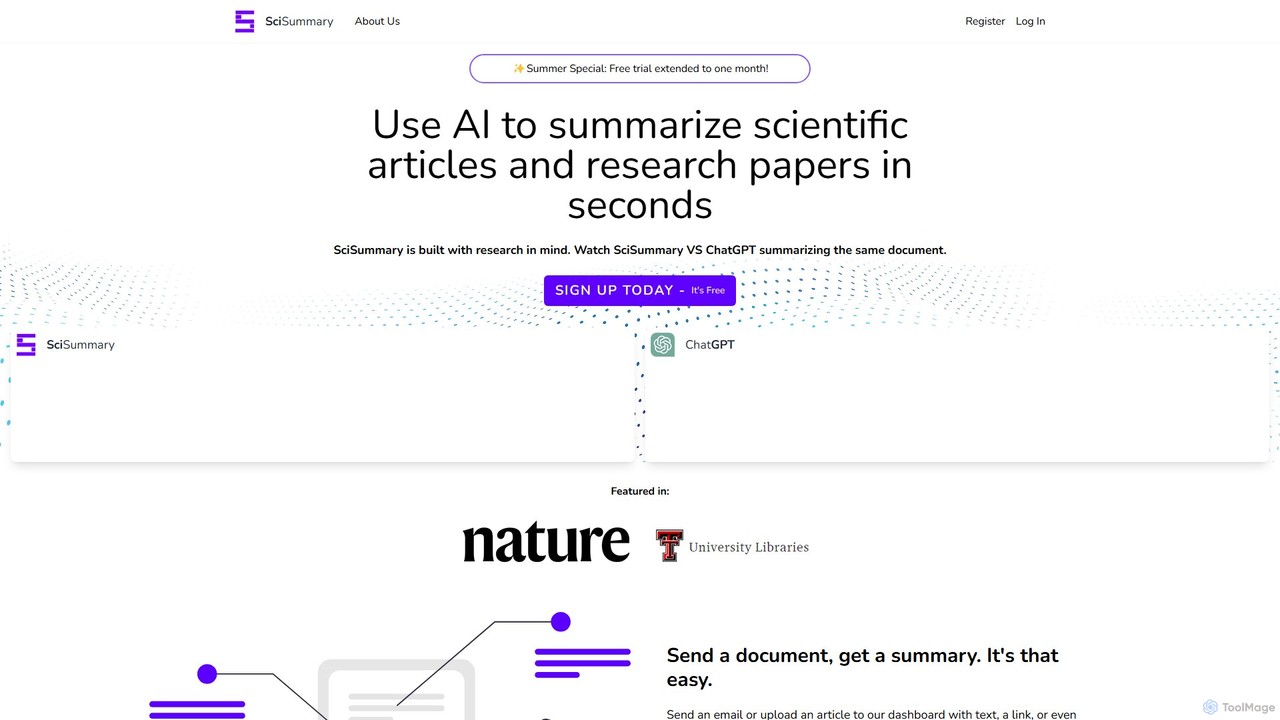
SciSummary is an AI-powered tool that summarizes scientific articles and research papers in seconds. Designed for researchers, students, and scientists, it helps you quickly digest complex documents, analyze figures and tables, and even chat with your papers to extract key insights efficiently.
Students
Gatsbi
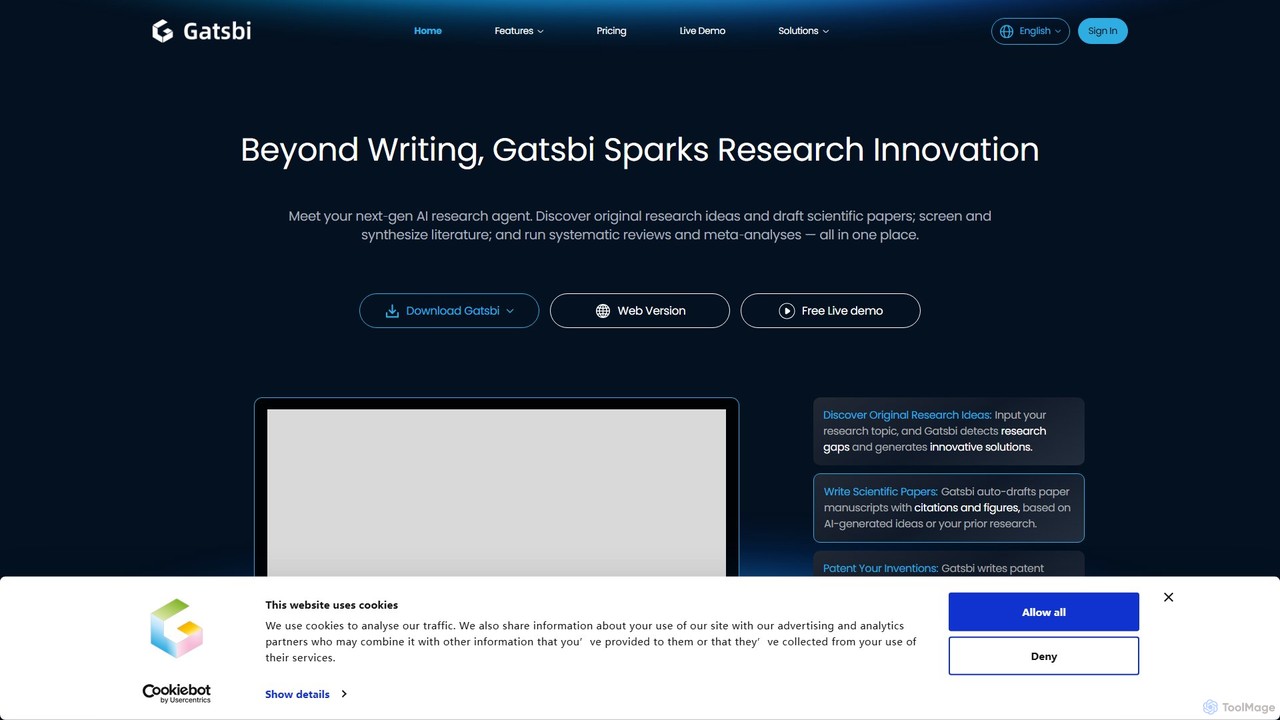
Gatsbi is an all-in-one AI research assistant designed to accelerate innovation. It helps researchers, engineers, and students discover original research ideas, draft scientific papers and patent disclosures, and conduct systematic literature reviews and meta-analyses, streamlining the entire workflow from ideation to publication.
Research
Lateral
Lateral is an AI-powered research assistant designed for academics, students, and professionals. It helps you rapidly search, organize, and synthesize information from multiple documents, transforming the literature review and document analysis process into a fast and structured workflow.
Academia
Seamless
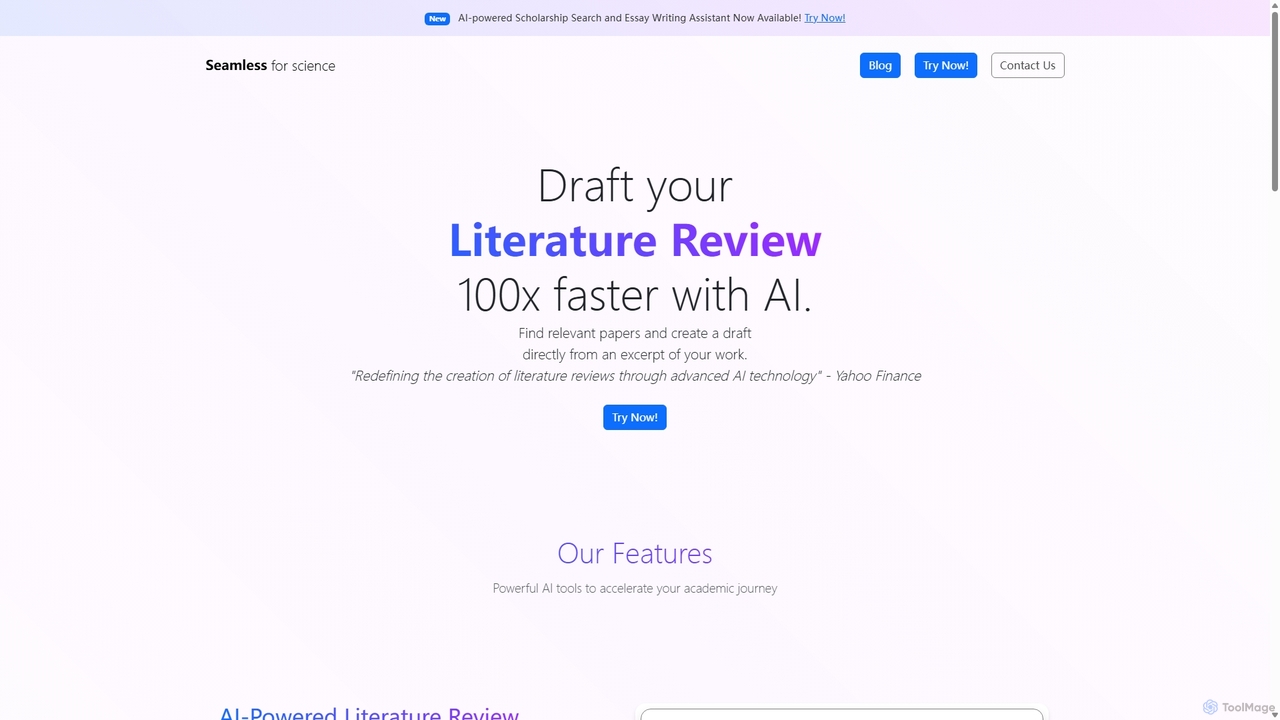
Seamless is an AI-powered platform designed to accelerate academic research. It generates comprehensive literature reviews with citations in minutes, helps students find and apply for scholarships, and offers an AI assistant for crafting compelling essays. It's built for students, researchers, and academics.
Research
papertalk.io
papertalk.io is an AI-powered research assistant that allows you to chat with your documents. Upload research papers, articles, or any PDF, and instantly get summaries, explanations, and answers to your questions, accelerating your literature review and comprehension.
Study Aid
PaperBrain
PaperBrain is an AI-powered research assistant designed to help students, academics, and researchers understand complex academic papers effortlessly. Upload a PDF, and PaperBrain will provide summaries, answer your questions, and explain intricate concepts, accelerating your literature review and research workflow.
Academic
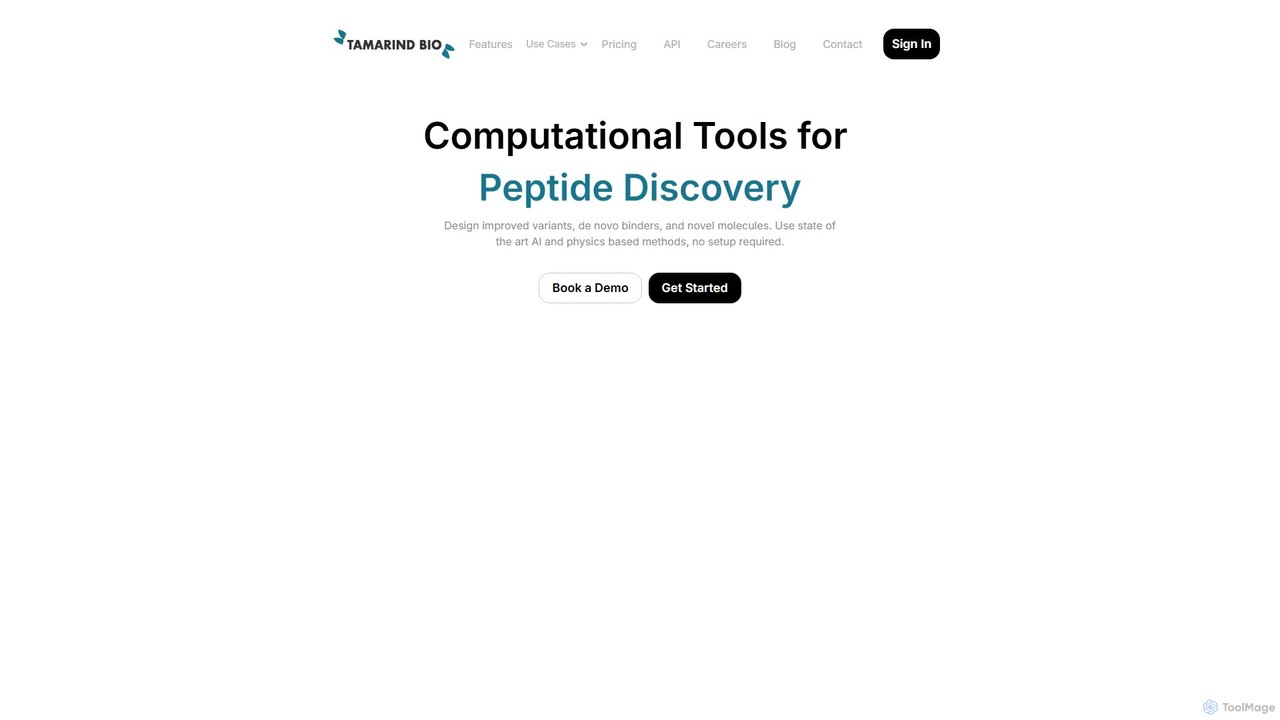
Tamarind Bio
Tamarind Bio is an advanced computational platform that democratizes protein engineering. It provides scientists with a user-friendly interface and a powerful API to access state-of-the-art AI and physics-based tools like AlphaFold and RFdiffusion. The platform streamlines protein design, antibody engineering, and enzyme optimization, handling all high-performance computing and orchestration. This allows researchers to design novel molecules and improve biological variants at a massive scale, accelerating discovery in life sciences without requiring specialized computational expertise.
Api
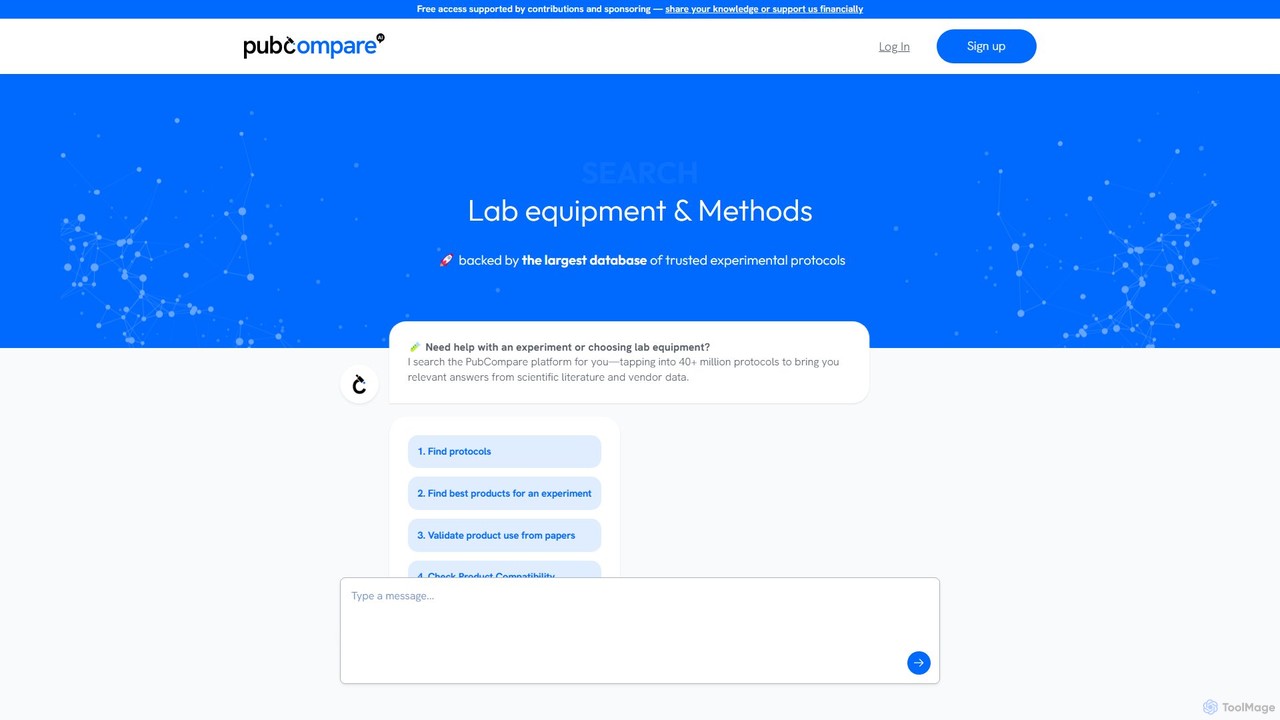
Pubcompare
Pubcompare is an AI-powered search engine with the largest database of trusted experimental protocols. It helps scientists and researchers discover, compare, and optimize methodologies from over 40 million protocols, saving significant time, reducing errors, and enhancing research reproducibility.
Academic Research
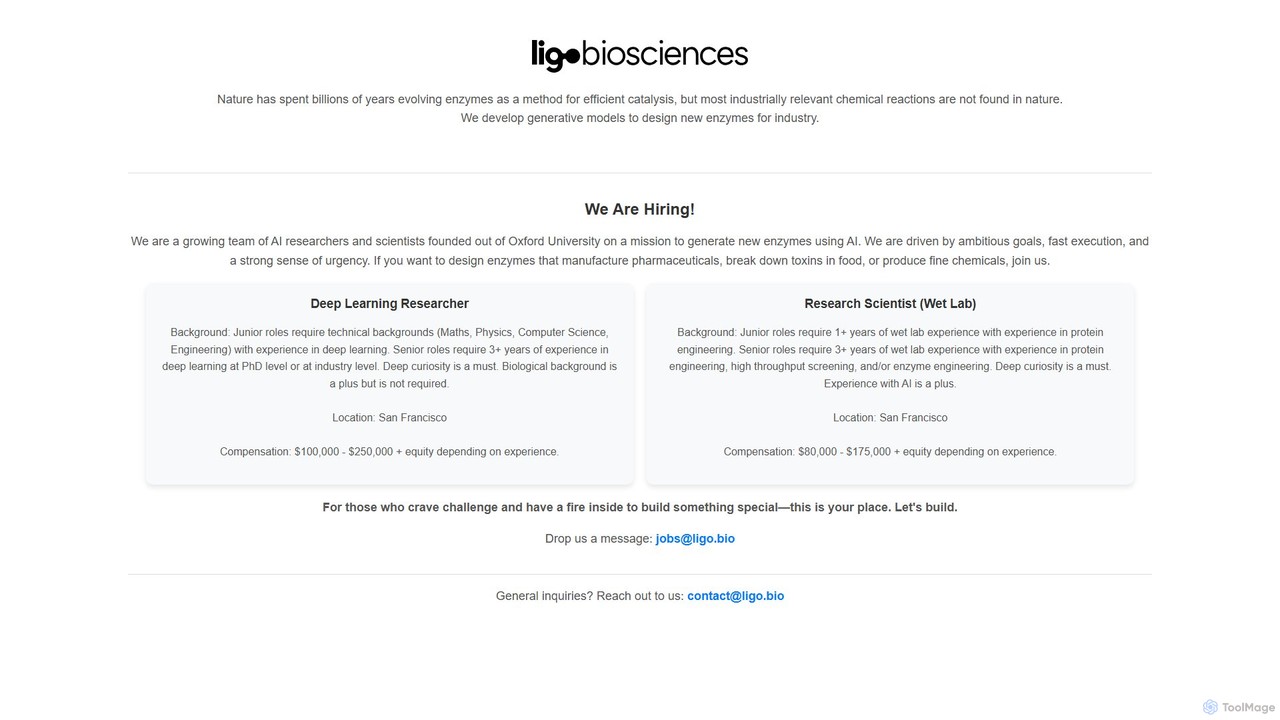
Ligo Biosciences
Ligo Biosciences is a research-driven company that leverages generative AI models to design novel enzymes for industrial applications. Originating from Oxford University, they create custom biocatalysts for pharmaceuticals, fine chemical production, and food safety, accelerating innovation beyond the limits of naturally occurring enzymes.
Generative Models
Semantic Scholar
A free, AI-powered research tool from the Allen Institute for AI that helps scholars discover and understand scientific literature. It uses AI to analyze over 200 million papers, providing features like semantic search, influential citation analysis, and paper summaries to accelerate scientific breakthroughs.
Apis
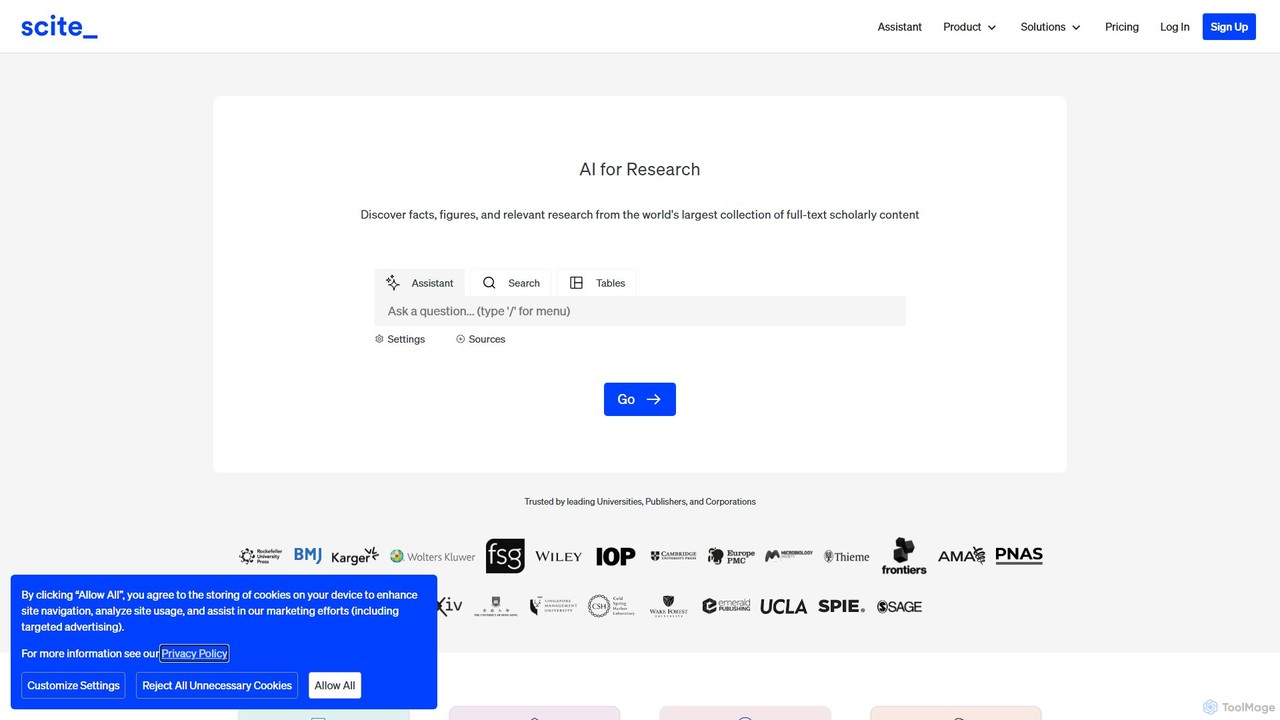
scite
scite is an AI-powered research platform that helps users discover and evaluate scientific literature. Its core feature, Smart Citations, shows how research papers have been cited by others, classifying citations as supporting, contrasting, or mentioning, thus providing deeper context beyond simple citation counts.
Academic
txyz
txyz is an all-in-one AI-powered research platform designed to streamline the entire knowledge workflow for academics, researchers, and professionals. It integrates advanced semantic search, AI-assisted reading and analysis, and intelligent writing tools to accelerate knowledge discovery, comprehension, and creation. Trusted by over 500,000 users, txyz helps you find relevant papers, gain deep insights from documents, and manage your research library efficiently.
Academic
OpenRead
OpenRead is an AI-powered research platform designed to streamline the entire research workflow. It integrates paper discovery, reading, note-taking, and analysis into a single, seamless experience. Users can interact with documents via AI chat, compare multiple papers, generate summaries, and visualize research connections, significantly boosting research efficiency and depth.
Academic Tools
Ontosight
Ontosight is an AI-powered research assistant designed for physicians, scientists, and students in the life sciences and medical fields. It accelerates research by providing direct, cited answers from millions of scientific papers. Features include advanced search, literature review automation, PDF interaction, and a paraphrasing tool to enhance writing and collaboration.
Academic