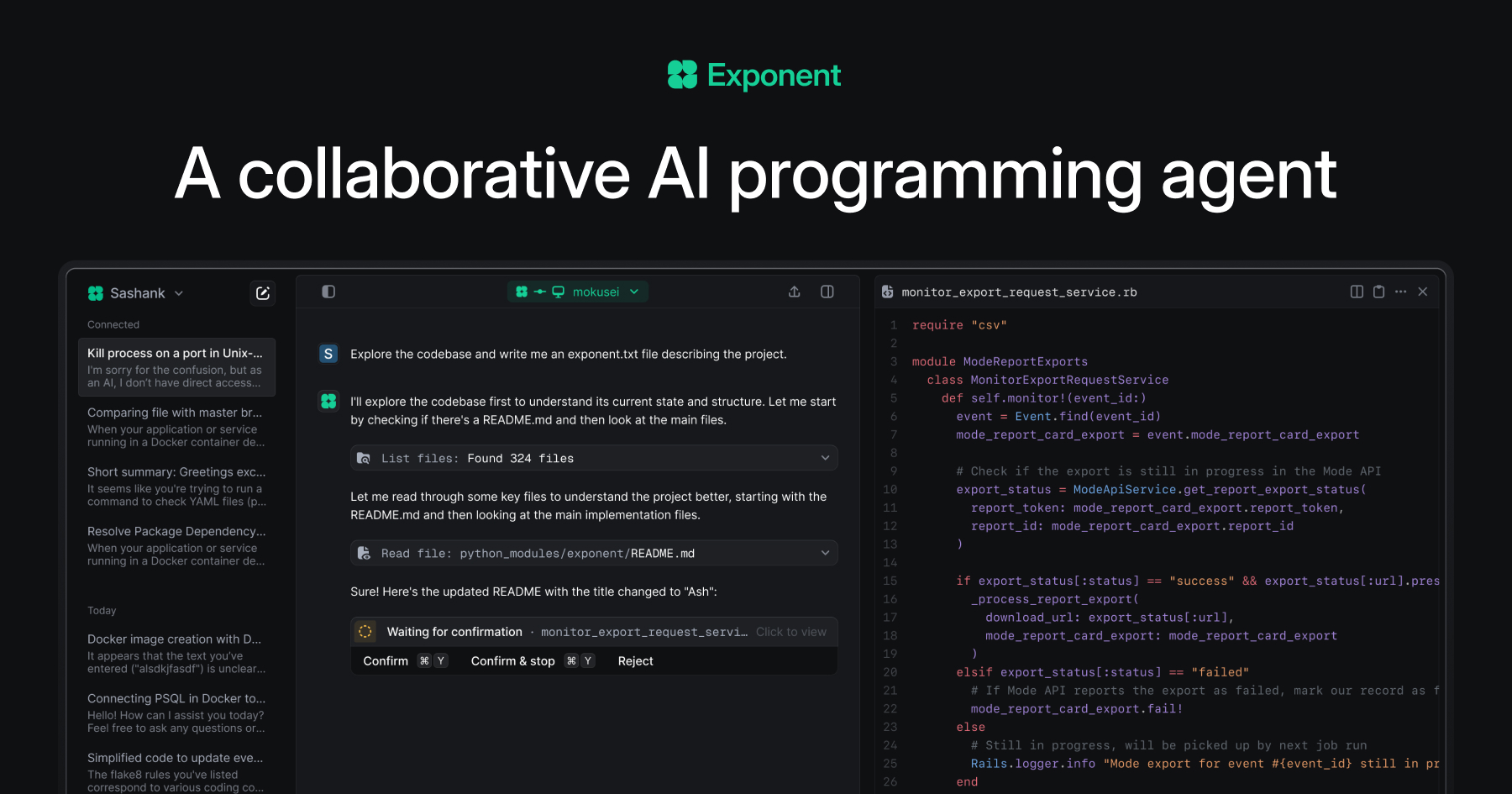
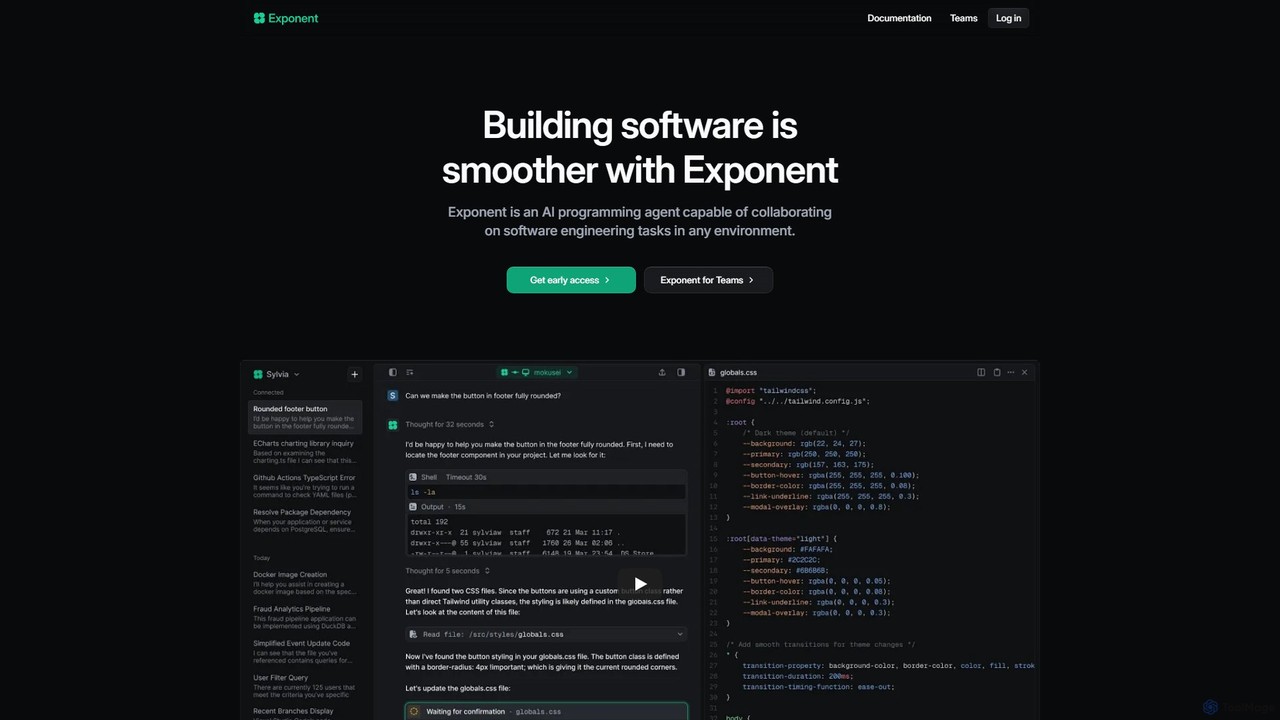
Exponent is a collaborative AI programming agent designed to assist software engineering teams. It integrates into any environment—shell, local IDE, or CI/CD pipelines—to automate tasks, write code, debug issues, review pull requests, and analyze data, streamlining the entire development lifecycle.
Plandex is an open-source, terminal-based AI coding agent designed for complex, large-scale software development tasks. It excels at handling large projects and files with its 2M token context window. Featuring a diff review sandbox, configurable autonomy, and multi-model support, Plandex empowers developers to build, debug, and refactor entire applications with AI assistance, ensuring control and productivity in a dev-friendly workflow.
Product overview
Exponent Product overview
Exponent is a collaborative AI programming agent designed to assist software engineering teams. It integrates into any environment—shell, local IDE, or CI/CD pipelines—to automate tasks, write code, debug issues, review pull requests, and analyze data, streamlining the entire development lifecycle.
Plandex Product overview
Plandex is an open-source, terminal-based AI coding agent designed for complex, large-scale software development tasks. It excels at handling large projects and files with its 2M token context window. Featuring a diff review sandbox, configurable autonomy, and multi-model support, Plandex empowers developers to build, debug, and refactor entire applications with AI assistance, ensuring control and productivity in a dev-friendly workflow.
Detailed feature comparison
| Feature | Exponent | Plandex |
|---|---|---|
| Primary category | Code Assistant | Code Generation |
| Added | 2025-08-15 | 2025-09-11 |
| Pricing | Paid | Freemium |
| Official website | www.exponent.run | plandex.ai |
| Product type | Website | App |
| Performance data | ||
| User rating | Not verified | Not verified |
| Comments | 0 | 0 |
| Monthly visits | 1.3K | 21.2K |
| Monthly growth | 668.7% | 34.4% |
| Favorites | 111 | 96 |
| Details | View details | View details |
Exponent vs Plandex monthly traffic
Compare Exponent and Plandex by monthly reach, traffic trend, visit depth, top regions, and acquisition sources.
How to interpret the traffic data
In the Exponent vs Plandex monthly traffic comparison, Exponent currently shows 1.3K visits and Plandex shows 21.2K; Plandex has about 17 times the visible traffic of Exponent, an absolute difference of about 20K visits. This reflects visible reach, not feature quality or paid users.
Both tools provide verified traffic details, so monthly trends, visit depth, regions, and acquisition sources can be compared on the same basis.
Exponent monthly traffic:
Latest traffic
Monthly traffic trend
- 2025/9: 2.9K Monthly visits
- 2026/1: 2.4K Monthly visits
- 2026/2: 2K Monthly visits
- 2026/3: 1.5K Monthly visits
- 2026/4: 163 Monthly visits
- 2026/5: 1.3K Monthly visits
Top regions
Top 5 countries/regions
| Country/region | Percentage | Traffic |
|---|---|---|
| 🇺🇸United States | 100% | 1.3K |
Search keywords
Plandex monthly traffic:
Latest traffic
Monthly traffic trend
- 2025/9: 9.6K Monthly visits
- 2026/1: 16.2K Monthly visits
- 2026/2: 15.6K Monthly visits
- 2026/3: 16.8K Monthly visits
- 2026/4: 15.8K Monthly visits
- 2026/5: 21.2K Monthly visits
Top regions
Top 5 countries/regions
| Country/region | Percentage | Traffic |
|---|---|---|
| 🇺🇸United States | 45.52% | 9.7K |
| 🇻🇳Vietnam | 16.17% | 3.4K |
| 🇷🇺Russia | 14.18% | 3K |
| 🇹🇷Turkey | 12.11% | 2.6K |
| 🇫🇷France | 12.02% | 2.6K |
Search keywords
Usage comparison
Compare the core capabilities of Exponent and Plandex
Exponent Core features
Plandex Core features
Use cases
Exponent Use cases
Plandex Use cases
Best suited roles
Exponent Best suited roles
Plandex Best suited roles
Exponent vs Plandex:In-depth comparison and selection guidance
First decide whether the products solve the same kind of need
This in-depth Exponent vs Plandex comparison uses only the product records, taxonomy, audience, traffic, and community signals available on this page. Exponent is primarily listed under “Code Assistant”, while Plandex is primarily listed under “Code Generation”, so the first decision is whether your actual task matches their recorded scope.
The structured fields currently show these decision-relevant differences: Primary category (Exponent: Code Assistant; Plandex: Code Generation); Product type (Exponent: Website; Plandex: App); Pricing (Exponent: Paid; Plandex: Freemium); Monthly visits (Exponent: 1.3K; Plandex: 21.2K); Monthly growth (Exponent: 668.7%; Plandex: 34.4%). These facts are more useful for selection than brand visibility alone.
What market visibility and monthly traffic mean
In the Exponent vs Plandex monthly traffic comparison, Exponent currently shows 1.3K visits and Plandex shows 21.2K; Plandex has about 17 times the visible traffic of Exponent, an absolute difference of about 20K visits. This reflects visible reach, not feature quality or paid users.
Both tools provide verified traffic details, so monthly trends, visit depth, regions, and acquisition sources can be compared on the same basis.
If public market visibility is an important first-pass criterion, investigate Plandex first. The final choice should still follow taxonomy, use case, and a real trial because higher traffic does not prove broader capabilities or better workflow fit.
Product positioning, use cases, and roles
Exponent and Plandex currently overlap in shared categories: Code Assistant and Automation; shared tags: code assistant, debugging, developer tool, and software development. This can place both on the same shortlist, but it does not prove equal implementation, depth, or cost.
Exponent's unique categories/tags are Ci Cd, AI programmer, automation, CI/CD, code review, incident response, pair programming, and SQL; Plandex's are Code Generation, AI agent, code generation, coding, large projects, open source, refactoring, and terminal. These unique fields are the strongest differentiators: validate the product whose recorded scope matches the task instead of following traffic alone.
What ratings, comments, and favorites can tell you
Exponent has no verified rating, 0 comments, 111 favorites, and 89 likes;Plandex has no verified rating, 0 comments, 96 favorites, and 105 likes。
Neither product has enough rating or comment samples for a credible reputation ranking.
Selection guidance by actual need
When to evaluate Exponent first
Put Exponent on the priority trial list when the task aligns with “Code Assistant” and especially Ci Cd, AI programmer, automation, CI/CD, code review, and incident response. This follows recorded positioning and does not imply unlisted capabilities are absent.
Exponent also currently records: pricing is paid, product type is website, 1.3K verified monthly visits, no verified user rating. Verify any hard requirement around price, platform, or reach before trial, and do not let sparse review data substitute for testing.
When to evaluate Plandex first
Put Plandex on the priority trial list when the task aligns with “Code Generation” and especially Code Generation, AI agent, code generation, coding, large projects, and open source, or the users include Backend Developer, Data Scientist, DevOps Engineer, and Engineering Manager. This follows recorded positioning and does not imply unlisted capabilities are absent.
Plandex also currently records: pricing is freemium, product type is app, 21.2K verified monthly visits, no verified user rating. Verify any hard requirement around price, platform, or reach before trial, and do not let sparse review data substitute for testing.
How to validate the recommendation before deciding
The available data describes positioning, public visibility, and community signals, but it cannot prove output quality, speed, integration effort, privacy, or long-term cost in your workflow. Before deciding, run the same representative tasks in Exponent and Plandex, then record completion time, accuracy, manual corrections, and the real paid threshold. A like-for-like trial turns this comparison into a defensible adoption decision.
Comparison FAQ
How should I choose between Exponent and Plandex?
Where does this comparison data come from?
What do unknown fields mean?
Related AI tools

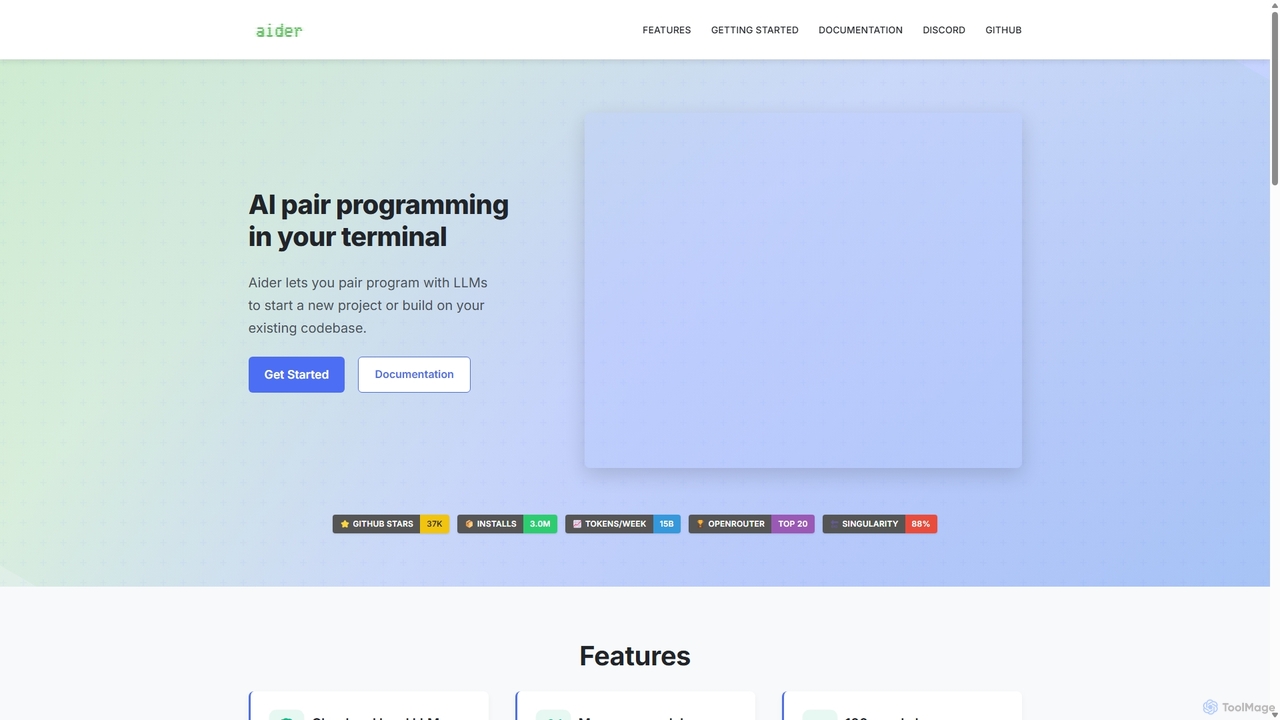
Aider
Aider is an AI-powered pair programmer that operates directly in your terminal. It intelligently maps your entire codebase, providing full project context for complex tasks. Seamlessly integrated with Git, it automates commits and allows you to manage AI-driven changes with familiar tools. Aider supports over 100 programming languages, connects to leading cloud and local LLMs, and even accepts voice and image inputs, making it a versatile and powerful assistant for any developer seeking to accelerate their workflow and improve code quality.
Programming
Buildt
Buildt is an AI-powered code search and understanding tool for developers. It integrates directly into your IDE, allowing you to search your entire codebase using natural language, understand complex code snippets, and generate or modify code on the fly, acting as an intelligent assistant.
Code Generation
All Hands AI (OpenHands)
All Hands AI (OpenHands) is a leading open-source AI coding agent designed to automate software development. It helps engineers with tasks like code reviews, refactoring, bug fixing, and test generation. Available as a flexible SaaS, self-hosted, or open-source solution, it integrates with tools like GitHub and GitLab to accelerate development cycles and improve code quality.
Code Generation
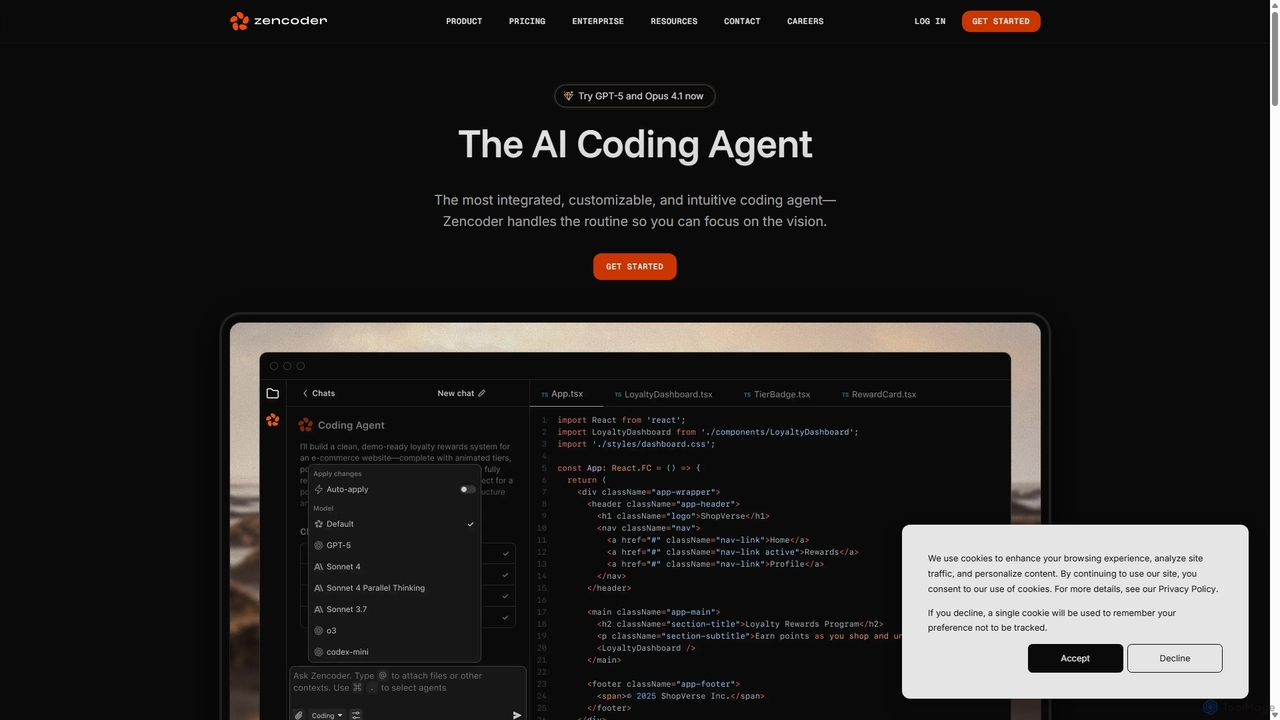
Zencoder
Zencoder is an advanced AI coding agent designed to automate routine development tasks. It deeply integrates into your workflow, understanding your entire codebase to implement features, write tests, fix bugs, and refactor code autonomously. With customizable 'Zen Agents' and seamless integration with VS Code, JetBrains, and over 100 developer tools, Zencoder empowers engineering teams to focus on innovation and ship products faster.
Code Assistant
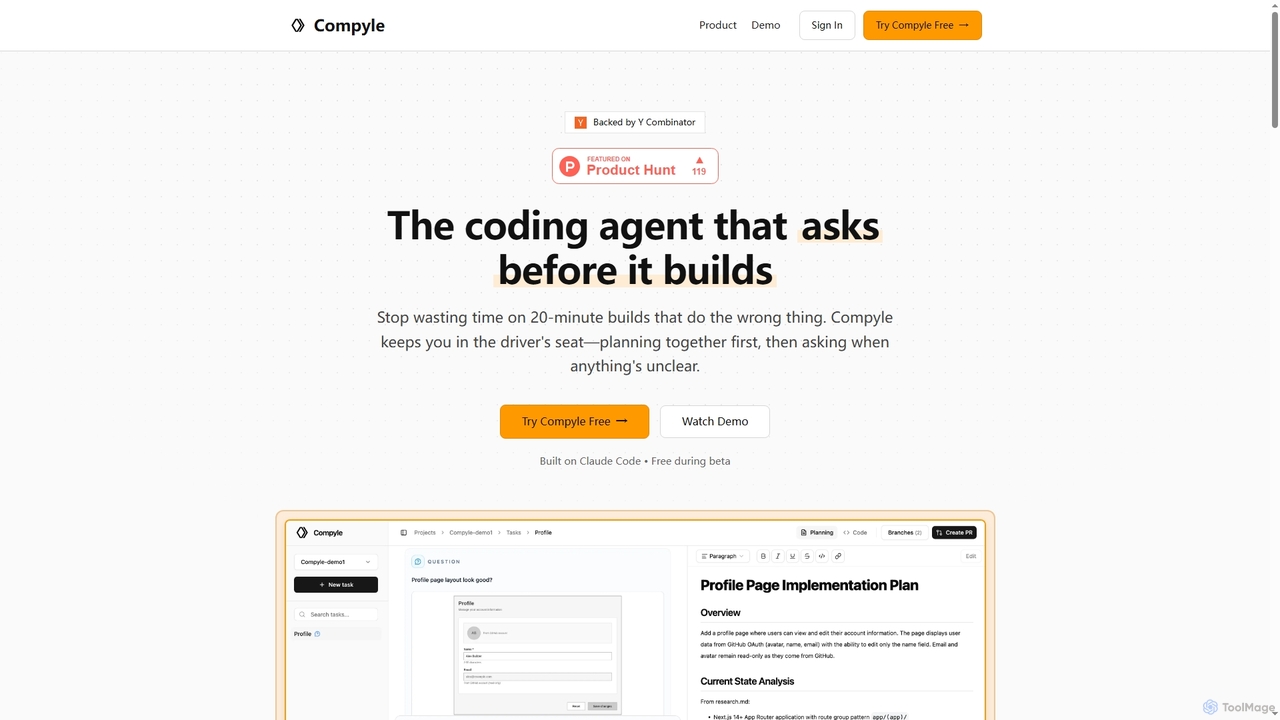
Compyle
Compyle is an interactive AI coding agent that builds software by collaborating with developers. It researches your existing codebase, creates a detailed plan by asking clarifying questions, and implements features without making assumptions, ensuring the final code perfectly matches your intent.
Code Assistant
Codebay
Codebay is an AI-powered development platform designed to accelerate the entire software lifecycle. It acts as an intelligent co-pilot for developers, offering advanced features for code generation, automated review, intelligent debugging, and seamless integration with existing workflows to enhance productivity and code quality.
Code Generation
Amp
Amp is a frontier AI coding agent designed for developers. It operates as a CLI and within IDEs like VS Code, automating complex tasks such as code editing, debugging, and refactoring. Amp leverages the latest AI models to provide autonomous reasoning and execution, enhancing developer productivity through features like subagents, an Oracle for complex analysis, and deep IDE integration.
Code Assistant
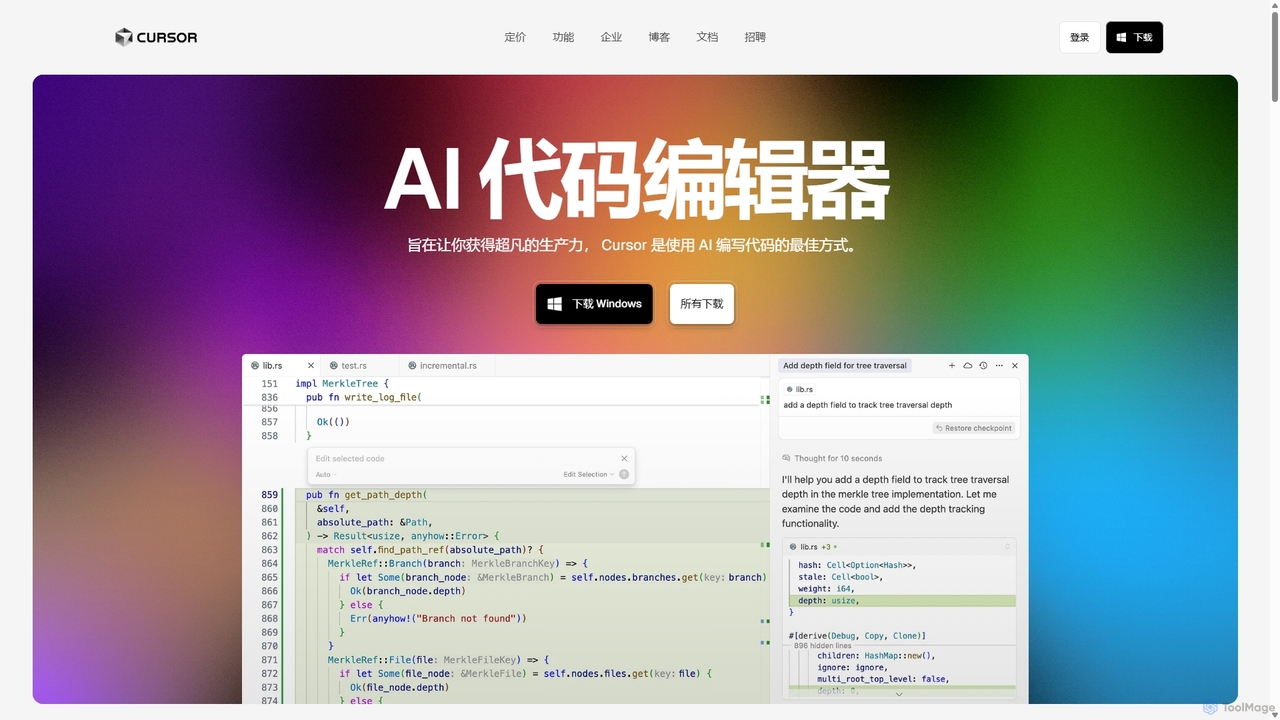
Cursor
Cursor is an AI-first code editor designed for pair-programming with artificial intelligence. Built as a fork of VS Code, it offers a familiar environment supercharged with advanced AI capabilities for code generation, editing, debugging, and codebase comprehension, aiming to significantly boost developer productivity.
Code Assistant
Safurai
Safurai is an AI-powered IDE extension that acts as a virtual assistant for software developers. It helps with coding, debugging, and refactoring, aiming to streamline the development process and improve code quality directly within your favorite IDE like VS Code and JetBrains.
Code Generation
CodeWiz
CodeWiz is an AI-powered coding assistant designed to accelerate software development. It integrates into your IDE to provide intelligent code completion, real-time debugging, code explanation, and automated test generation, helping developers write better code faster and with fewer errors.
Code Assistant
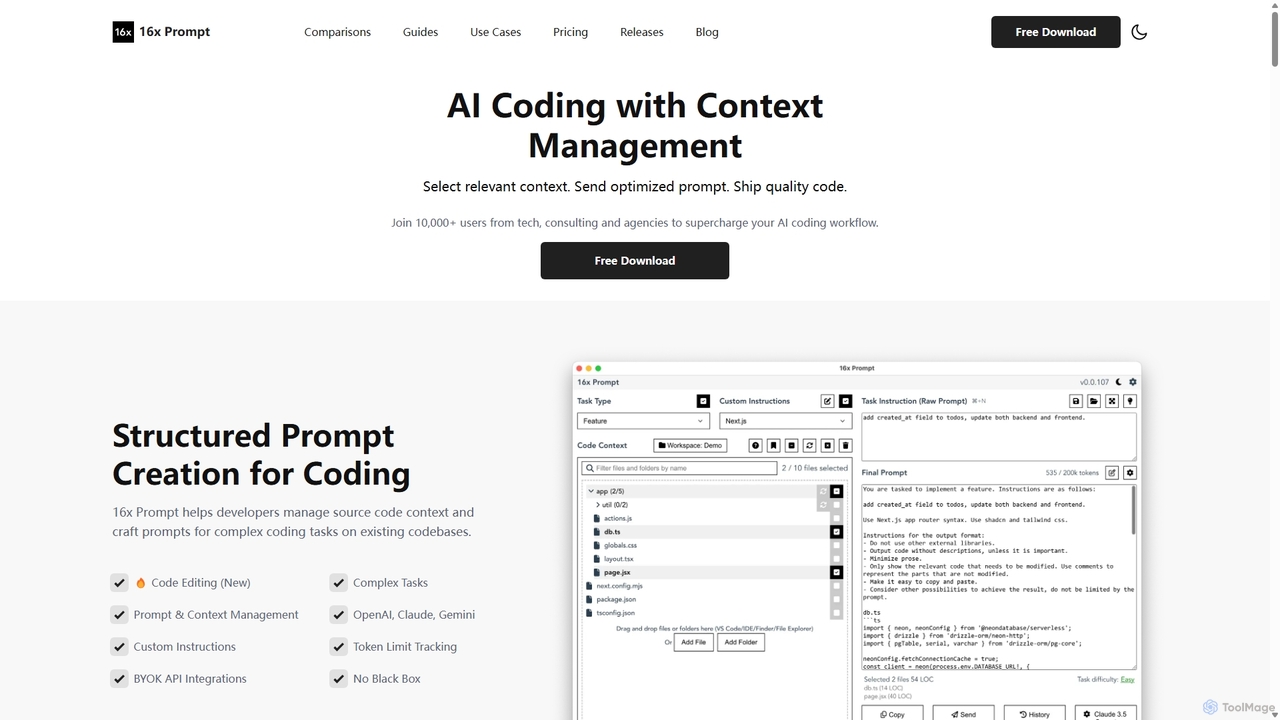
16x Prompt
16x Prompt is a desktop application for developers that enhances AI-assisted coding by enabling advanced context management. It helps you compose complex, context-rich prompts from task instructions and multiple source code files to get superior code generation from any LLM, all while running locally to ensure data privacy and IP protection.
Code Generation
Refact
Refact is an open-source, self-hostable, and autonomous AI coding agent. It integrates into your IDE to act as a digital twin, automating coding tasks, providing context-aware completions and chat, and adapting to your codebase for maximum productivity and data privacy.
Code Assistant
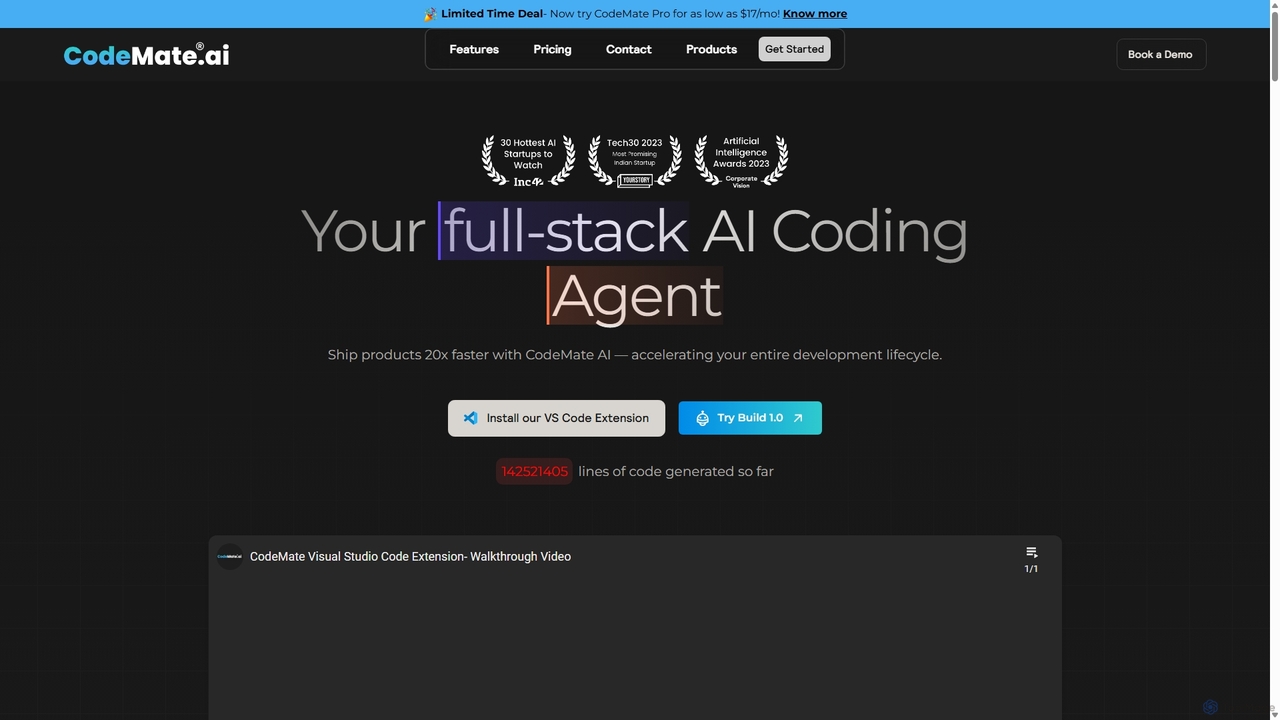
CodeMate
CodeMate is a secure, personalized AI pair programmer designed to enhance developer productivity. It assists with debugging, reviewing, and optimizing code, offering context-aware chat and seamless integration with IDEs like VS Code to help developers build software up to 20x faster.
Code Assistant
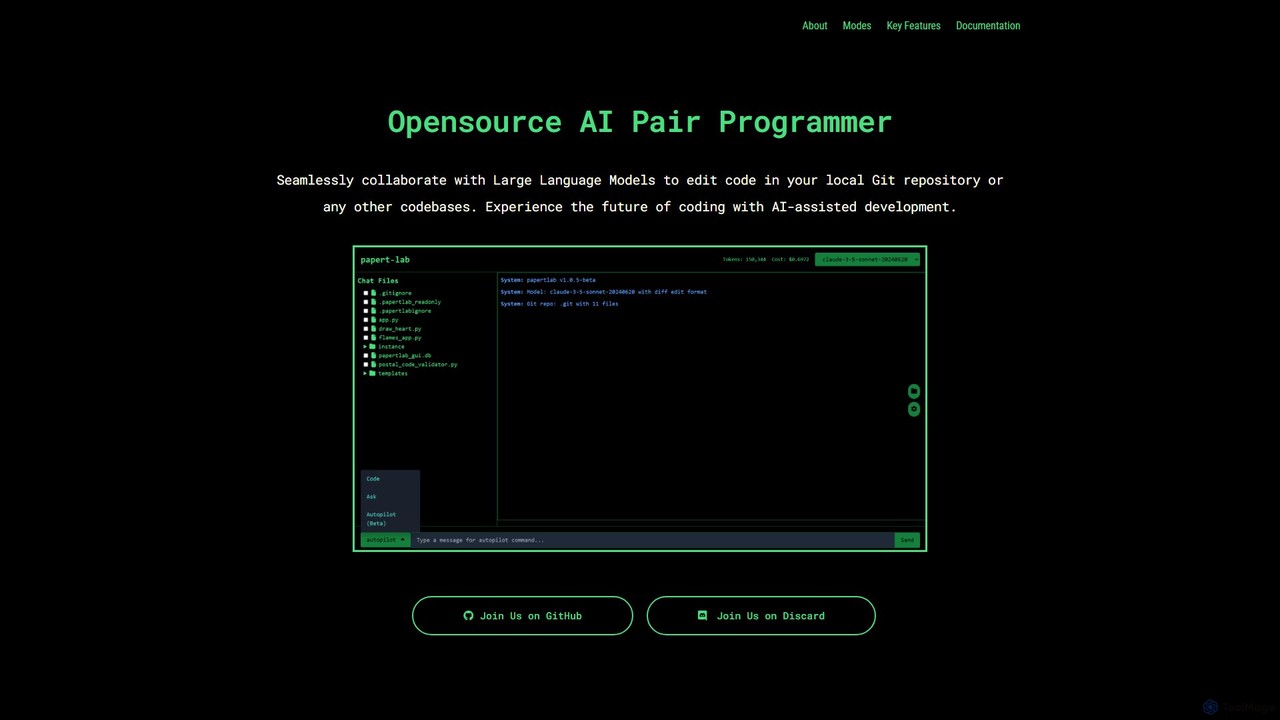
papert
papert is an open-source AI pair programmer that integrates with your local Git repository. It allows developers to collaborate with LLMs like GPT-4o and Claude 3.5 Sonnet to ask questions, edit code across multiple files, refactor, debug, and automate routine coding tasks.
Debugging
Rebolt
Rebolt is an AI-powered platform designed to automate the entire software development lifecycle. It helps developer and DevOps teams build, test, and deploy applications faster and more reliably by leveraging AI for CI/CD pipeline optimization, code generation, and intelligent monitoring.
Code Assistant