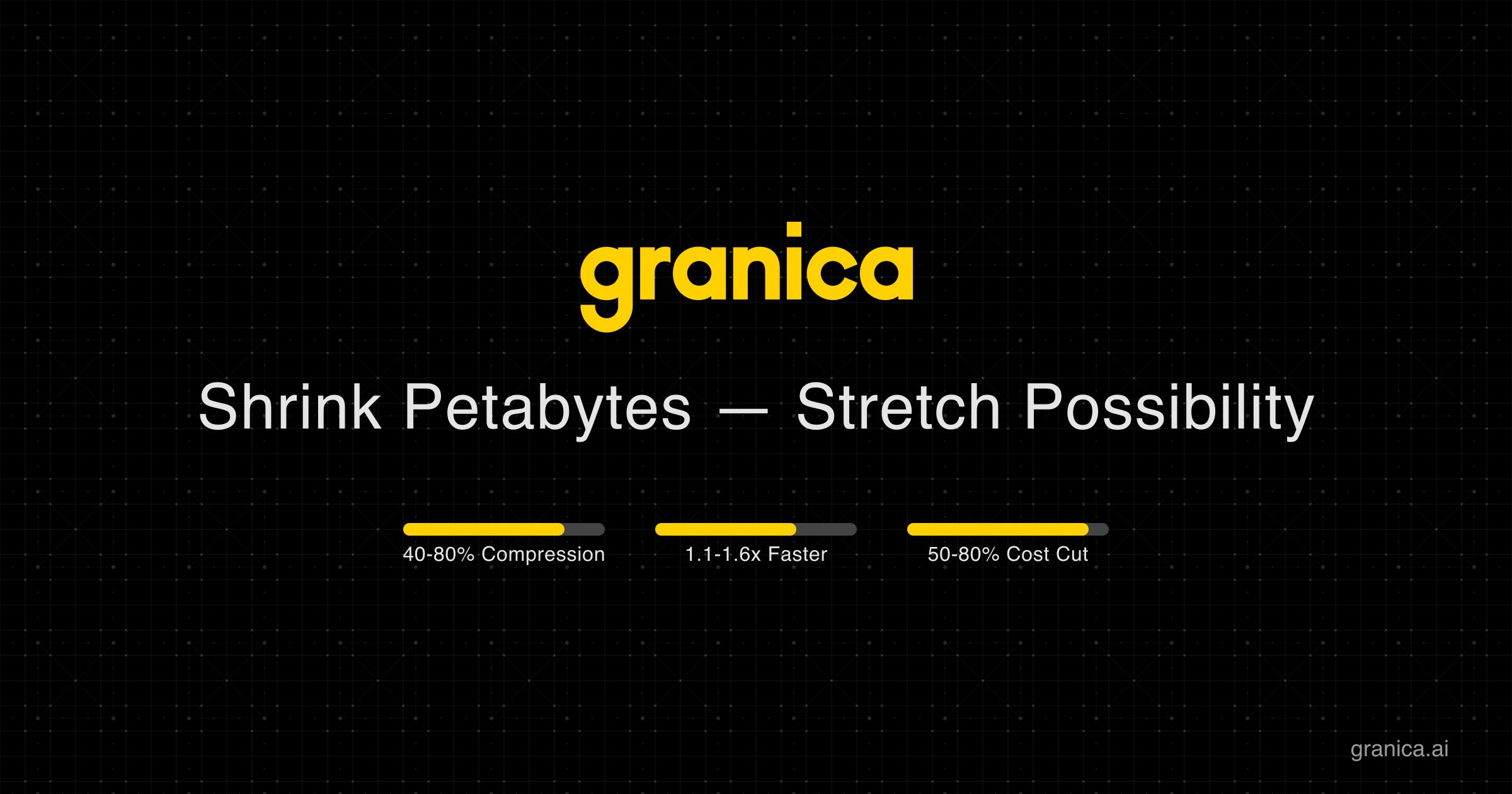
Granica is an AI-powered data infrastructure platform that provides self-optimizing, lossless compression for petabyte-scale data lakes. It dramatically reduces cloud storage and compute costs while accelerating query performance across platforms like Snowflake, Databricks, Spark, and more.

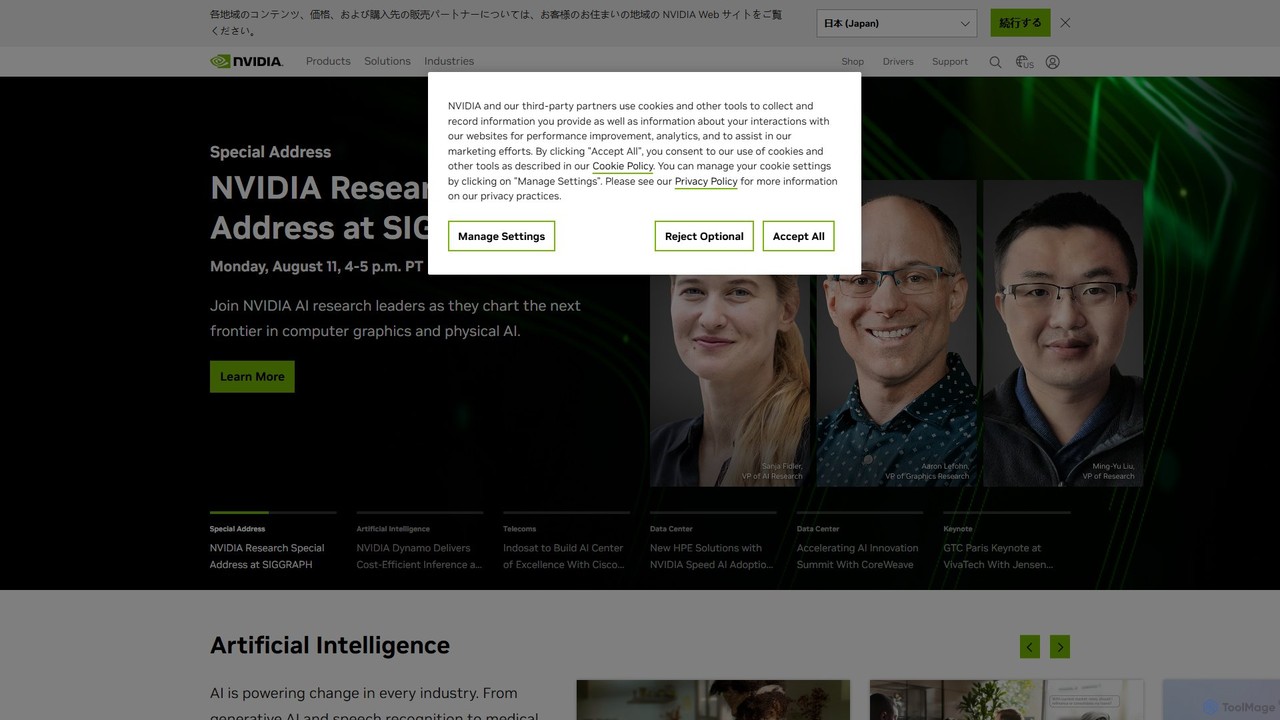
NVIDIA is a global leader in artificial intelligence computing, providing a full-stack platform of hardware, software, and services. Its solutions power everything from gaming and professional graphics with GeForce and RTX GPUs to advanced AI, data science, and high-performance computing in data centers and the cloud.
Product overview
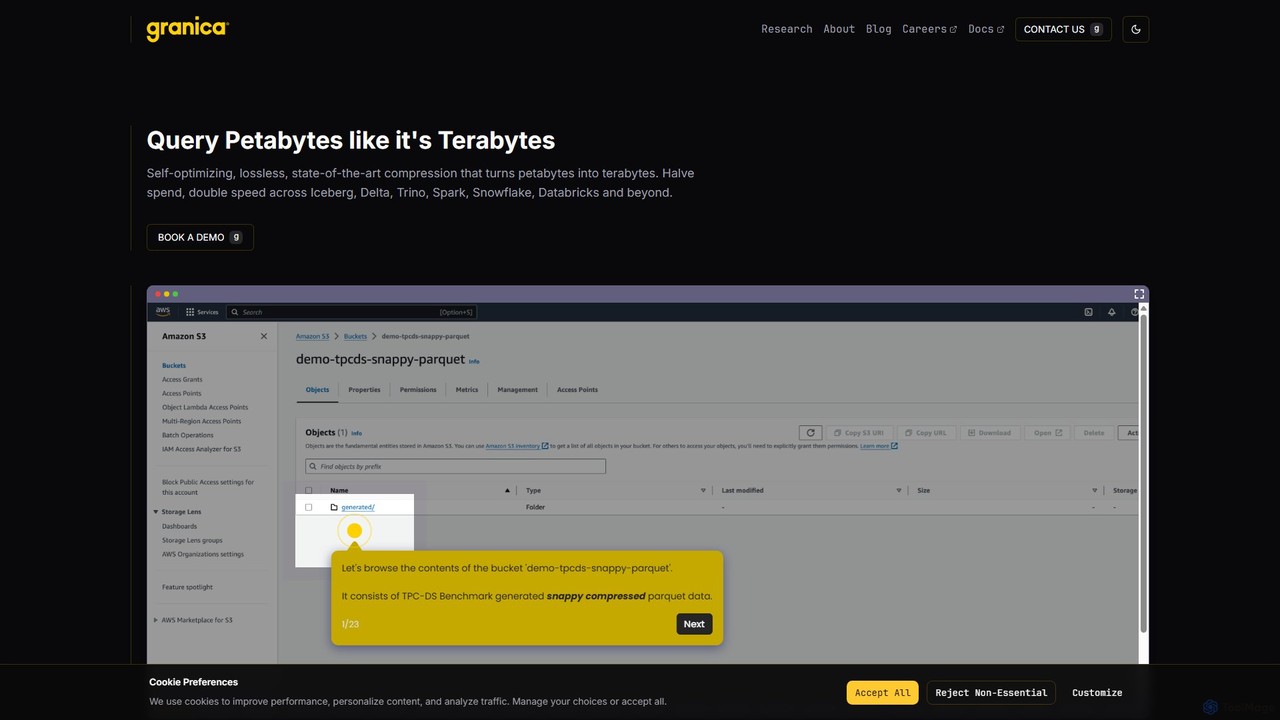
Granica Product overview
Granica is an AI-powered data infrastructure platform that provides self-optimizing, lossless compression for petabyte-scale data lakes. It dramatically reduces cloud storage and compute costs while accelerating query performance across platforms like Snowflake, Databricks, Spark, and more.
NVIDIA Product overview
NVIDIA is a global leader in artificial intelligence computing, providing a full-stack platform of hardware, software, and services. Its solutions power everything from gaming and professional graphics with GeForce and RTX GPUs to advanced AI, data science, and high-performance computing in data centers and the cloud.
Detailed feature comparison
| Feature | Granica | NVIDIA |
|---|---|---|
| Primary category | Cost Management | Infrastructure |
| Added | 2025-08-05 | 2025-08-12 |
| Pricing | Paid | Freemium |
| Official website | www.granica.ai | www.nvidia.com |
| Product type | Website | Website |
| Performance data | ||
| User rating | Not verified | Not verified |
| Comments | 0 | 0 |
| Monthly visits | 6K | 39M |
| Monthly growth | -7.2% | 14.9% |
| Favorites | 134 | 97 |
| Details | View details | View details |
Granica vs NVIDIA monthly traffic
Compare Granica and NVIDIA by monthly reach, traffic trend, visit depth, top regions, and acquisition sources.
How to interpret the traffic data
In the Granica vs NVIDIA monthly traffic comparison, Granica currently shows 6K visits and NVIDIA shows 39M; NVIDIA has about 6,553.4 times the visible traffic of Granica, an absolute difference of about 39M visits. This reflects visible reach, not feature quality or paid users.
Both tools provide verified traffic details, so monthly trends, visit depth, regions, and acquisition sources can be compared on the same basis.
NVIDIA is registered at the www.nvidia.com/en-us subpage. Because the current data does not state whether other host pages are excluded, treat this as domain-level context rather than independent traffic for one product or project.
Granica monthly traffic:
Latest traffic
Monthly traffic trend
- 2025/9: 8.2K Monthly visits
- 2026/1: 7.8K Monthly visits
- 2026/2: 7.5K Monthly visits
- 2026/3: 8.2K Monthly visits
- 2026/4: 6.4K Monthly visits
- 2026/5: 6K Monthly visits
Top regions
Top 5 countries/regions
| Country/region | Percentage | Traffic |
|---|---|---|
| 🇺🇸United States | 69.58% | 4.1K |
| 🇮🇳India | 30.42% | 1.8K |
Search keywords
NVIDIA monthly traffic:
Latest traffic
Monthly traffic trend
- 2026/1: 36.3M Monthly visits
- 2026/2: 28.7M Monthly visits
- 2026/3: 36.2M Monthly visits
- 2026/4: 34M Monthly visits
- 2026/5: 39M Monthly visits
Top regions
Top 5 countries/regions
| Country/region | Percentage | Traffic |
|---|---|---|
| 🇺🇸United States | 46.74% | 18.2M |
| 🇮🇳India | 18.69% | 7.3M |
| 🇨🇳China | 14.27% | 5.6M |
| 🇷🇺Russia | 10.48% | 4.1M |
| 🇩🇪Germany | 9.82% | 3.8M |
Traffic sources
| Source type | Percentage | Traffic |
|---|---|---|
| Direct | 72.2% | 28.2M |
| Referral | 23.79% | 9.3M |
| 4.01% | 1.6M |
Search keywords
Usage comparison
Compare the core capabilities of Granica and NVIDIA
Granica Core features
NVIDIA Core features
Use cases
Granica Use cases
NVIDIA Use cases
Granica vs NVIDIA:In-depth comparison and selection guidance
First decide whether the products solve the same kind of need
This in-depth Granica vs NVIDIA comparison uses only the product records, taxonomy, audience, traffic, and community signals available on this page. Granica is primarily listed under “Cost Management”, while NVIDIA is primarily listed under “Infrastructure”, so the first decision is whether your actual task matches their recorded scope.
The structured fields currently show these decision-relevant differences: Primary category (Granica: Cost Management; NVIDIA: Infrastructure); Pricing (Granica: Paid; NVIDIA: Freemium); Monthly visits (Granica: 6K; NVIDIA: 39M); Monthly growth (Granica: -7.2%; NVIDIA: 14.9%); Favorites (Granica: 134; NVIDIA: 97). These facts are more useful for selection than brand visibility alone.
What market visibility and monthly traffic mean
In the Granica vs NVIDIA monthly traffic comparison, Granica currently shows 6K visits and NVIDIA shows 39M; NVIDIA has about 6,553.4 times the visible traffic of Granica, an absolute difference of about 39M visits. This reflects visible reach, not feature quality or paid users.
Both tools provide verified traffic details, so monthly trends, visit depth, regions, and acquisition sources can be compared on the same basis.
NVIDIA is registered at the www.nvidia.com/en-us subpage. Because the current data does not state whether other host pages are excluded, treat this as domain-level context rather than independent traffic for one product or project.
NVIDIA is registered under a www.nvidia.com subpath, so its large visible total may include the host platform. The current data does not justify choosing NVIDIA for traffic alone; shortlist by unique taxonomy and use case, then validate with the same tasks.
Product positioning, use cases, and roles
Granica and NVIDIA currently overlap in shared categories: Infrastructure; shared tags: machine learning. This can place both on the same shortlist, but it does not prove equal implementation, depth, or cost.
Granica's unique categories/tags are Cost Management, Optimization, AI, big data, cloud cost optimization, databricks, data compression, and data infrastructure; NVIDIA's are Computing, 3D, Science, AI hardware, autonomous vehicles, CUDA, data center, and deep learning. These unique fields are the strongest differentiators: validate the product whose recorded scope matches the task instead of following traffic alone.
What ratings, comments, and favorites can tell you
Granica has no verified rating, 0 comments, 134 favorites, and 136 likes;NVIDIA has no verified rating, 0 comments, 97 favorites, and 91 likes。
Neither product has enough rating or comment samples for a credible reputation ranking.
Selection guidance by actual need
When to evaluate Granica first
Put Granica on the priority trial list when the task aligns with “Cost Management” and especially Cost Management, Optimization, AI, big data, cloud cost optimization, and databricks. This follows recorded positioning and does not imply unlisted capabilities are absent.
Granica also currently records: pricing is paid, product type is website, 6K verified monthly visits, no verified user rating. Verify any hard requirement around price, platform, or reach before trial, and do not let sparse review data substitute for testing.
When to evaluate NVIDIA first
Put NVIDIA on the priority trial list when the task aligns with “Infrastructure” and especially Computing, 3D, Science, AI hardware, autonomous vehicles, and CUDA. This follows recorded positioning and does not imply unlisted capabilities are absent.
NVIDIA also currently records: pricing is freemium, product type is website, 39M monthly visits shown for the registered host (subpage scope unknown), no verified user rating. Verify any hard requirement around price, platform, or reach before trial, and do not let sparse review data substitute for testing.
How to validate the recommendation before deciding
The available data describes positioning, public visibility, and community signals, but it cannot prove output quality, speed, integration effort, privacy, or long-term cost in your workflow. Before deciding, run the same representative tasks in Granica and NVIDIA, then record completion time, accuracy, manual corrections, and the real paid threshold. A like-for-like trial turns this comparison into a defensible adoption decision.
Comparison FAQ
How should I choose between Granica and NVIDIA?
Where does this comparison data come from?
What do unknown fields mean?
Related AI tools

Nebius
Nebius is a high-performance cloud platform specifically engineered for AI and machine learning. It provides access to the latest NVIDIA GPUs, scalable clusters with InfiniBand networking, and fully managed services like Kubernetes and Slurm, enabling seamless AI model training, fine-tuning, and inference at any scale.
Machine Learning
Augmented Startups
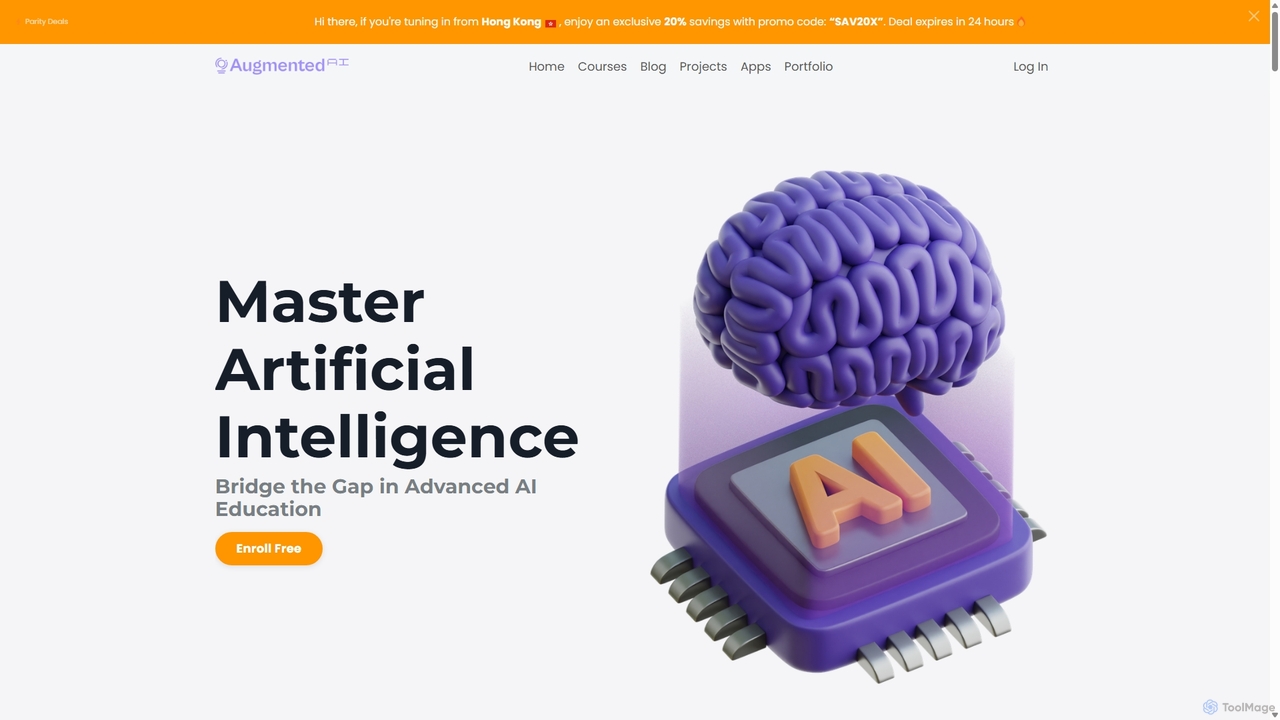
Augmented Startups is an online AI university offering practical, project-based courses for all skill levels. It specializes in advanced topics like Computer Vision, Large Language Models (LLMs), Robotics, and Autonomous Vehicles. The platform provides comprehensive learning paths with code, datasets, and expert support to help students and professionals build real-world AI applications and bridge the gap between theory and practical implementation.
Code Libraries
Together AI
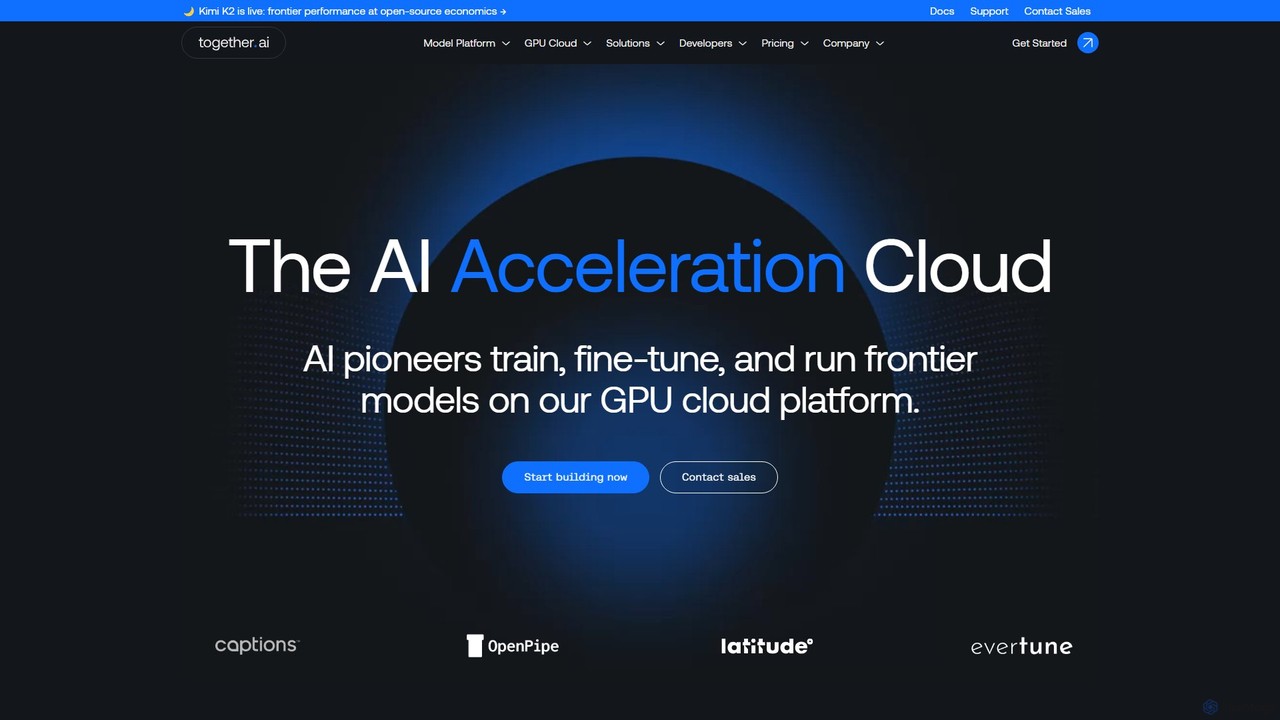
Together AI is a leading cloud platform for developers, providing fast, cost-effective infrastructure to run, fine-tune, and train open-source generative AI models. It offers an extensive library of over 200 models, serverless inference APIs, customizable fine-tuning, and dedicated GPU clusters, creating an end-to-end solution for building and scaling AI applications.
Gpu Infrastructure
Amazon Science
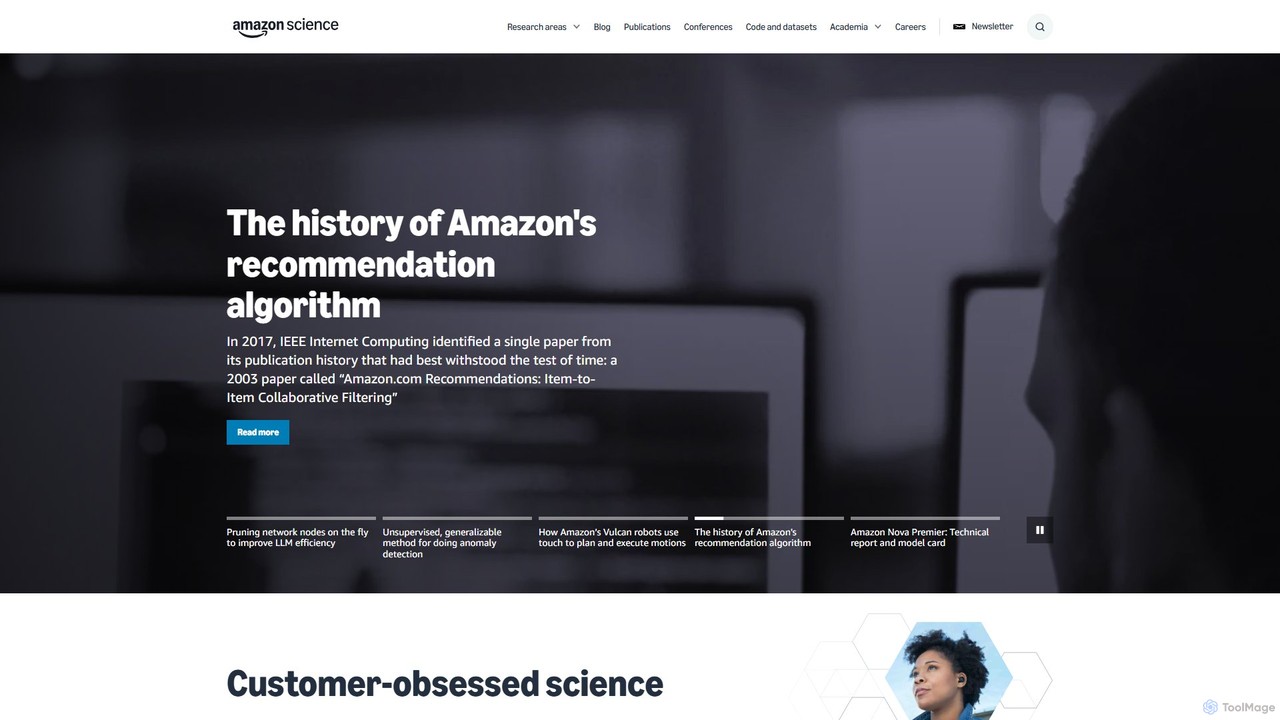
Amazon Science is the official hub for Amazon's cutting-edge scientific research and innovation. It provides free access to a vast repository of research papers, articles, and news across diverse fields like AI, machine learning, robotics, and computer vision, connecting academia with industry.
Data Science
ApX Machine Learning
ApX Machine Learning is an educational platform for AI engineers and students, providing practical courses, in-depth guides, and tools like a VRAM calculator. It focuses on bridging the gap between AI theory and real-world application, covering everything from LLM construction to hardware requirements.
Resource
Rescale
Rescale is a cloud-based High Performance Computing (HPC) platform designed to accelerate engineering and scientific R&D. It provides on-demand access to a multi-cloud infrastructure, a vast catalog of simulation and AI software, and a unified environment for managing complex workflows, data, and security. It empowers organizations in aerospace, automotive, life sciences, and more to innovate faster and more efficiently.
High Performance Computing (Hpc)
FuriosaAI
FuriosaAI develops high-performance, power-efficient AI accelerators for data centers. Its flagship product, RNGD, is designed for demanding AI inference tasks, particularly for large language models (LLMs). Featuring the innovative Tensor Contraction Processor (TCP) architecture, RNGD delivers exceptional performance at a very low 180W power consumption, significantly reducing the total cost of ownership and environmental impact for enterprise and cloud AI deployments.
Infrastructure
GreenNode
GreenNode is a one-stop AI cloud infrastructure provider, offering high-performance NVIDIA GPU solutions for startups and enterprises. It provides instant access to cutting-edge resources like H100 GPUs, scalable infrastructure, and expert AI Lab support. Focused on cost-effectiveness and performance, GreenNode helps accelerate model training, fine-tuning, and inference, with a strong presence in Southeast Asia.
Model Training
Roboto
Roboto is an advanced analytics engine designed for physical AI and robotics. It empowers robotics teams to organize, search, analyze, and automate workflows on vast amounts of multimodal data, including logs, video, and sensor data. This platform accelerates development, enhances system reliability, and helps uncover critical edge cases before deployment.
Robotics
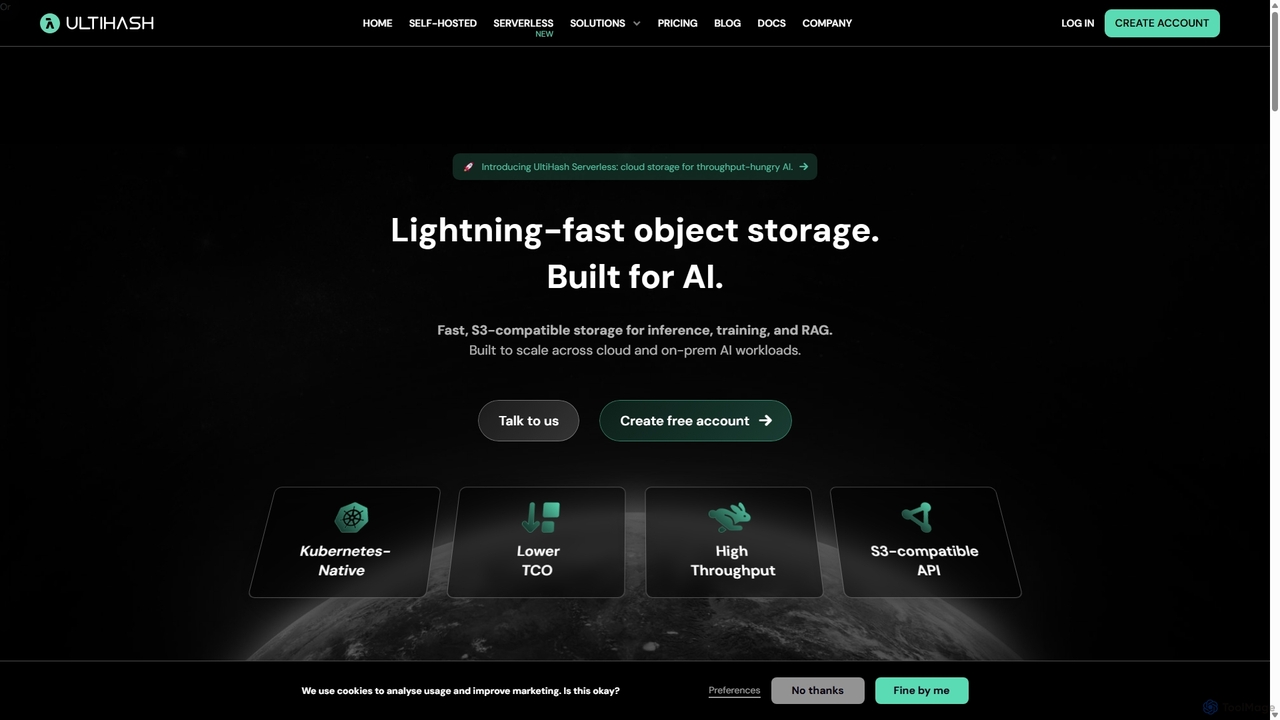
UltiHash
UltiHash is a high-performance, Kubernetes-native object storage platform specifically built for AI and big data workloads. It offers lightning-fast data access, significant cost savings through advanced byte-level deduplication, and flexible deployment across cloud, on-premises, or hybrid environments. Its S3-compatible API ensures seamless integration with existing data stacks and AI workflows.
Machine Learning Operations
GenAI List
GenAI List is a comprehensive online directory dedicated to tracking, exploring, and comparing generative AI models. It serves as an essential guide to the rapidly evolving AI landscape, featuring thousands of models from various organizations. Users can discover new releases, filter by type, openness, and capabilities, and gain insights into practitioner opinions.
Model Discovery
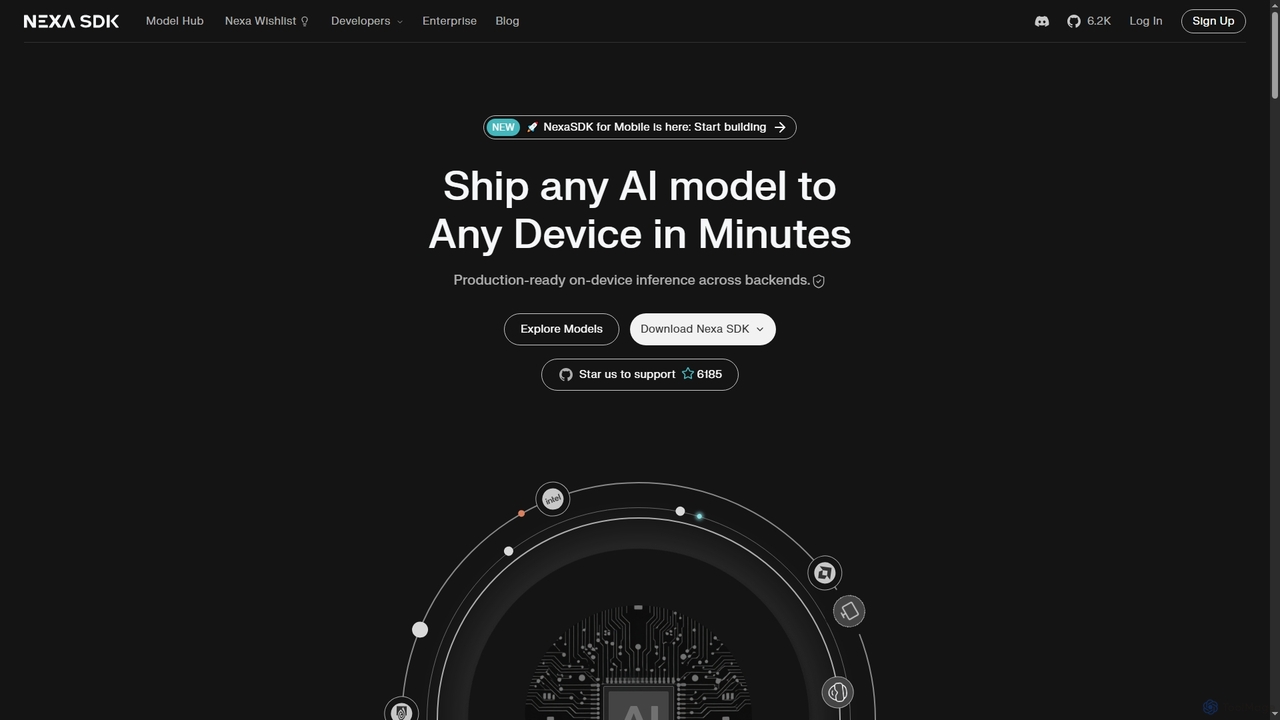
Nexa SDK
Nexa SDK is a powerful toolkit enabling developers to deploy any AI model, including frontier and state-of-the-art models, to any device (mobile, PC, IoT, automotive) in minutes. It offers production-ready on-device inference with hardware acceleration across NPUs, GPUs, and CPUs, optimized for speed and energy efficiency.
Ai Development Kit
Get AI Courses
A curated directory of online AI courses from top universities and platforms like Harvard, Stanford, and MIT. Discover over 178 courses in Data Science, Machine Learning, Generative AI, and Prompt Engineering, with both free and paid options for all skill levels.
Course Aggregator
Anyscale
Anyscale is a fully-managed compute platform for scaling AI and Python workloads. Built on the open-source Ray framework by its original creators, it empowers developers to build, run, and scale distributed applications, from LLM training to data processing, with optimized performance and cost-efficiency on any cloud.
Mlops
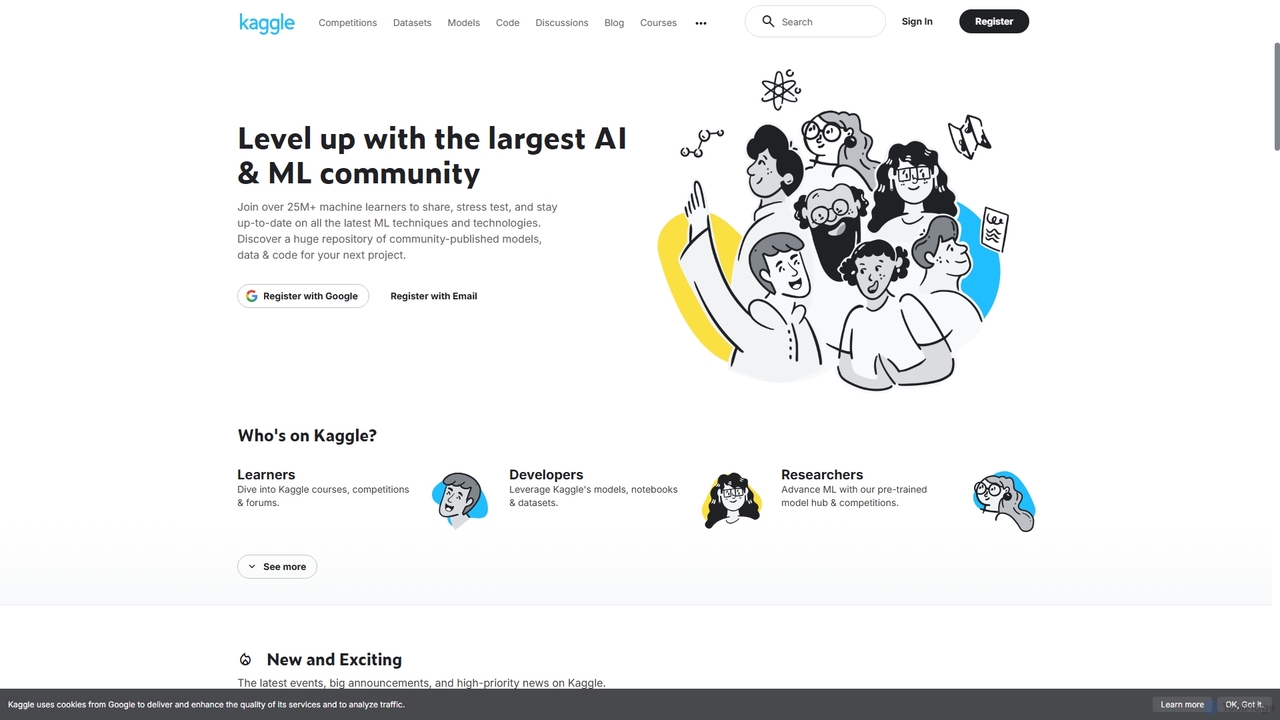
Kaggle
Kaggle is the world's largest online community for data scientists and machine learning practitioners. Owned by Google, it provides a platform to explore datasets, build models in a web-based environment, compete in machine learning challenges, and access educational resources. It offers free access to powerful computational resources, including GPUs and TPUs, making it an essential tool for anyone from beginners to seasoned experts in the AI and data science fields.
Datasets