LotusEye is an AI-powered anomaly detection platform designed for time-series sensor data. It enables businesses to build custom AI models without coding, monitor equipment health in real-time, identify potential failures early, and reduce false positives, thereby preventing costly downtime and improving operational efficiency.

An AI-powered platform for creating and managing Digital Twins of physical assets, processes, and systems. TwinSync enables real-time monitoring, predictive simulation, and operational optimization to enhance efficiency and reduce downtime.
Product overview
LotusEye Product overview
LotusEye is an AI-powered anomaly detection platform designed for time-series sensor data. It enables businesses to build custom AI models without coding, monitor equipment health in real-time, identify potential failures early, and reduce false positives, thereby preventing costly downtime and improving operational efficiency.
twinsync Product overview
An AI-powered platform for creating and managing Digital Twins of physical assets, processes, and systems. TwinSync enables real-time monitoring, predictive simulation, and operational optimization to enhance efficiency and reduce downtime.
Detailed feature comparison
| Feature | LotusEye | twinsync |
|---|---|---|
| Primary category | Predictive Maintenance | Data Analysis |
| Added | 2025-08-15 | 2025-08-15 |
| Pricing | Freemium | Freemium |
| Official website | lotuseye.co.jp | twinsync.xyz |
| Product type | Website | Website |
| Performance data | ||
| User rating | Not verified | Not verified |
| Comments | 0 | 0 |
| Monthly visits | 143 | 4.4K |
| Monthly growth | 333.3% | Not verified |
| Favorites | 106 | 109 |
| Details | View details | View details |
LotusEye vs twinsync monthly traffic
Compare LotusEye and twinsync by monthly reach, traffic trend, visit depth, top regions, and acquisition sources.
How to interpret the traffic data
In the LotusEye vs twinsync monthly traffic comparison, LotusEye currently shows 143 visits and twinsync shows 4.4K; twinsync has about 30.7 times the visible traffic of LotusEye, an absolute difference of about 4.2K visits. This reflects visible reach, not feature quality or paid users.
Only LotusEye has complete third-party traffic details; twinsync uses visits recorded inside ToolMage. These scopes cannot estimate market share directly, and on-site views should not be treated as the product’s total website traffic.
LotusEye is registered at the lotuseye.co.jp/en subpage. Because the current data does not state whether other host pages are excluded, treat this as domain-level context rather than independent traffic for one product or project.
LotusEye monthly traffic:
Latest traffic
Monthly traffic trend
- 2026/1: 79 Monthly visits
- 2026/2: 549 Monthly visits
- 2026/3: 294 Monthly visits
- 2026/4: 33 Monthly visits
- 2026/5: 143 Monthly visits
Search keywords
twinsync monthly traffic:
Latest traffic
Usage comparison
Compare the core capabilities of LotusEye and twinsync
LotusEye Core features
twinsync Core features
Use cases
LotusEye Use cases
twinsync Use cases
LotusEye vs twinsync:In-depth comparison and selection guidance
First decide whether the products solve the same kind of need
This in-depth LotusEye vs twinsync comparison uses only the product records, taxonomy, audience, traffic, and community signals available on this page. LotusEye is primarily listed under “Predictive Maintenance”, while twinsync is primarily listed under “Data Analysis”, so the first decision is whether your actual task matches their recorded scope.
The structured fields currently show these decision-relevant differences: Primary category (LotusEye: Predictive Maintenance; twinsync: Data Analysis); Monthly visits (LotusEye: 143; twinsync: 4.4K); Favorites (LotusEye: 106; twinsync: 109); Website (LotusEye: lotuseye.co.jp; twinsync: twinsync.xyz). These facts are more useful for selection than brand visibility alone.
What market visibility and monthly traffic mean
In the LotusEye vs twinsync monthly traffic comparison, LotusEye currently shows 143 visits and twinsync shows 4.4K; twinsync has about 30.7 times the visible traffic of LotusEye, an absolute difference of about 4.2K visits. This reflects visible reach, not feature quality or paid users.
Only LotusEye has complete third-party traffic details; twinsync uses visits recorded inside ToolMage. These scopes cannot estimate market share directly, and on-site views should not be treated as the product’s total website traffic.
LotusEye is registered at the lotuseye.co.jp/en subpage. Because the current data does not state whether other host pages are excluded, treat this as domain-level context rather than independent traffic for one product or project.
The current traffic scope is not sufficient for a reliable product ranking. Treat monthly visits as a market-interest signal, then decide using taxonomy, use cases, pricing, and a like-for-like trial rather than reading exposure as product capability.
Product positioning, use cases, and roles
LotusEye and twinsync currently overlap in shared categories: Api; shared tags: industrial AI, IoT, and predictive maintenance. This can place both on the same shortlist, but it does not prove equal implementation, depth, or cost.
LotusEye's unique categories/tags are Predictive Maintenance, Monitoring, anomaly detection, machine learning, monitoring, no-code, sensor data, and time series analysis; twinsync's are Data Analysis, Operations Management, Simulation, data visualization, digital twin, operations management, simulation, and smart manufacturing. These unique fields are the strongest differentiators: validate the product whose recorded scope matches the task instead of following traffic alone.
What ratings, comments, and favorites can tell you
LotusEye has no verified rating, 0 comments, 106 favorites, and 102 likes;twinsync has no verified rating, 0 comments, 109 favorites, and 114 likes。
Neither product has enough rating or comment samples for a credible reputation ranking.
Selection guidance by actual need
When to evaluate LotusEye first
Put LotusEye on the priority trial list when the task aligns with “Predictive Maintenance” and especially Predictive Maintenance, Monitoring, anomaly detection, machine learning, monitoring, and no-code. This follows recorded positioning and does not imply unlisted capabilities are absent.
LotusEye also currently records: pricing is freemium, product type is website, 143 monthly visits shown for the registered host (subpage scope unknown), no verified user rating. Verify any hard requirement around price, platform, or reach before trial, and do not let sparse review data substitute for testing.
When to evaluate twinsync first
Put twinsync on the priority trial list when the task aligns with “Data Analysis” and especially Data Analysis, Operations Management, Simulation, data visualization, digital twin, and operations management. This follows recorded positioning and does not imply unlisted capabilities are absent.
twinsync also currently records: pricing is freemium, product type is website, 4.4K on-site monthly views, no verified user rating. Verify any hard requirement around price, platform, or reach before trial, and do not let sparse review data substitute for testing.
How to validate the recommendation before deciding
The available data describes positioning, public visibility, and community signals, but it cannot prove output quality, speed, integration effort, privacy, or long-term cost in your workflow. Before deciding, run the same representative tasks in LotusEye and twinsync, then record completion time, accuracy, manual corrections, and the real paid threshold. A like-for-like trial turns this comparison into a defensible adoption decision.
Comparison FAQ
How should I choose between LotusEye and twinsync?
Where does this comparison data come from?
What do unknown fields mean?
Related AI tools

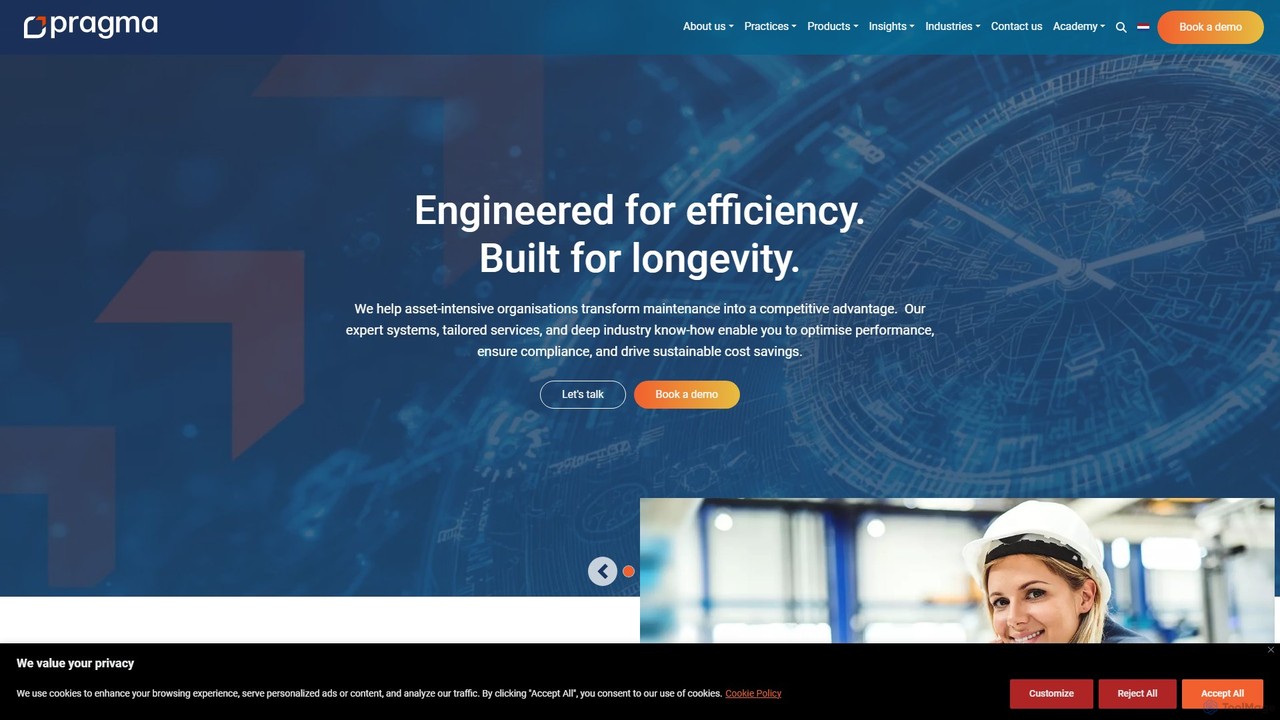
Pragma
Pragma is an AI-powered Enterprise Asset Management (EAM) platform designed to optimize the entire lifecycle of physical assets. By leveraging AI, IoT, and predictive analytics, Pragma helps businesses shift from reactive to proactive maintenance, reducing downtime, cutting costs, and extending asset lifespan. It's a comprehensive solution for industries like manufacturing, energy, and logistics.
Asset Management
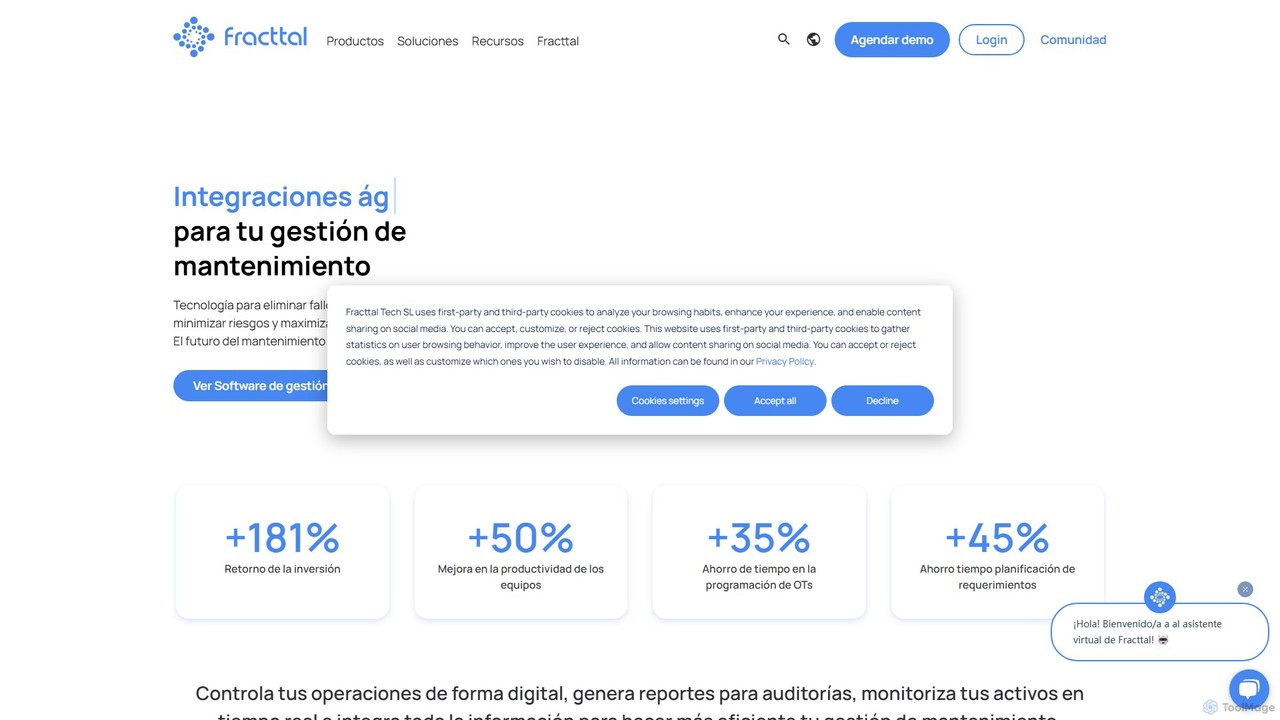
Fracttal
Fracttal is an AI-powered maintenance management platform (CMMS/EAM) designed to optimize asset performance and operational efficiency. It combines predictive maintenance, IoT device integration, and an AI assistant to help businesses reduce failures, cut costs, and maximize asset uptime across various industries.
Maintenance Management
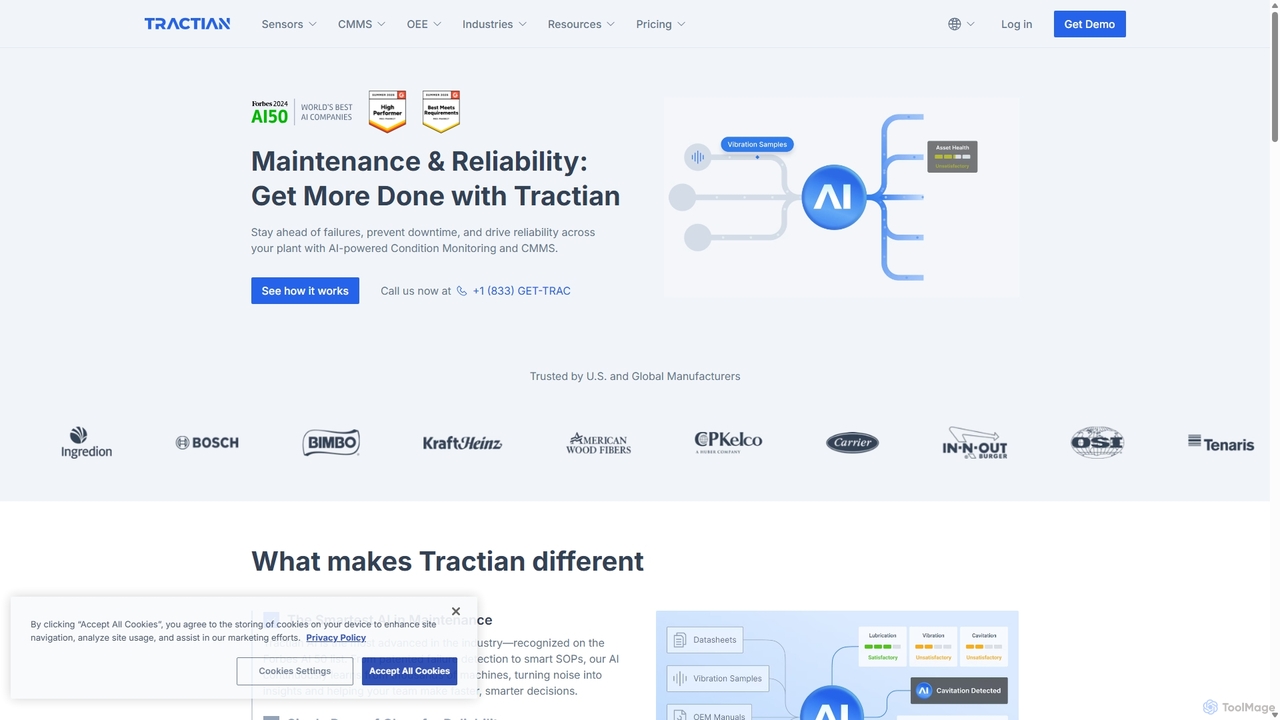
Tractian
Tractian is an AI-powered Industrial Copilot for manufacturing, maintenance, and reliability. It integrates advanced condition monitoring sensors, AI-driven failure detection, and a full-featured CMMS into a single platform. This system predicts machine failures to prevent downtime, streamlines maintenance workflows, and optimizes overall operational efficiency. Trusted by global manufacturers and recognized on the Forbes AI 50 list, Tractian empowers teams to make smarter, data-driven decisions and transform maintenance into a competitive advantage.

Operations Management
Neuton.AI
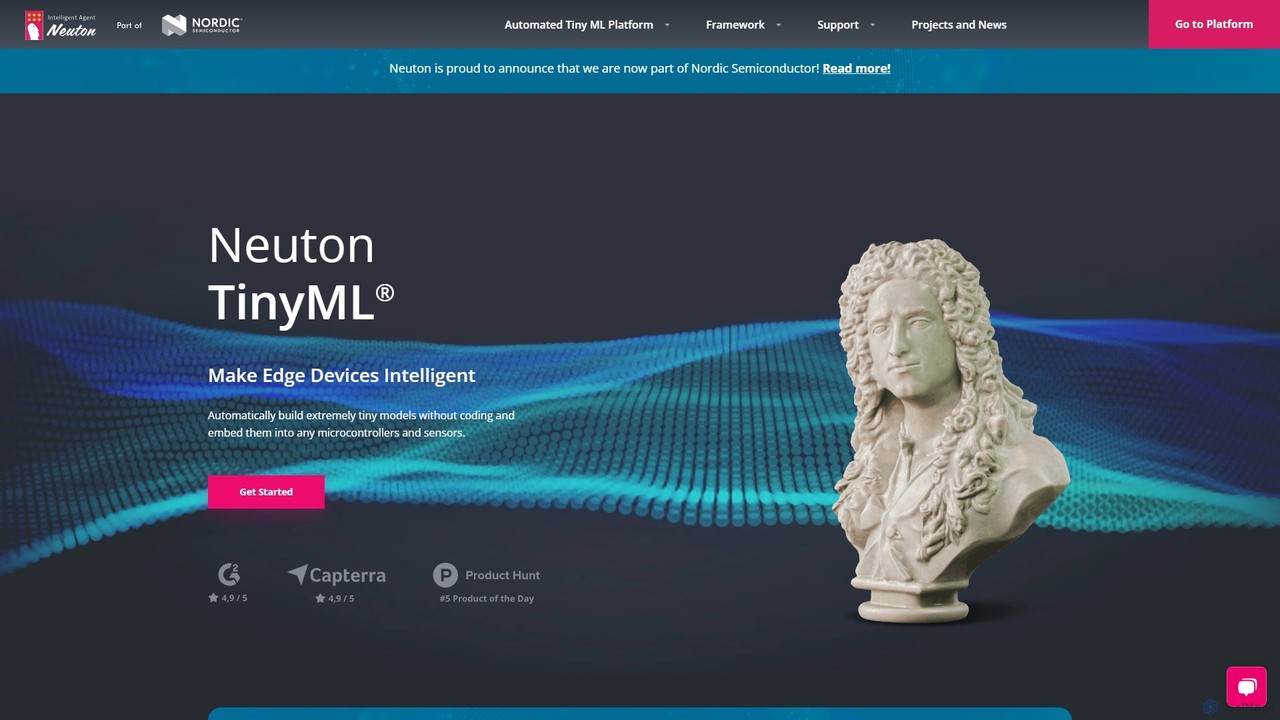
Neuton.AI is a no-code AutoML platform designed to create ultra-compact and efficient machine learning models (TinyML) for edge and IoT devices. It empowers developers to build and deploy AI on resource-constrained hardware like MCUs and sensors without deep technical expertise.
Machine Learning
DeviceHub
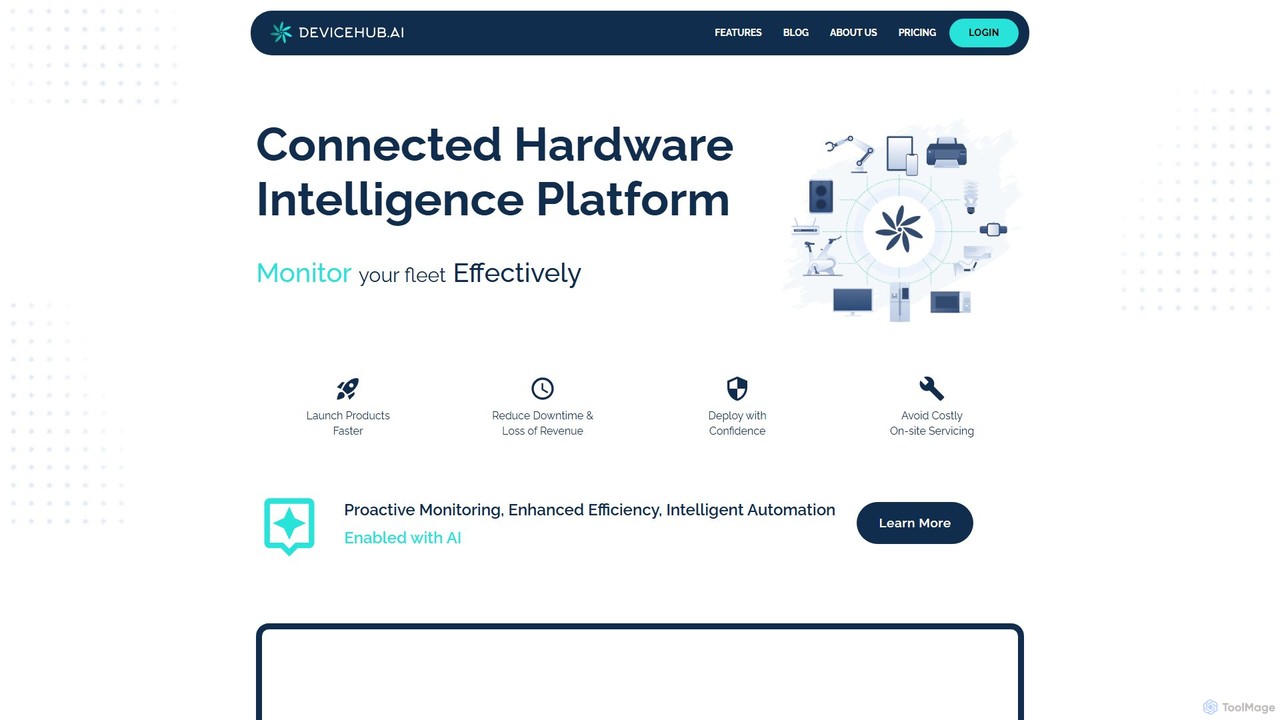
DeviceHub is an AI-powered intelligence platform for connected hardware. It enables companies to monitor, analyze, and deploy software to large-scale IoT device fleets, reducing downtime, accelerating product launches, and providing actionable insights through advanced AI and automation.
Data Analysis
Jungle AI
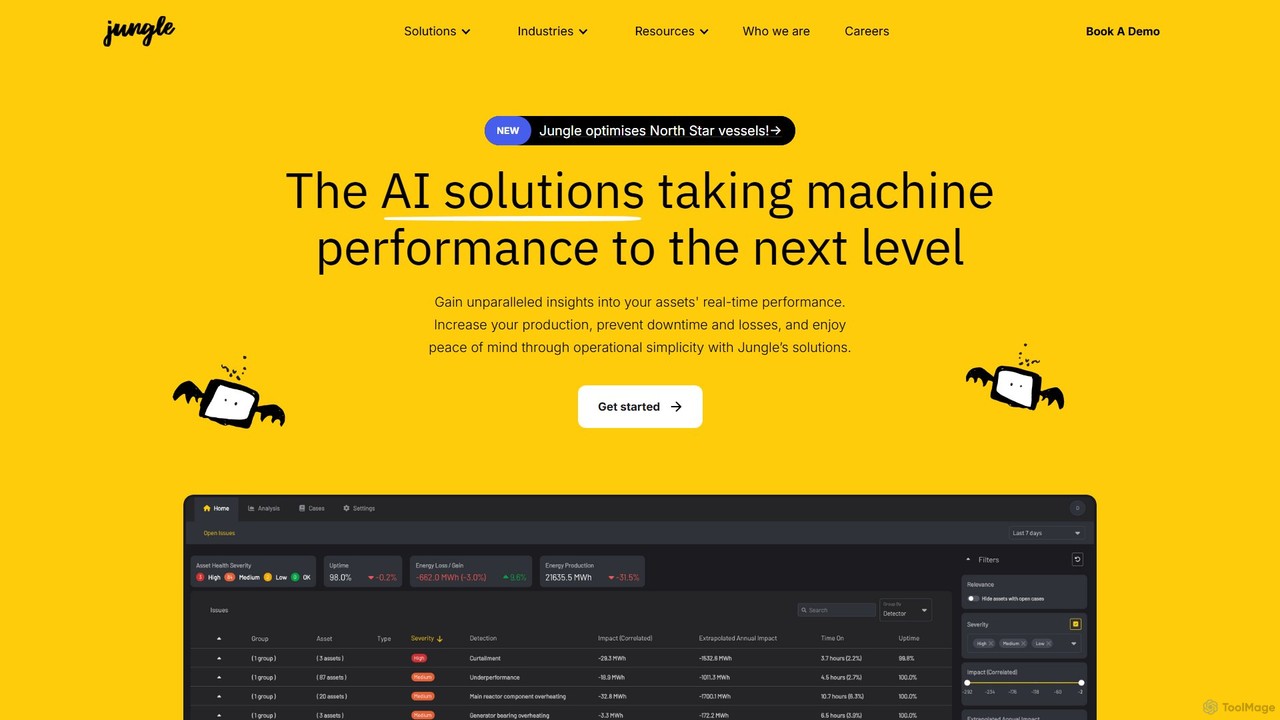
Jungle AI provides advanced AI solutions to optimize the performance and reliability of industrial assets, particularly in the renewable energy (wind, solar) and maritime sectors. Its platforms, Canopy and Toucan, offer predictive maintenance, performance monitoring, and power forecasting to prevent failures, reduce downtime, and maximize operational efficiency.

Predictive Analytics
LatenceTech
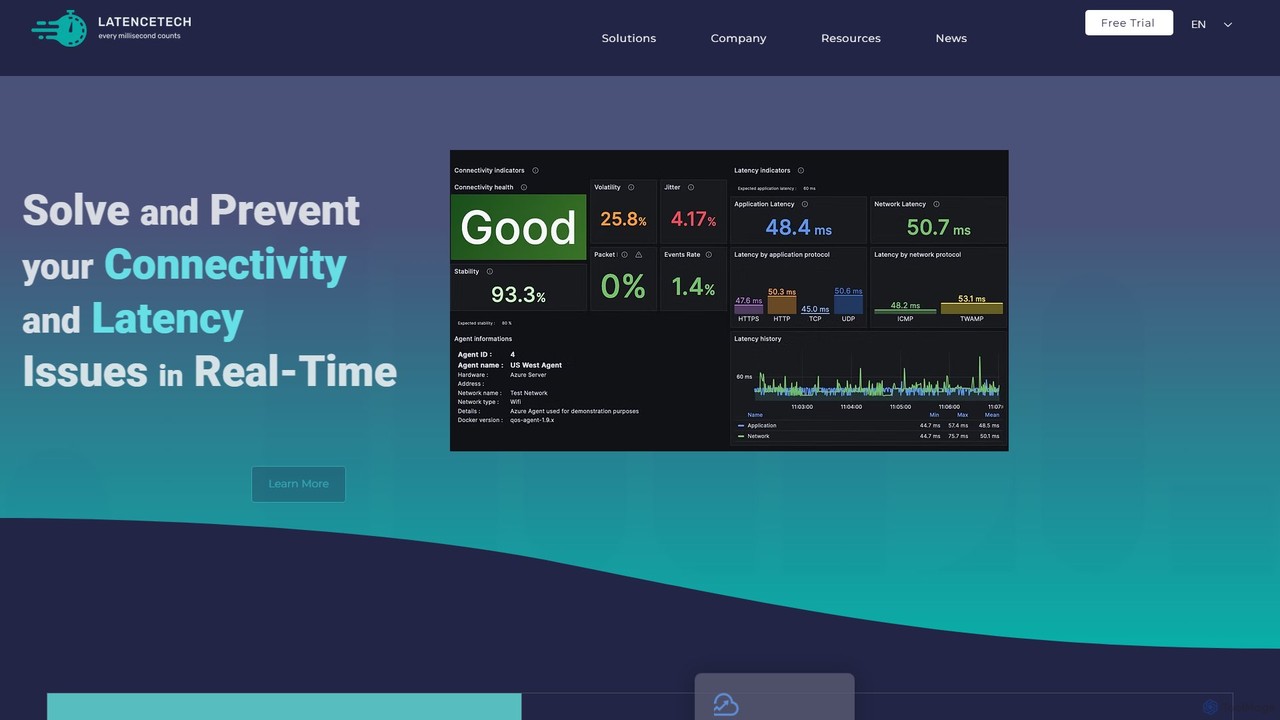
LatenceTech is an AI-powered platform for real-time wireless network monitoring and analytics. It helps businesses visualize, predict, and resolve connectivity and latency issues across various networks like 5G, LTE, Wi-Fi, and Satellite. By leveraging machine learning, it provides end-to-end visibility, predictive insights, and customizable solutions to ensure stable, low-latency performance for critical applications and innovations.
Network Monitoring
Navier AI
Navier AI deploys an autonomous AI agent that functions like a senior engineer, automating complete Computational Fluid Dynamics (CFD) simulation workflows from a simple Slack message. It integrates simulation, AI, and collaboration to accelerate design, analysis, and iteration cycles, offering a 95% reduction in time.
Api
OPAX.ai
OPAX.ai is an AI-driven operations and workflow automation platform. It empowers businesses to optimize processes, manage resources, and analyze complex data to enhance efficiency, reduce costs, and drive intelligent decision-making.
Operations Management
Julius AI
Julius AI is your AI Data Analyst, designed to interpret, analyze, and visualize complex data effortlessly. Connect your data from spreadsheets, databases, or PDFs, ask questions in natural language, and receive instant insights, charts, and reports. No coding is required, but it also supports Python, R, and SQL for advanced users, making data analysis accessible to everyone.
Developer Tools
InfluxData
InfluxData offers InfluxDB, the leading time series database platform built for real-time data and AI applications. It empowers developers to ingest, store, and analyze massive volumes of high-velocity data from IoT, applications, and infrastructure. Featuring high-performance querying, superior data compression, and seamless integration with data lakes and AI/ML pipelines, InfluxData is the engine for anomaly detection, predictive maintenance, and autonomous systems.
Data Management
Liquid AI
Liquid AI provides an edge-native AI stack for building efficient, general-purpose AI that runs directly on devices. It features Liquid Foundation Models (LFMs), a platform (LEAP), and an app (Apollo) to deliver fast, private, and customizable AI solutions with zero cloud dependency, optimized for low-power environments like IoT, automotive, and mobile.
Machine Learning
Rescale
Rescale is a cloud-based High Performance Computing (HPC) platform designed to accelerate engineering and scientific R&D. It provides on-demand access to a multi-cloud infrastructure, a vast catalog of simulation and AI software, and a unified environment for managing complex workflows, data, and security. It empowers organizations in aerospace, automotive, life sciences, and more to innovate faster and more efficiently.
High Performance Computing (Hpc)
Gecko Robotics
Gecko Robotics combines wall-climbing robots and an AI-powered data platform to inspect and manage critical infrastructure. Their technology provides high-resolution data on asset health, enabling predictive maintenance for industries like power generation, oil and gas, and manufacturing. By creating digital twins and identifying potential failures early, Gecko helps improve safety, reduce downtime, and extend the life of essential equipment.
Predictive Maintenance
Lumenore
Lumenore is an AI-powered, no-code business intelligence and data analytics platform designed to transform complex data into actionable insights. It offers a complete analytics workspace with advanced features like Gen AI-powered Natural Language Query (NLQ), automated insights, and data storytelling, enabling businesses to make faster, informed decisions without requiring deep technical expertise.
3D