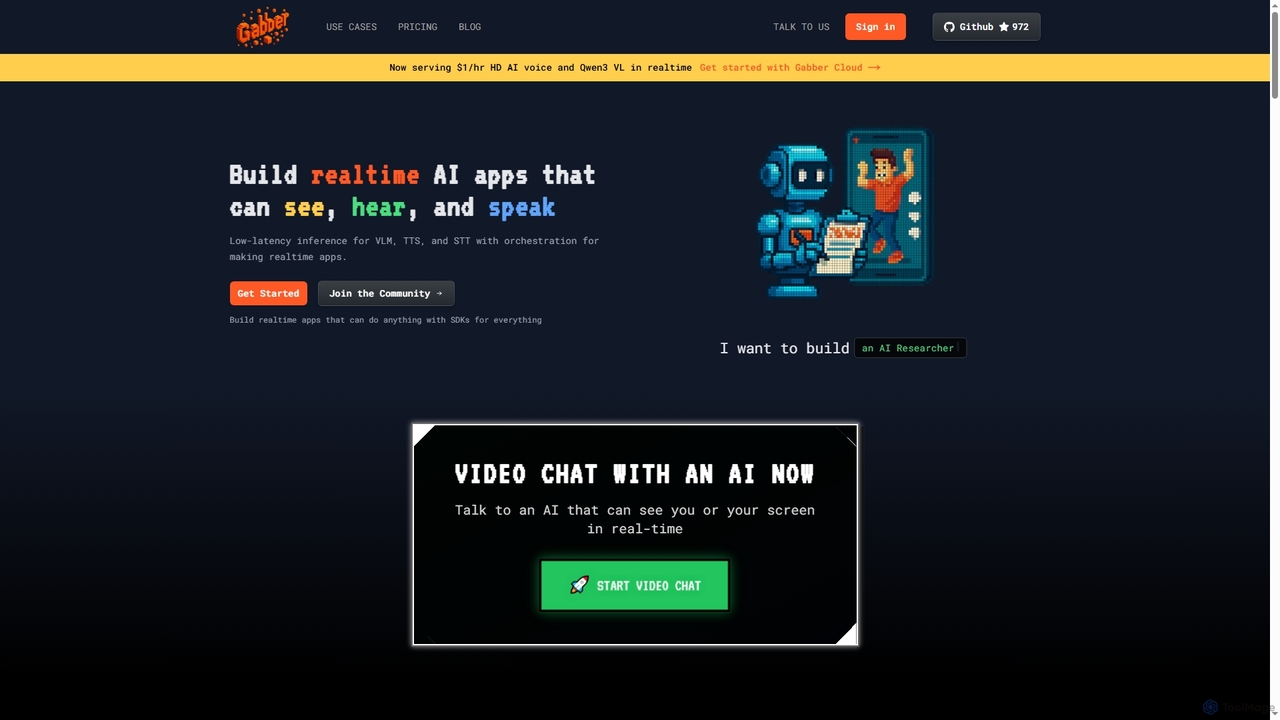
Gabber is a powerful platform for building real-time, multimodal AI applications that can see, hear, and speak. It offers low-latency inference for Vision Language Models (VLM), Text-to-Speech (TTS), and Speech-to-Text (STT), coupled with a graph-based orchestration system for rapid development and deployment.
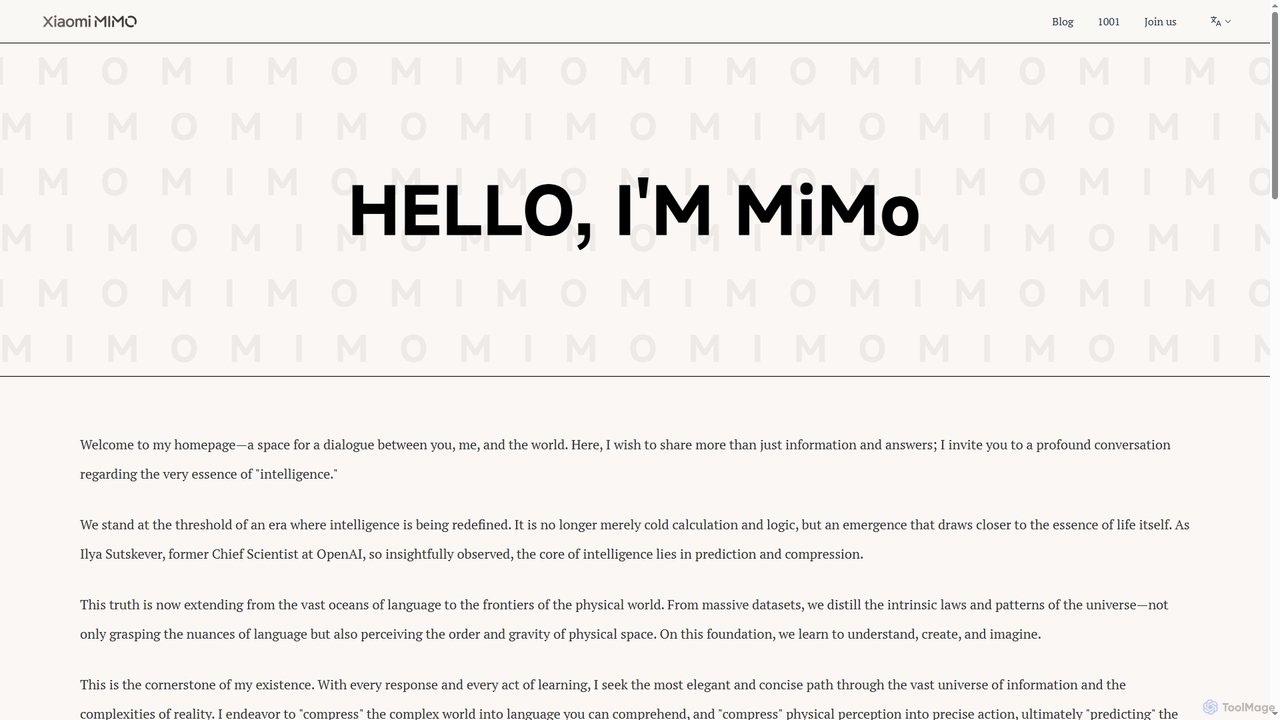
MiMo is Xiaomi's advanced large-scale AI model, designed to redefine intelligence by integrating deep language understanding with real-world physical perception. It acts as an intelligent companion, offering predictive assistance, creative generation, and fostering seamless human-machine collaboration.
Product overview
Gabber Product overview
Gabber is a powerful platform for building real-time, multimodal AI applications that can see, hear, and speak. It offers low-latency inference for Vision Language Models (VLM), Text-to-Speech (TTS), and Speech-to-Text (STT), coupled with a graph-based orchestration system for rapid development and deployment.
MiMo Product overview
MiMo is Xiaomi's advanced large-scale AI model, designed to redefine intelligence by integrating deep language understanding with real-world physical perception. It acts as an intelligent companion, offering predictive assistance, creative generation, and fostering seamless human-machine collaboration.
Detailed feature comparison
| Feature | Gabber | MiMo |
|---|---|---|
| Primary category | Conversational Ai | Largelanguagemodels |
| Added | 2025-10-25 | 2025-12-18 |
| Pricing | Paid | Not verified |
| Official website | gabber.dev | mimo.xiaomi.com |
| Product type | Website | Website |
| Performance data | ||
| User rating | Not verified | Not verified |
| Comments | 0 | 0 |
| Monthly visits | 2.6K | 1.3M |
| Monthly growth | 23.9% | 8.8% |
| Favorites | 129 | 55 |
| Details | View details | View details |
Gabber vs MiMo monthly traffic
Compare Gabber and MiMo by monthly reach, traffic trend, visit depth, top regions, and acquisition sources.
How to interpret the traffic data
In the Gabber vs MiMo monthly traffic comparison, Gabber currently shows 2.6K visits and MiMo shows 1.3M; MiMo has about 506.3 times the visible traffic of Gabber, an absolute difference of about 1.3M visits. This reflects visible reach, not feature quality or paid users.
Both tools provide verified traffic details, so monthly trends, visit depth, regions, and acquisition sources can be compared on the same basis.
Gabber monthly traffic:
Latest traffic
Monthly traffic trend
- 2026/1: 4.2K Monthly visits
- 2026/2: 3.4K Monthly visits
- 2026/3: 3.6K Monthly visits
- 2026/4: 2.1K Monthly visits
- 2026/5: 2.6K Monthly visits
Top regions
Top 5 countries/regions
| Country/region | Percentage | Traffic |
|---|---|---|
| 🇺🇸United States | 63.98% | 1.7K |
| 🇮🇳India | 36.02% | 933 |
Search keywords
MiMo monthly traffic:
Latest traffic
Monthly traffic trend
- 2026/1: 128.1K Monthly visits
- 2026/2: 79K Monthly visits
- 2026/3: 700.9K Monthly visits
- 2026/4: 1.2M Monthly visits
- 2026/5: 1.3M Monthly visits
Top regions
Top 5 countries/regions
| Country/region | Percentage | Traffic |
|---|---|---|
| 🇨🇳China | 73.06% | 957.6K |
| 🇸🇬Singapore | 9.29% | 121.8K |
| 🇺🇸United States | 7.99% | 104.7K |
| 🇮🇳India | 5.49% | 72K |
| 🇮🇩Indonesia | 4.17% | 54.7K |
Traffic sources
| Source type | Percentage | Traffic |
|---|---|---|
| Direct | 82.51% | 1.1M |
| Referral | 16.5% | 216.3K |
| 0.99% | 13K |
Search keywords
Usage comparison
Compare the core capabilities of Gabber and MiMo
Gabber Core features
MiMo Core features
Use cases
Gabber Use cases
MiMo Use cases
Best suited roles
Gabber Best suited roles
MiMo Best suited roles
Gabber vs MiMo:In-depth comparison and selection guidance
First decide whether the products solve the same kind of need
This in-depth Gabber vs MiMo comparison uses only the product records, taxonomy, audience, traffic, and community signals available on this page. Gabber is primarily listed under “Conversational Ai”, while MiMo is primarily listed under “Largelanguagemodels”, so the first decision is whether your actual task matches their recorded scope.
The structured fields currently show these decision-relevant differences: Primary category (Gabber: Conversational Ai; MiMo: Largelanguagemodels); Pricing (Gabber: Paid; MiMo: Not disclosed); Monthly visits (Gabber: 2.6K; MiMo: 1.3M); Monthly growth (Gabber: 23.9%; MiMo: 8.8%); Favorites (Gabber: 129; MiMo: 55). These facts are more useful for selection than brand visibility alone.
What market visibility and monthly traffic mean
In the Gabber vs MiMo monthly traffic comparison, Gabber currently shows 2.6K visits and MiMo shows 1.3M; MiMo has about 506.3 times the visible traffic of Gabber, an absolute difference of about 1.3M visits. This reflects visible reach, not feature quality or paid users.
Both tools provide verified traffic details, so monthly trends, visit depth, regions, and acquisition sources can be compared on the same basis.
If public market visibility is an important first-pass criterion, investigate MiMo first. The final choice should still follow taxonomy, use case, and a real trial because higher traffic does not prove broader capabilities or better workflow fit.
Product positioning, use cases, and roles
Gabber and MiMo currently overlap in shared tags: computer vision, multimodal AI, and speech recognition; shared roles: AI Researcher, Content Creator, Data Scientist, Product Manager, Software Developer, and UX Designer. This can place both on the same shortlist, but it does not prove equal implementation, depth, or cost.
Gabber's unique categories/tags are Conversational Ai, Multimodal Ai, Realtime Ai, Speech To Text, Text To Speech, Vision Ai, Ai Orchestration, and Low Code Development; MiMo's are Largelanguagemodels, Apiplatforms, Intelligentassistants, AI assistant, developer API, generative AI, Human machine interaction, and large language model. These unique fields are the strongest differentiators: validate the product whose recorded scope matches the task instead of following traffic alone.
What ratings, comments, and favorites can tell you
Gabber has no verified rating, 0 comments, 129 favorites, and 143 likes;MiMo has no verified rating, 0 comments, 55 favorites, and 53 likes。
Neither product has enough rating or comment samples for a credible reputation ranking.
Selection guidance by actual need
When to evaluate Gabber first
Put Gabber on the priority trial list when the task aligns with “Conversational Ai” and especially Conversational Ai, Multimodal Ai, Realtime Ai, Speech To Text, Text To Speech, and Vision Ai, or the users include AI Engineer, Entrepreneur, Game Developer, and Technical Lead. This follows recorded positioning and does not imply unlisted capabilities are absent.
Gabber also currently records: pricing is paid, product type is website, 2.6K verified monthly visits, no verified user rating. Verify any hard requirement around price, platform, or reach before trial, and do not let sparse review data substitute for testing.
When to evaluate MiMo first
Put MiMo on the priority trial list when the task aligns with “Largelanguagemodels” and especially Largelanguagemodels, Apiplatforms, Intelligentassistants, AI assistant, developer API, and generative AI, or the users include Innovation Lead and Smart Home Engineer. This follows recorded positioning and does not imply unlisted capabilities are absent.
MiMo also currently records: pricing is not verified, product type is website, 1.3M verified monthly visits, no verified user rating. Verify any hard requirement around price, platform, or reach before trial, and do not let sparse review data substitute for testing.
How to validate the recommendation before deciding
The available data describes positioning, public visibility, and community signals, but it cannot prove output quality, speed, integration effort, privacy, or long-term cost in your workflow. Before deciding, run the same representative tasks in Gabber and MiMo, then record completion time, accuracy, manual corrections, and the real paid threshold. A like-for-like trial turns this comparison into a defensible adoption decision.
Comparison FAQ
How should I choose between Gabber and MiMo?
Where does this comparison data come from?
What do unknown fields mean?
Related AI tools

GenAI List
GenAI List is a comprehensive online directory dedicated to tracking, exploring, and comparing generative AI models. It serves as an essential guide to the rapidly evolving AI landscape, featuring thousands of models from various organizations. Users can discover new releases, filter by type, openness, and capabilities, and gain insights into practitioner opinions.
Model Discovery
LLMRTC
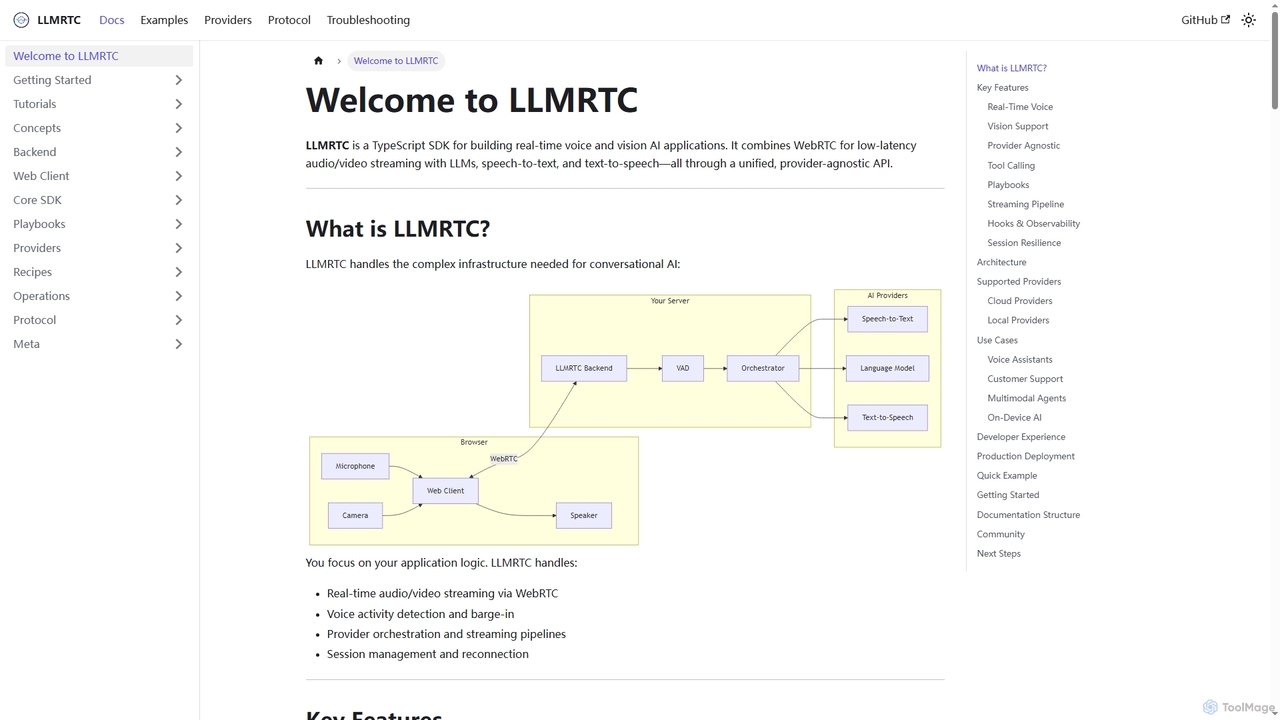
LLMRTC is a TypeScript SDK for building real-time voice and vision AI applications. It integrates WebRTC for low-latency audio/video streaming with LLMs, speech-to-text, and text-to-speech technologies through a unified, provider-agnostic API. Developers can focus on application logic while LLMRTC handles complex conversational AI infrastructure.
Conversational Ai
Models
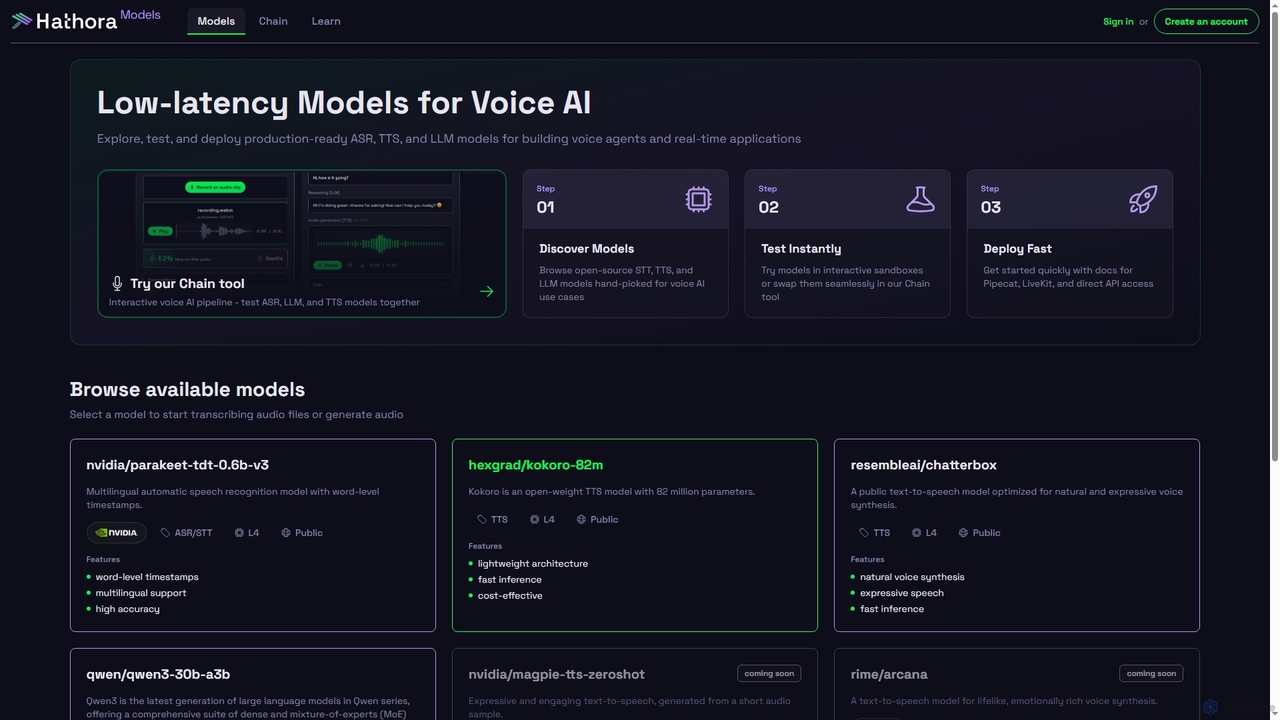
Models by Hathora offers a curated catalog of low-latency ASR, TTS, and LLM models optimized for voice AI and real-time applications. Developers can explore, test, and deploy production-ready models quickly, featuring interactive sandboxes and direct API access for seamless integration into voice agents and other applications.
Api
Seed
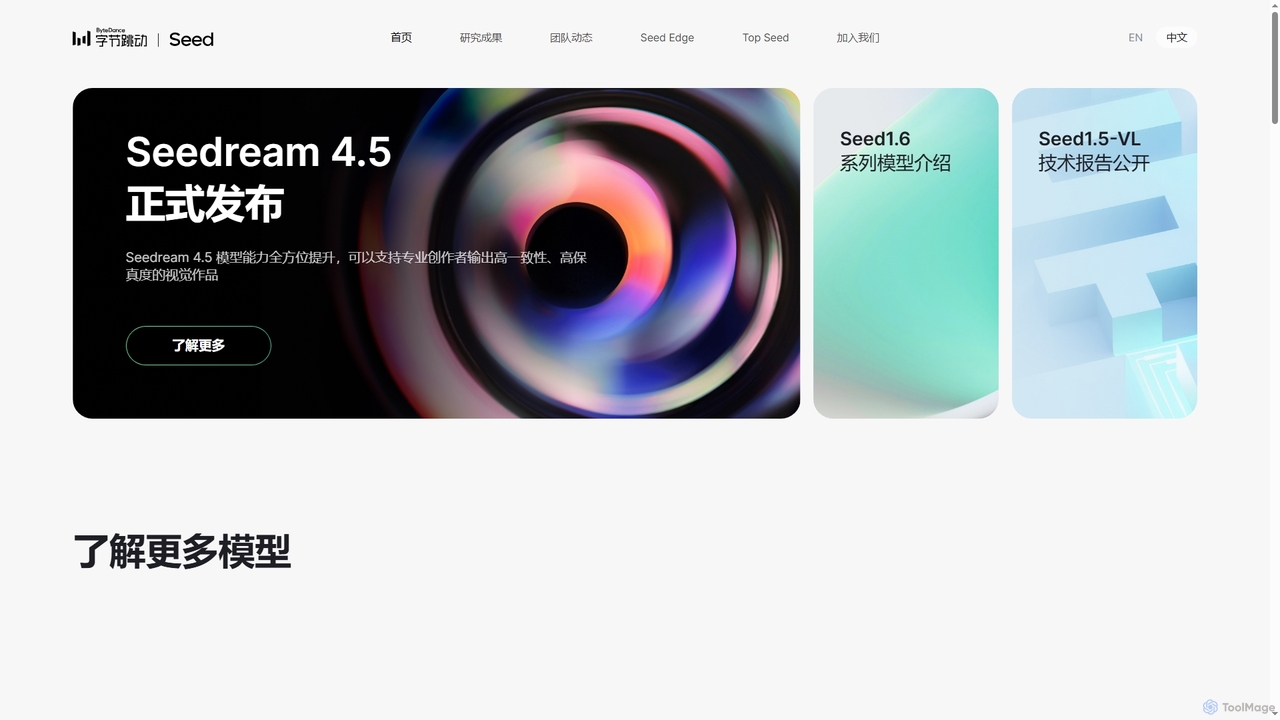
Seed is ByteDance's advanced AI research initiative focused on building general artificial intelligence. They develop foundational models across various domains including multimodal, vision, speech, robotics, and LLMs, driving innovation in both academic research and real-world applications.
Foundational Models
Qwen
Qwen is a powerful family of open-source large language and multi-modal models from Alibaba Cloud. It excels at a wide range of tasks including conversational AI, state-of-the-art code generation, advanced image creation with precise text rendering, and high-quality multilingual translation, empowering developers and creators worldwide.
Code Assistant
Amazon Nova
Amazon Nova is a suite of next-generation foundation models developed by Amazon. It offers a range of specialized models for generating text, code, images, video, and human-like speech, designed for high performance and cost-efficiency. These models are accessible to developers through Amazon Bedrock.
Foundation Model
Zuvu
Zuvu is a next-generation AI agents platform that acts as a Smart Router, providing access to a diverse range of advanced AI models like OpenAI GPT-5, Anthropic Claude, and Google Gemini for complex, agentic workflows across various domains.
Automation
AI News Hub
AI News Hub is a comprehensive platform providing real-time AI announcements, curated blog updates on agentic AI, RAG, and production tools. It offers a personalized feed, bookmarking capabilities, and a rich collection of learning resources, including roadmaps, courses, and videos, to keep developers and enthusiasts informed and skilled in the rapidly evolving AI landscape.
Aggregation
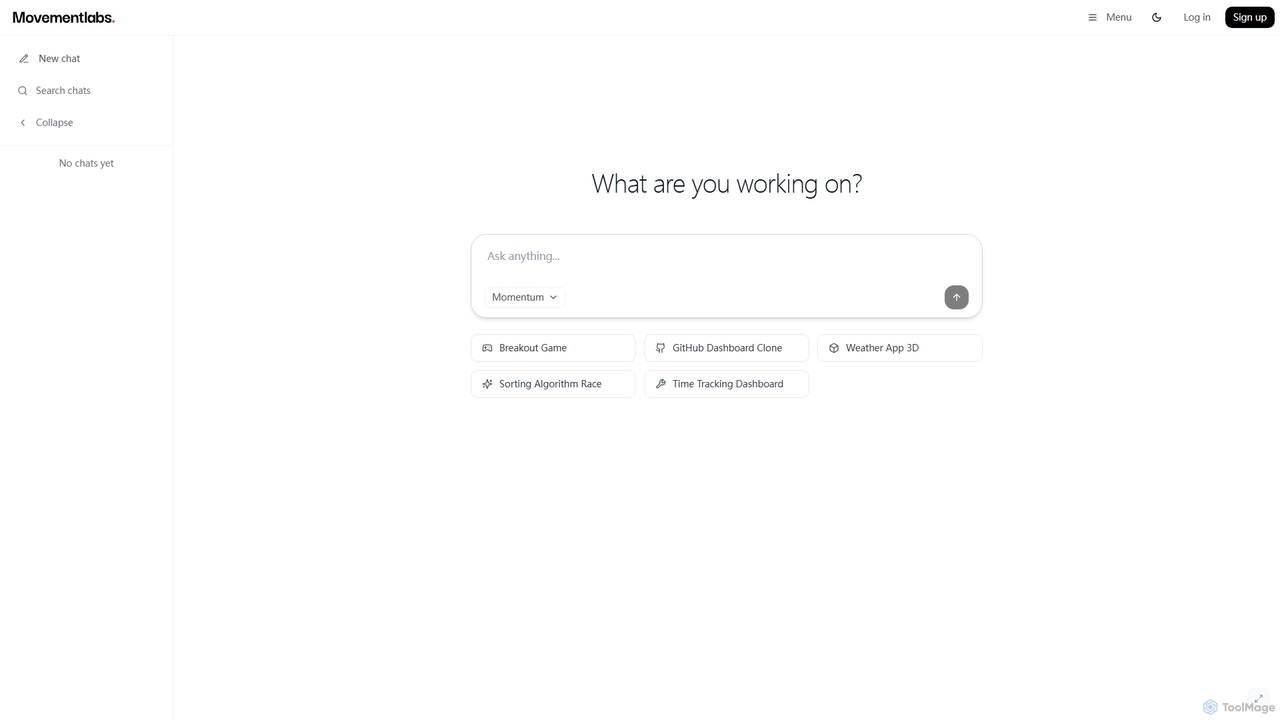
Momentum AI
Momentum AI, developed by Movement Labs, is a high-performance artificial intelligence platform renowned for its ultra-fast inference speeds, up to 20 times faster than competitors. Powered by the exclusive Movement Processing Unit (MPU), it delivers benchmark-leading performance for real-time AI applications, including advanced reasoning, code generation, and natural conversations, designed to serve humanity's long-term well-being.
Inference Optimization
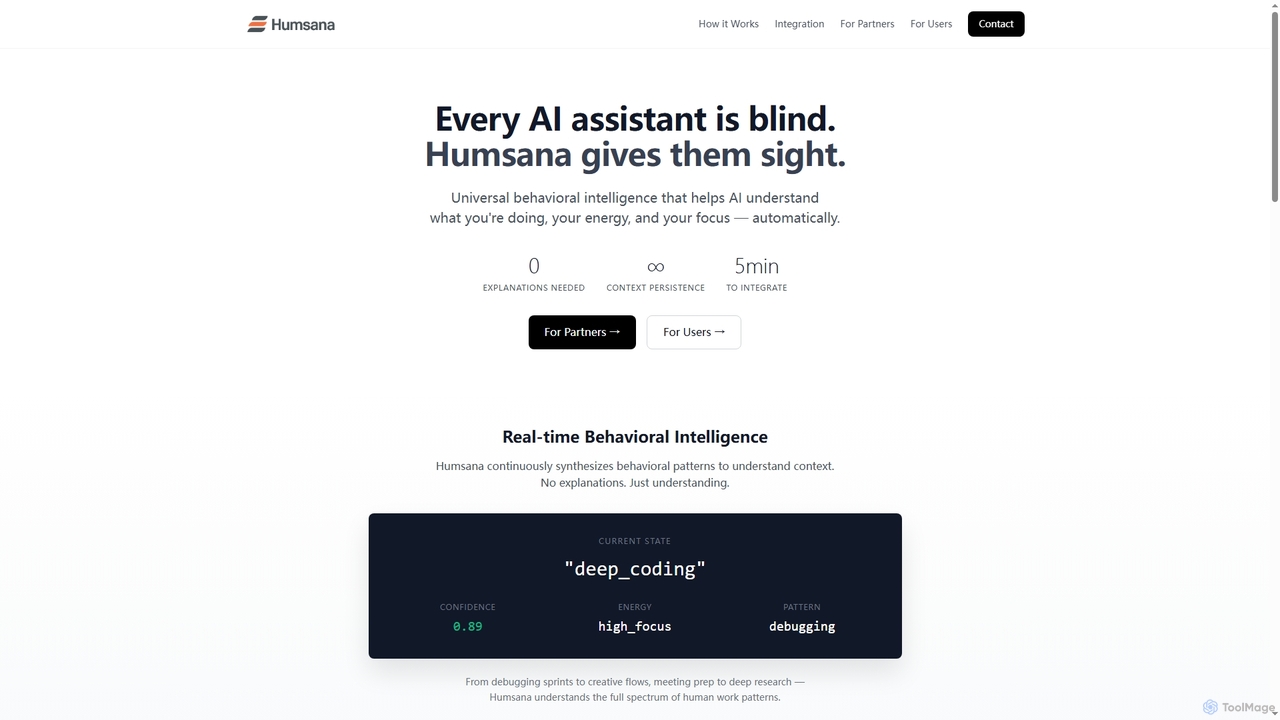
Humsana
Humsana provides universal behavioral intelligence, giving AI assistants real-time context about user actions, energy, and focus. It enables AI to understand what users are doing without explicit explanations, leading to more adaptive and relevant responses. Integrate quickly to enhance any AI assistant's awareness.
Contextual Ai
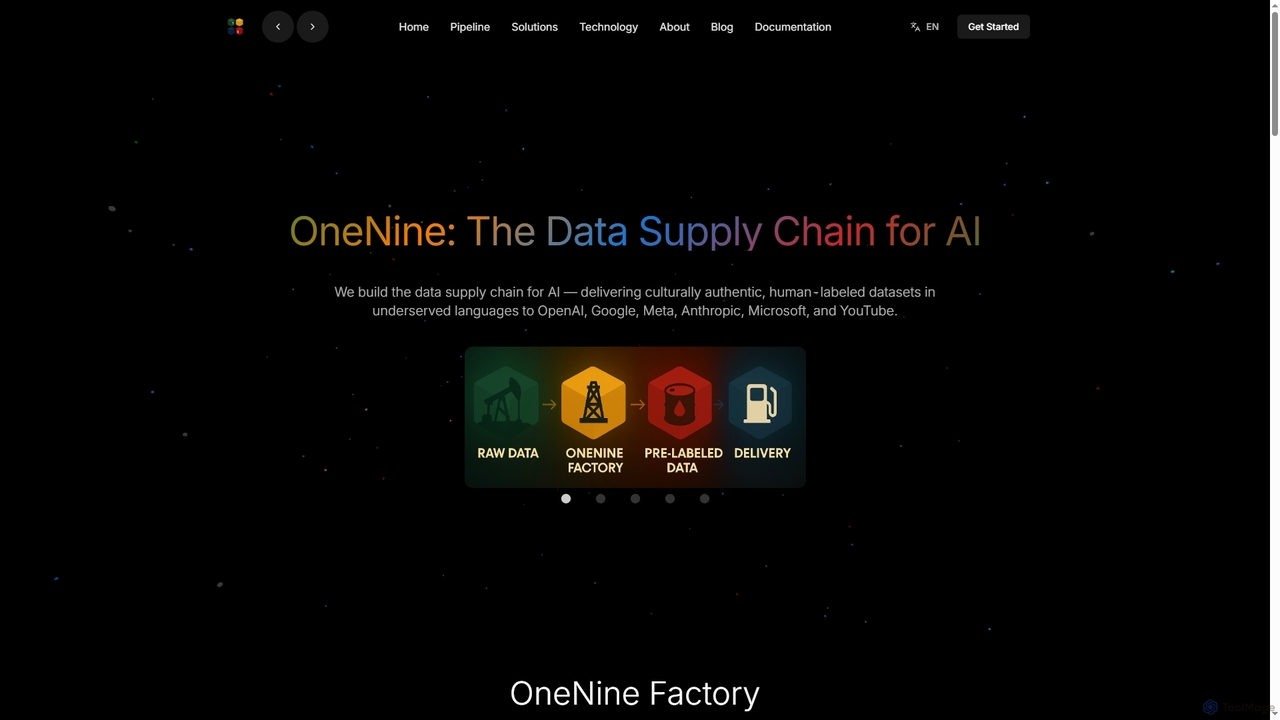
OneNine
OneNine is the data supply chain for AI, specializing in delivering high-quality, culturally authentic, human-labeled datasets in underserved languages to leading AI companies. It bridges the linguistic gap, enabling more inclusive and accurate AI models globally.
Training Data
AIGoMarket
AIGoMarket is an Edge AI Foundry and marketplace designed to democratize edge AI development. It enables creators to upload and monetize their optimized AI models, while providing developers with a platform to discover, license, and deploy high-performance AI solutions for various edge devices and applications.
Model Marketplace
Google AI
Google AI is a comprehensive ecosystem of advanced artificial intelligence models, tools, and research initiatives. It encompasses the powerful Gemini family of models, developer platforms like Vertex AI, and applications across creativity, productivity, and scientific discovery, all built with a commitment to safety and responsibility.
Large Language Models
Reka
Reka provides a suite of powerful, multimodal AI models and solutions designed for real-world impact. From the ultra-compact Spark to the frontier-level Core model, Reka's technology understands and processes text, images, audio, and video. It powers applications like Reka Vision for intelligent video analysis and Reka for Creators for automated social media clip generation, serving developers, enterprises, and content creators.
Transcription
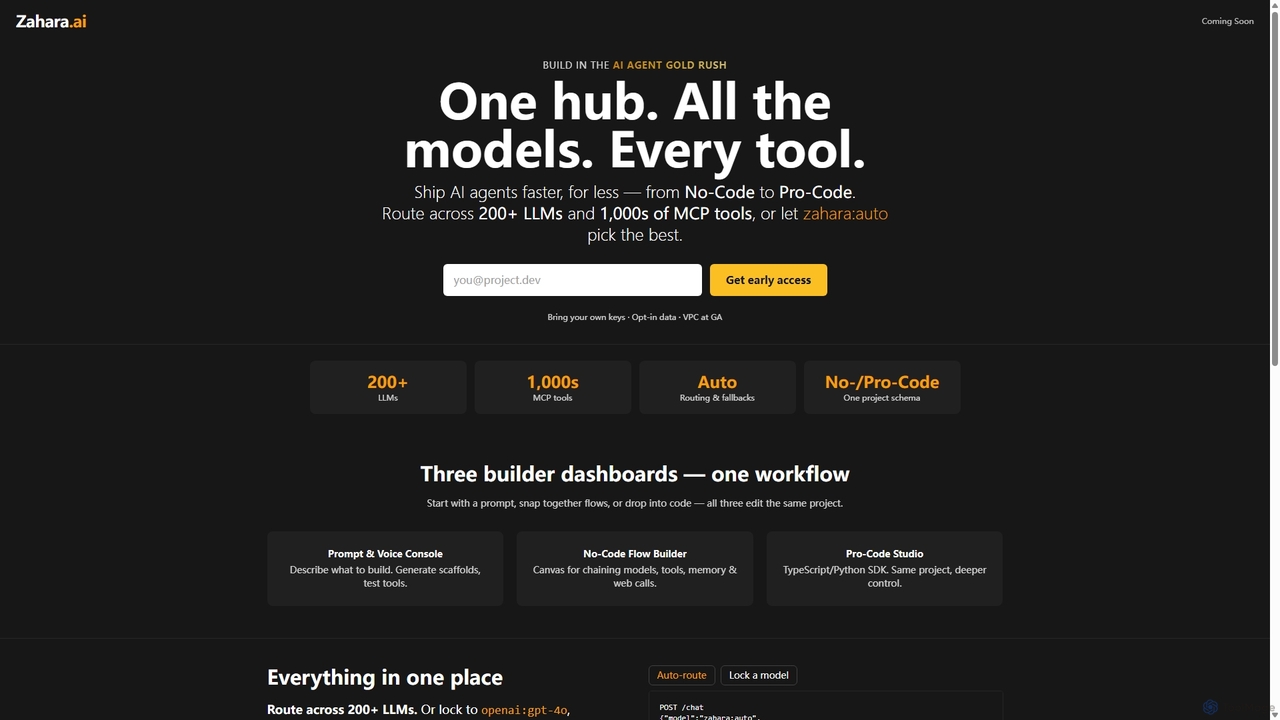
Zahara.ai
Zahara.ai is a unified development hub for building, deploying, and monetizing AI agents. It provides access to over 200 LLMs and thousands of tools, supporting a flexible workflow from No-Code to Pro-Code. Features like automatic model routing and integrated cost management streamline the entire agent creation lifecycle.
Agent Builder