
Ai Tools Best in category 1 results Assessment AI Tool

Popular AI tools in the Assessment field of Ai Tools include Sense, etc., helping you quickly improve efficiency.

Sense

Sense

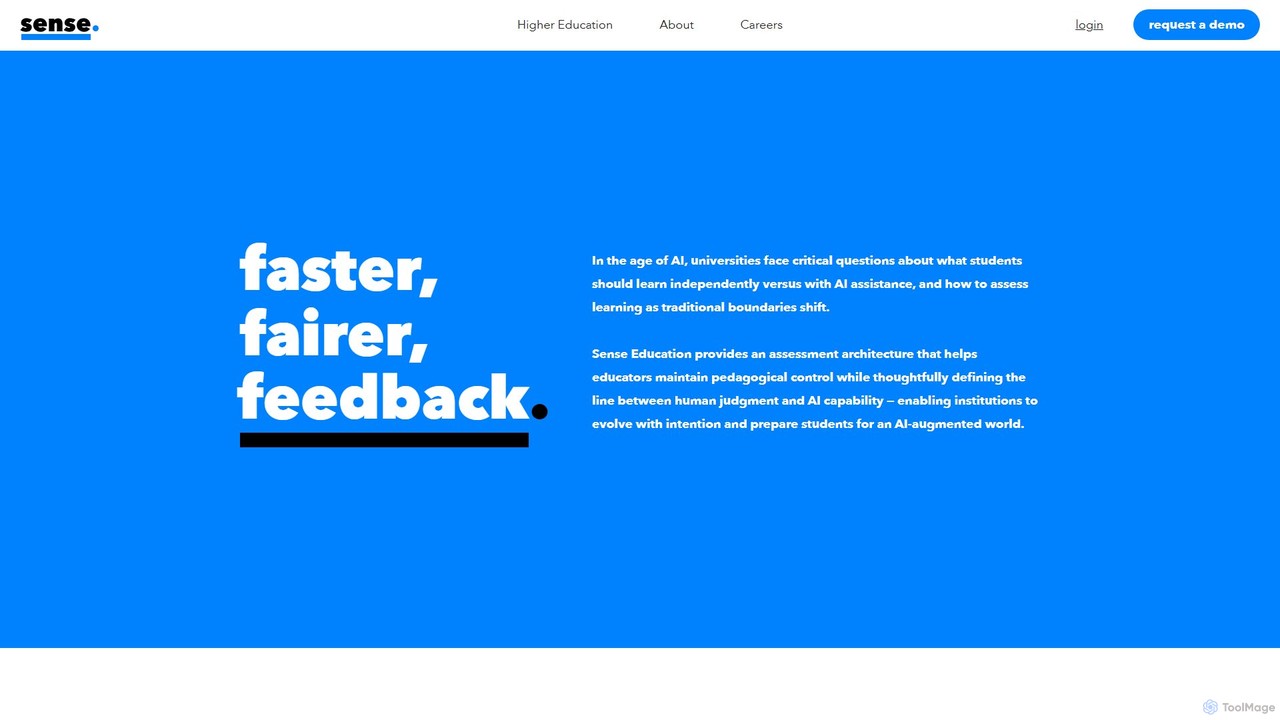
Sense is an AI-driven assessment and feedback platform designed for higher education. It empowers educators to provide personalized, …

11.3K

About Assessment

AI Assessment tools are a class of software that uses artificial intelligence to create, administer, and analyze evaluations. These tools leverage natural language processing (NLP) and machine learning to score complex responses, generate personalized questions, and identify knowledge gaps. Their primary value lies in providing objective, scalable, and data-driven insights into skills and performance. This automation saves significant time compared to manual grading and allows for more frequent and consistent evaluation in education and professional settings.

Core Features

  • Automated Question Generation: AI creates a wide range of questions (multiple-choice, open-ended, scenario-based) from source materials like documents or textbooks.
  • Intelligent Scoring: The system grades complex inputs, including essays, code, and spoken responses, based on predefined criteria and models.
  • Performance Analytics: Delivers detailed reports on individual and group performance, highlighting strengths, weaknesses, and common misconceptions.
  • Adaptive Testing: Automatically adjusts the difficulty of questions in real-time based on the test-taker's answers for a more accurate assessment.
  • AI-Powered Proctoring: Monitors test-takers via webcam and microphone to detect and flag potential academic integrity violations.

Use Cases

AI Assessment tools are widely adopted in the education sector by teachers and institutions to automate grading and personalize learning. In human resources, recruiters use them for pre-employment skill screening and technical interviews. Corporate training and development departments also rely on these tools to measure the effectiveness of their programs and certify employee competencies.

How to Choose

When selecting an AI Assessment tool, first consider the specific subject matter it supports, such as coding, writing, or languages. Evaluate the accuracy and transparency of its AI scoring model. Check for integration capabilities with your existing Learning Management System (LMS) or Applicant Tracking System (ATS). Finally, assess the robustness of its security and proctoring features to ensure the integrity of the evaluations.

AssessmentUse Cases

1

Automated Technical Skill Screening for Recruitment

A tech recruiter needs to screen hundreds of applications for a software developer role. Instead of manual resume reviews and initial calls, they use an AI assessment platform. The platform generates a relevant coding challenge based on the job description. Candidates complete the test in a monitored online environment. The AI automatically grades the code for correctness, efficiency, and code quality, providing a ranked list of top performers with detailed performance reports. This reduces screening time by over 80% and ensures an objective, skills-first evaluation process.

2

Personalized Learning Path Creation in Education

An educator wants to address the diverse skill levels within a large classroom. They administer an AI-powered diagnostic assessment at the beginning of the term. The test adapts in difficulty for each student, quickly identifying their specific strengths and weaknesses in the subject. Based on the results, the AI tool automatically generates a personalized study plan for each student, recommending specific chapters, exercises, and video tutorials to help them improve. This allows the educator to provide targeted support at scale and empowers students to focus on their individual learning gaps.

3

Measuring Corporate Compliance Training Effectiveness

A compliance officer at a financial firm needs to ensure all employees have understood the latest anti-money laundering regulations. After a mandatory training session, they deploy an AI-powered assessment. Instead of simple multiple-choice questions, the AI generates realistic scenarios requiring employees to apply the regulations. The AI analyzes their free-text responses for understanding and critical thinking. The resulting dashboard shows which departments or individuals need follow-up training, providing a clear, auditable record of comprehension and reducing regulatory risk.

4

Large-Scale Language Proficiency Evaluation

A global organization needs to certify the English proficiency of thousands of applicants from different countries. Conducting in-person interviews is logistically impossible and prone to bias. They adopt an AI assessment tool that evaluates both speaking and writing skills. Applicants record themselves answering prompts, and the AI analyzes their speech for fluency, pronunciation, and grammar. It also scores their written essays for coherence and vocabulary. This provides a standardized, unbiased, and highly scalable method for language certification, delivering consistent results in a fraction of the time.

5

Soft Skills Assessment for Leadership Development

A talent development manager is tasked with identifying high-potential employees for a leadership program. Traditional metrics don't capture soft skills like communication and problem-solving. They use an AI assessment tool featuring simulated video interviews. Candidates respond to challenging workplace scenarios. The AI analyzes not just what they say, but also their tone of voice and word choice to gauge confidence and empathy. The tool provides objective data on critical leadership competencies, helping the manager make more informed, data-backed decisions for succession planning.

6

AI Model Performance Benchmarking

A machine learning team has developed several versions of a natural language understanding model. They need to objectively determine which one performs best before deploying it to production. They use an AI assessment platform designed for model evaluation. The platform runs each model against a standardized, hidden dataset and calculates key metrics like accuracy, precision, recall, and F1-score. It also tests for robustness against adversarial examples. The tool generates a comparative leaderboard, allowing the team to quickly identify the superior model and justify their choice with empirical data.

AssessmentFrequently Asked Questions