ToolMage
Sign in

Best 1 Context Management AI tools for Ai Tools

Popular Context Management AI tools in Ai Tools include theogrowth, helping you work more efficiently.

theogrowth
Freemium

theogrowth

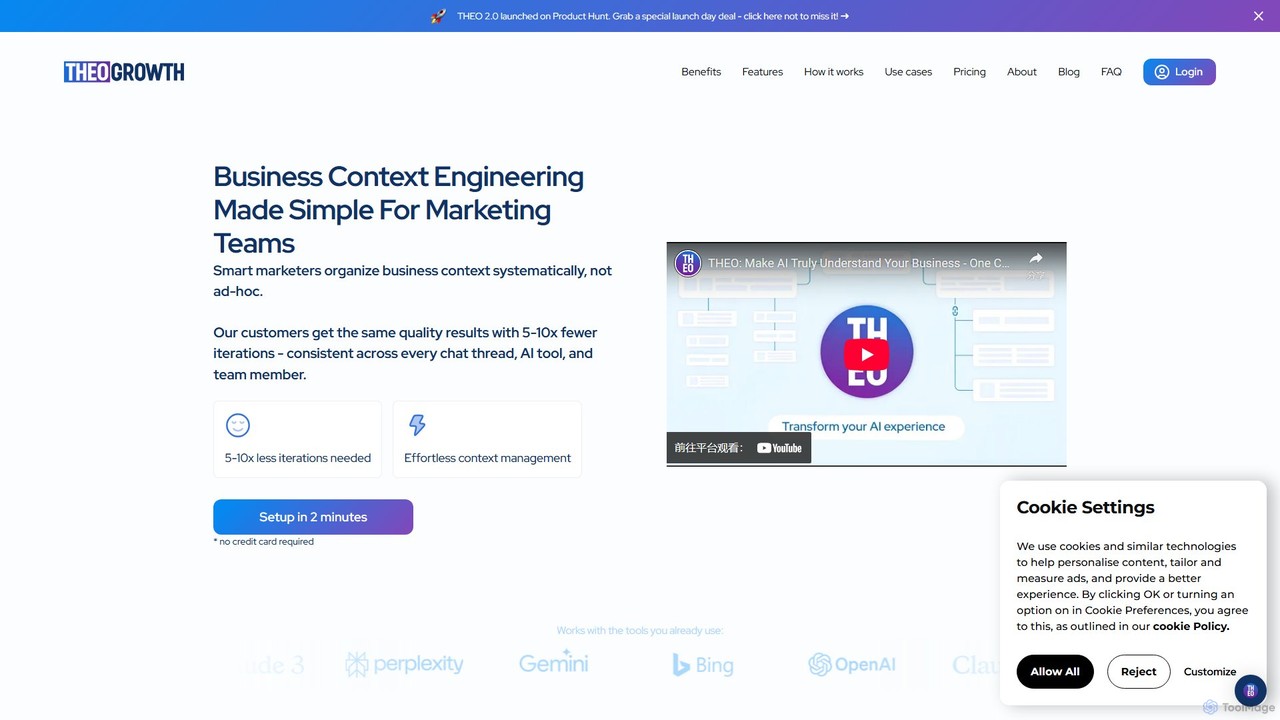
THEO is an AI marketing assistant that transforms your scattered business documents and website content into a structured 'Business DNA' file. This allows any AI tool like ChatGPT or Claude to deeply understand your brand, audience, and goals, delivering consistent, on-brand, and strategic outputs while saving you hours of repetitive work.

Context Management
Visits 12.5KFavorites 121Likes 119

About Context Management

Context Management tools are AI-powered solutions designed to maintain, understand, and utilize relevant information from ongoing interactions or external data sources. These tools enable AI systems, particularly large language models and conversational agents, to remember past exchanges, user preferences, and external knowledge. By effectively managing this contextual information, they ensure AI responses are coherent, highly relevant, and personalized across multi-turn conversations and complex tasks.

Core Features

  • Session Memory: Stores and recalls previous turns in a conversation to maintain continuity and relevance.
  • Knowledge Integration: Connects to external databases or documents to enrich AI responses with factual and domain-specific information.
  • User Profile Management: Remembers individual user preferences, history, and attributes for highly personalized interactions.
  • Dynamic Context Window: Intelligently manages the input context length, prioritizing relevance to optimize efficiency and accuracy.

Applicable Scenarios

These tools are vital for advanced customer service chatbots that need to recall past issues, virtual assistants managing ongoing tasks, and personalized recommendation engines. They also support complex content creation, ensuring narrative consistency and character development over long texts, and aid in multi-turn technical troubleshooting.

How to Choose

When selecting a Context Management tool, consider its memory depth and retention capabilities, integration options with existing systems (CRMs, knowledge bases), and the level of customization available for specific domain knowledge. Evaluate its scalability for handling concurrent sessions, its efficiency in managing token usage to control operational costs, and its security features for sensitive data.

Featured tool rankings

Context Management use cases

1

Personalized Customer Support

A customer service manager implements a Context Management AI for their chatbot. When a customer returns with a follow-up question about a previous issue, the AI automatically recalls the entire conversation history, their past purchases, and preferences. This allows the chatbot to provide immediate, relevant assistance without the customer needing to repeat information, significantly improving resolution times and customer satisfaction.

2

Multi-turn Technical Troubleshooting

A software developer uses an AI coding assistant powered by context management. While debugging a complex issue, the developer provides code snippets, error messages, and previous attempts. The AI maintains this context, understanding the problem's evolution and suggesting increasingly refined solutions or code corrections, acting as an intelligent pair programmer throughout the debugging session.

3

Consistent Content Generation

A content creator leverages context management tools for long-form writing, such as novel drafting or scriptwriting. The AI remembers character backstories, plot points, and established world-building details from previous sections. This ensures that new content generated by the AI remains consistent with the narrative, avoiding contradictions and maintaining the overall tone and style of the project.

4

Dynamic Learning & Tutoring Systems

An educational platform integrates context management into its AI tutor. As a student progresses through lessons, the AI tracks their learning pace, areas of difficulty, and preferred learning styles. When the student asks a new question, the AI uses this context to provide tailored explanations, suggest relevant exercises, or review previous concepts, creating a highly personalized and effective learning path.

5

Intelligent Meeting Summarization

A project manager uses an AI meeting assistant with context management capabilities. During a series of project meetings, the AI not only transcribes and summarizes each session but also links discussions to previous decisions, action items, and project goals. This allows the AI to generate comprehensive project updates that reflect the evolving context, highlighting dependencies and progress over time.

6

Personalized Product Recommendations

An e-commerce platform employs context management AI to enhance its recommendation engine. When a user browses products, adds items to their cart, or views past purchases, the AI stores this information. It then uses this rich context to offer highly personalized product suggestions, promotions, and bundles, increasing conversion rates and improving the overall shopping experience.

Context Management FAQ

What are AI Context Management tools?

AI Context Management tools are specialized software solutions that enable artificial intelligence systems to store, retrieve, and utilize relevant information from past interactions, user profiles, or external knowledge bases. Their primary function is to provide AI models with the necessary background information to generate coherent, accurate, and personalized responses in ongoing conversations or complex tasks.

Why is Context Management crucial for AI applications?

Context Management is crucial because it allows AI systems to move beyond single-turn interactions and engage in meaningful, multi-turn conversations or complex problem-solving. Without it, AI would lack memory, leading to repetitive questions, irrelevant responses, and a poor user experience. Effective context management ensures continuity, personalization, and higher accuracy in AI outputs.

What are the main functions of Context Management tools?

The main functions include maintaining session memory (recalling conversation history), integrating external knowledge (connecting to databases or documents), managing user profiles (remembering preferences and attributes), and dynamically adjusting the context window for optimal relevance. Some tools also offer contextual filtering and summarization to extract key information from large contexts, enhancing the AI's understanding.

How do Context Management tools differ from basic AI memory features?

Basic AI memory might simply recall the immediate previous turn or a fixed number of recent interactions. Context Management tools, however, offer a more sophisticated approach. They can intelligently filter and prioritize information, integrate diverse data sources (not just conversation history), and adapt context dynamically, allowing for deeper understanding and more complex reasoning over extended periods, crucial for advanced AI applications.

How do I choose the right Context Management tool for my AI project?

To choose the right tool, assess your project's specific needs for memory depth (how much history is needed), integration capabilities (what external systems need to connect), and customization options for domain-specific knowledge. Consider the tool's scalability, its efficiency in managing token usage to control costs, and its security features for handling sensitive contextual data, ensuring it aligns with your operational requirements.