ToolMage
Sign in

Best 1 Exam Preparation AI tools for Ai Tools

Popular Exam Preparation AI tools in Ai Tools include Lingali, helping you work more efficiently.

Lingali
Freemium

Lingali

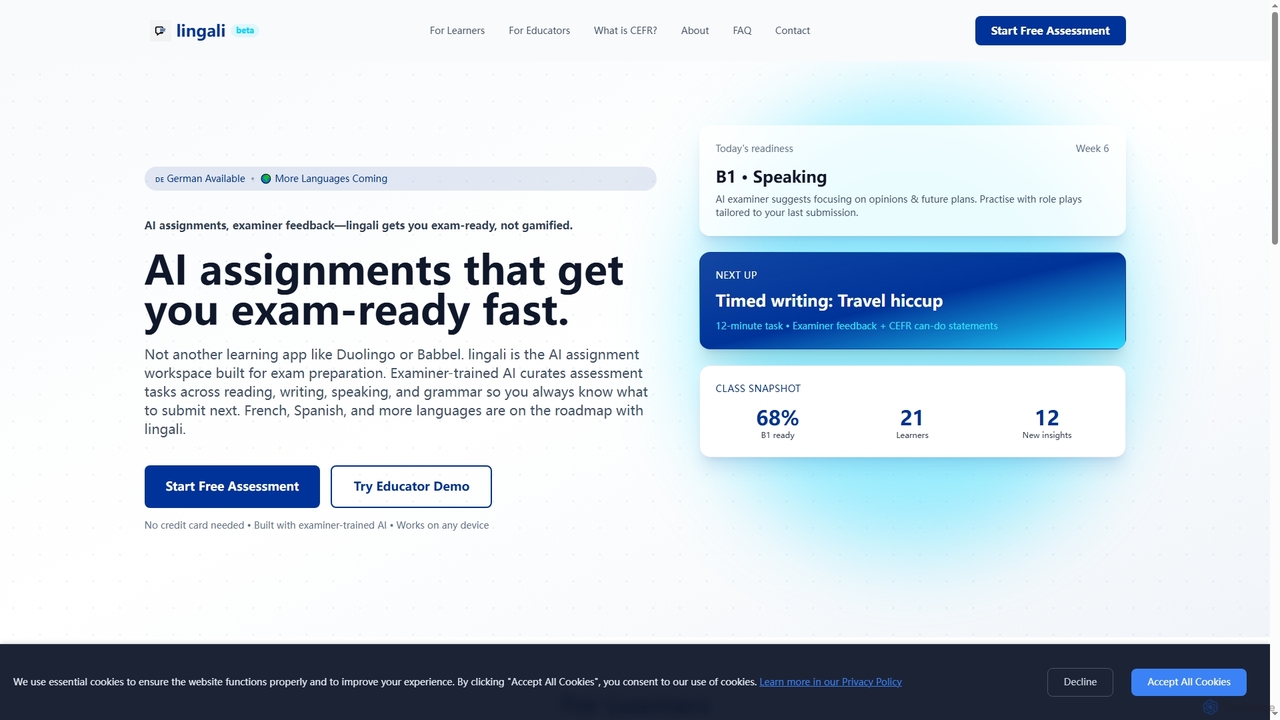
An AI-powered platform for CEFR language assessment, designed to prepare learners for German exams (A1-B2). It provides AI-driven assignments, examiner-trained feedback, and simulated tests for reading, writing, speaking, and grammar, focusing on exam readiness rather than gamified learning.

Exam Preparation
Visits 5.6KFavorites 151Likes 143

About Exam Preparation

AI Exam Preparation tools are specialized applications that use artificial intelligence to create personalized study experiences. They leverage adaptive learning algorithms and natural language processing to analyze study materials, generate practice questions, and simulate real exam conditions. These tools help learners identify knowledge gaps, optimize their study schedules, and build confidence by providing targeted feedback and performance analytics. They transform traditional study methods into a more efficient, data-driven, and personalized process.

Core Features

  • Adaptive Question Generation: Creates a limitless supply of practice questions that adjust in difficulty based on your performance, targeting weak areas.
  • Personalized Study Plans: Analyzes your learning pace and goals to generate a customized study schedule, optimizing time management.
  • Performance Analytics: Offers detailed dashboards tracking your progress, highlighting strengths and weaknesses by topic.
  • Exam Simulation: Mimics the format, timing, and pressure of the actual exam to reduce test anxiety and improve pacing.
  • Automated Content Summarization: Extracts key concepts from uploaded materials like textbooks or notes to create concise summaries and flashcards.

Applicable Scenarios

These tools are widely used by students preparing for standardized tests such as the SAT, GRE, or GMAT. Professionals seeking certifications in fields like IT (e.g., AWS, CompTIA), project management (PMP), or finance (CFA) also rely on them. Additionally, they are valuable for university students studying for final exams and for language learners preparing for proficiency tests like TOEFL or IELTS.

Selection Criteria

When choosing an AI Exam Preparation tool, consider the breadth and depth of its subject coverage for your specific exam. Evaluate the sophistication of its adaptive learning engine and the clarity of its performance analytics. Check for features like the ability to upload your own study materials and the quality of the exam simulations. Finally, assess the pricing model to ensure it aligns with your budget and study timeline.

Exam Preparation use cases

1

Preparation for Standardized University Entrance Exams

A high school student preparing for the SAT uses an AI tool to improve their score. After an initial diagnostic test, the AI creates a personalized study plan focusing on their weaker areas, such as algebra and reading comprehension. The platform generates adaptive practice questions that become more challenging as the student improves. They can also take full-length, timed mock exams that simulate the real test environment, helping them manage time effectively and reduce anxiety. The detailed analytics dashboard shows their progress over time, allowing them to focus their final weeks of study with precision.

2

Studying for a Professional IT Certification

An IT professional aiming for an AWS Certified Solutions Architect certification uploads official study guides and personal notes into an AI exam prep tool. The AI processes the documents, automatically generating flashcards for key services and concepts. It creates practice quizzes focused on specific domains like 'Design for High Availability' or 'Design for Cost Optimization'. The tool's exam simulator provides practice tests with scenario-based questions similar to the actual exam, helping the professional apply theoretical knowledge to practical problems and identify any remaining knowledge gaps before scheduling the official test.

3

Reviewing for University Final Exams

A university student facing multiple final exams uses an AI tool to streamline their revision process. They upload lecture slides, notes, and PDF textbook chapters for their biology course. The AI tool summarizes lengthy chapters into key bullet points and generates multiple-choice and short-answer questions for self-assessment. The student can create custom quizzes focusing on topics they find difficult, like cellular respiration. This targeted practice helps them efficiently review a large volume of material and reinforce their understanding of complex subjects, saving significant time compared to manual review methods.

4

Preparing for a Language Proficiency Test

A candidate preparing for the IELTS exam uses a specialized AI platform to practice all four skills. For writing, they submit essays and receive instant feedback on grammar, vocabulary, and structure, along with a predicted band score. For speaking, they practice with an AI tutor that asks common exam questions and provides feedback on pronunciation and fluency. The platform also offers adaptive reading and listening exercises that adjust to their skill level. This comprehensive, feedback-driven approach allows the candidate to systematically improve each aspect of their language ability required for the test.

5

Mastering Medical Board Examinations

A medical resident preparing for their board exams uses a highly specialized AI platform with a vast, peer-reviewed question bank. The tool's adaptive algorithm presents questions that target the resident's specific areas of weakness, identified through ongoing assessments. It simulates the computer-based testing format of the actual boards, including case-based questions and timed sections. For each question, the platform provides detailed explanations for both correct and incorrect answers, referencing clinical guidelines and medical literature. This rigorous, evidence-based approach helps the resident build deep clinical reasoning skills, not just memorize facts.

6

Creating Corporate Compliance Training Assessments

A compliance officer at a financial firm needs to create an annual anti-money laundering (AML) exam for all employees. Instead of manually writing questions, they upload the company's latest AML policy documents and relevant regulations into an AI tool. The AI analyzes the text and generates a diverse pool of multiple-choice and scenario-based questions that accurately test employees' understanding of the material. The officer can then assemble these questions into a standardized test, track completion rates, and analyze results to identify departments that may need further training, ensuring regulatory compliance across the organization.

Exam Preparation FAQ

What are AI Exam Preparation tools?

AI Exam Preparation tools are software applications that use artificial intelligence to help users study for tests more effectively. Unlike static question banks, they create a dynamic and personalized learning environment. Key features include:

  • Adaptive Learning: The difficulty of questions adjusts based on the user's performance.
  • Personalized Study Plans: They generate schedules based on a user's goals and diagnostic results.
  • Performance Analytics: They provide detailed insights into strengths and weaknesses.
  • Content Generation: Many can create quizzes, summaries, and flashcards from user-uploaded materials.
These tools are designed to optimize study time by focusing efforts on areas that need the most improvement.

How to choose the right AI Exam Preparation tool?

Choosing the right tool depends on your specific needs. Consider the following factors:

  • Exam Specificity: Does the tool specialize in your specific test (e.g., SAT, PMP, USMLE)? Specialized tools often have more relevant content and question styles.
  • Content Sources: Can you upload your own materials (PDFs, notes), or are you limited to the platform's content? Flexibility is a key advantage.
  • Quality of AI: Look for tools with a proven adaptive learning algorithm. User reviews can provide insight into how well it identifies and targets weak spots.
  • Analytics and Feedback: A good tool should offer more than just a score. It should provide detailed analytics on why answers are right or wrong and track progress by topic.
  • User Interface and Experience: The platform should be intuitive and easy to navigate to ensure you spend your time learning, not figuring out the software.

What's the difference between AI Exam Prep tools and traditional flashcard apps?

The primary difference lies in personalization and intelligence. Traditional flashcard apps, like Anki or Quizlet, are excellent for memorization using spaced repetition but are generally passive; the user must create the content and the learning path is fixed. AI Exam Preparation tools are active learning partners.

  • Content Creation: AI tools can automatically generate questions and summaries from source materials, saving significant time.
  • Adaptive Learning: They dynamically adjust the difficulty and focus of the material based on your real-time performance, which traditional apps cannot do.
  • Deep Analytics: AI tools provide sophisticated analysis of your knowledge gaps, going beyond simple right/wrong counts to show you precisely where to focus.
In essence, while flashcard apps help you review what you've told them to, AI tools help you discover and fix what you don't know you don't know.

Can these tools guarantee a passing score on an exam?

No tool can guarantee a specific outcome on an exam. Success ultimately depends on the individual's effort, understanding of the material, and performance on test day. However, AI Exam Preparation tools are designed to significantly increase the probability of success. They do this by making study time more efficient and effective. By identifying and focusing on your specific weaknesses, providing unlimited practice, and simulating the exam experience, they help you prepare more thoroughly and build confidence. Think of them as an expert tutor that optimizes your study process, rather than a magic solution that ensures a pass.

Who can benefit most from AI Exam Preparation tools?

While almost any learner can benefit, certain groups find these tools particularly valuable:

  • Self-Directed Learners: Individuals studying independently for certifications (like PMP, AWS) or standardized tests (GRE, GMAT) who lack the structure of a formal class.
  • Time-Constrained Professionals: People balancing a full-time job with exam preparation who need to maximize the efficiency of every study session.
  • Students with Large Syllabi: University or medical students who need to master a vast amount of information and require help identifying and focusing on high-yield topics and personal weak spots.
  • Educators and Trainers: Instructors who want to create customized, data-driven assessments for their students without spending hours writing questions manually.
Essentially, anyone who wants to move from passive review to active, targeted, and data-informed studying will find these tools highly beneficial.