
How Old Do I Look
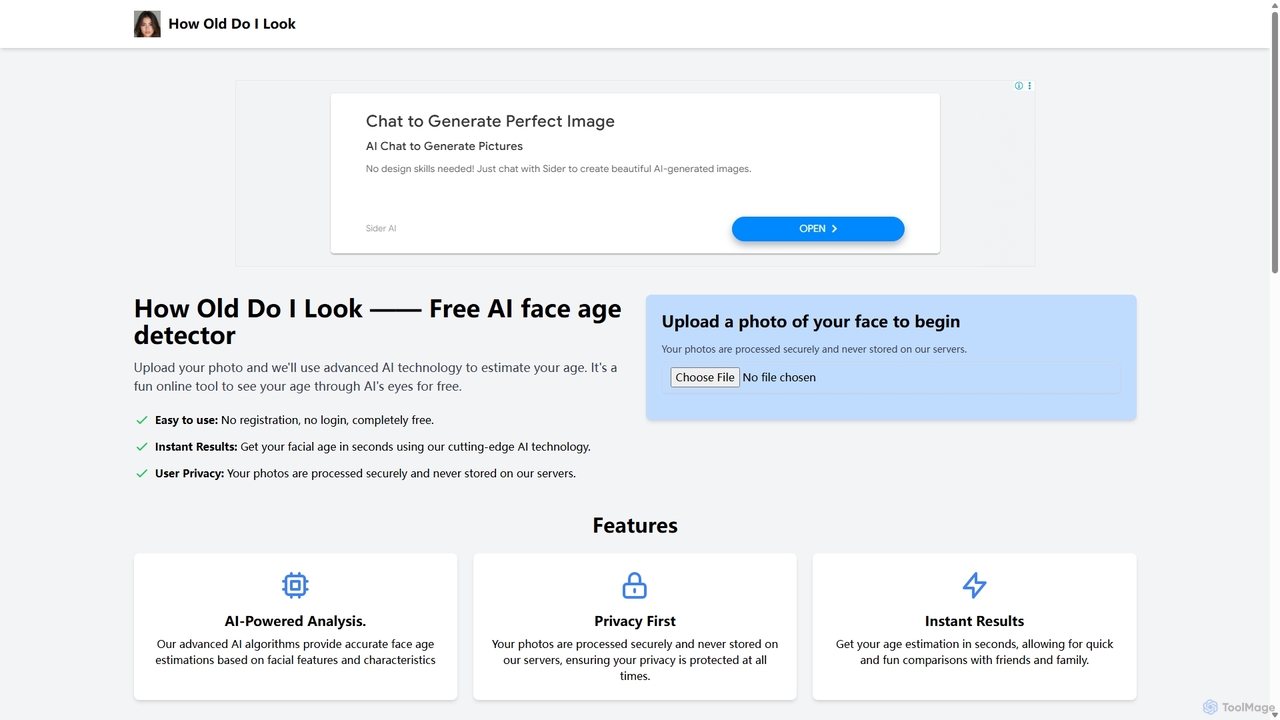
How Old Do I Look is a free online AI tool that estimates your age from a photo. …
How Old Do I Look is a free online AI tool that estimates your age from a photo. Simply upload an image, and its advanced facial recognition technology will analyze your features and provide an instant age guess. It's a fun, easy-to-use, and privacy-conscious tool with no registration or login required, ensuring your photos are never stored.
About Face Recognition
Face Recognition tools are a specialized category of AI software that identifies or verifies individuals by analyzing their facial features. These tools utilize computer vision and deep learning algorithms to map facial characteristics from an image or video and compare them against a database of known faces. They are widely used for security access control, identity verification, photo organization, and creating personalized user experiences. Modern systems can achieve high accuracy even with variations in lighting, expression, and age, making them a robust biometric solution.
Core Features
- Face Detection: Locating and isolating human faces within a larger image or video frame.
- Feature Extraction: Converting the facial image into a unique numerical representation, known as a faceprint.
- 1:1 Verification: Comparing a live face to a single stored template to confirm a claimed identity.
- 1:N Identification: Searching a database of faces to find a potential match for a given face.
- Liveness Detection: Distinguishing between a live person and a static image or video to prevent spoofing attacks.
Use Cases
Face Recognition technology is applied across various sectors. In corporate security, it manages building access and tracks employee attendance. Financial institutions use it for remote customer onboarding (KYC) and transaction authentication to prevent fraud. In retail, it can offer personalized experiences to loyalty members. Law enforcement also utilizes it for public safety and investigative purposes.
How to Choose
When selecting a Face Recognition tool, consider its accuracy rates, including False Acceptance Rate (FAR) and False Rejection Rate (FRR). Evaluate its performance speed and scalability to handle your database size. Ensure it provides a robust API for easy integration with your existing systems. Finally, prioritize solutions that comply with data privacy regulations like GDPR and offer strong data encryption and security measures.
Face RecognitionUse Cases
Secure Access Control for Facilities
A security manager at a corporate office uses a face recognition system to replace traditional key cards. When an employee approaches an entrance, a camera captures their face. The system instantly compares it against the authorized employee database. If a match is found, access is granted. This process enhances security by preventing unauthorized entry from lost or stolen cards and provides a seamless, touchless entry experience. It also creates a reliable digital log of all entries for auditing purposes.
Automating Customer Identity Verification (KYC)
A fintech company needs to quickly and securely onboard new users. During registration, the user is prompted to take a selfie and a photo of their government-issued ID. The face recognition tool verifies that the face in the selfie matches the ID photo and performs a liveness check to ensure the user is physically present. This automates the Know Your Customer (KYC) process, significantly reducing manual review time, preventing identity fraud, and allowing customers to access services within minutes instead of days.
Automated Photo Tagging and Organization
A professional photographer manages a library of thousands of event photos. Instead of manually tagging each person, they use a face recognition tool. The software scans the entire collection, detects all faces, and groups photos of the same individual together. The photographer only needs to assign a name to each group once. Subsequently, they can instantly find all photos of a specific client or guest by simply searching for their name, saving dozens of hours of tedious organizational work and improving client service.
Personalized In-Store Retail Experience
A high-end retail store uses face recognition to enhance the experience for its loyalty program members (with their explicit consent). When a registered VIP customer enters, the system identifies them and discreetly alerts a sales associate via a tablet. The associate can then greet the customer by name and access their purchase history and preferences to offer personalized recommendations. This creates a highly tailored and exclusive shopping experience, fostering customer loyalty and increasing sales.
Streamlining Employee Time and Attendance
An HR manager in a manufacturing plant implements a face recognition-based time clock to eliminate manual timesheets and prevent 'buddy punching'. Employees simply look at a device when they start and end their shifts. The system accurately records their clock-in and clock-out times, automatically calculating work hours. This ensures payroll accuracy, reduces administrative overhead for the HR department, and provides a more hygienic, touchless solution compared to traditional fingerprint scanners or punch cards.
Enhancing Public Safety in Smart Cities
A city's public safety department integrates face recognition with its network of CCTV cameras in public areas like airports and train stations. The system operates in real-time to scan crowds and compare faces against a secure watchlist of missing persons or individuals of interest. If a potential match is detected, an alert is sent to law enforcement officers for verification. This application helps authorities respond faster to potential threats, locate missing children or vulnerable adults, and conduct investigations more efficiently, contributing to overall urban safety.