Tile
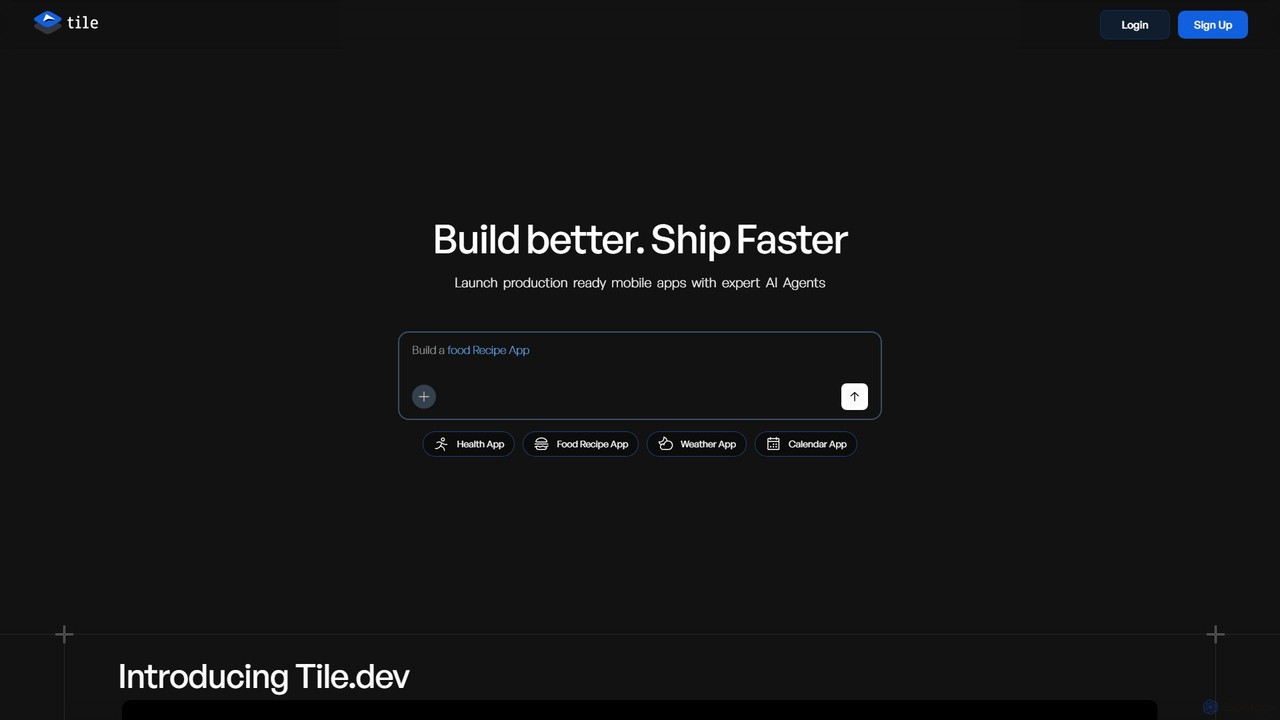
Tile is an AI-powered mobile app builder that transforms your ideas into production-ready iOS and Android applications. Describe …
Tile is an AI-powered mobile app builder that transforms your ideas into production-ready iOS and Android applications. Describe your app concept using text or visuals, and specialized AI agents will build it. You can then refine the app with a powerful no-code visual editor and publish it directly to the App Store and Play Store. It's designed for founders, developers, and creators to ship apps faster.
About Generative
Generative AI tools are a class of artificial intelligence applications designed to create new, original content across various modalities. Leveraging advanced deep learning models like Transformers and Diffusion Models, these tools learn complex patterns from vast datasets to produce text, images, audio, video, and even code from simple prompts. They empower creators, marketers, and developers to rapidly prototype ideas, automate content production, and explore novel creative avenues, significantly accelerating workflows and expanding creative possibilities.
Core Features
- Text Generation: Automatically produces articles, summaries, marketing copy, scripts, and creative writing based on given prompts or topics.
- Image Synthesis: Creates unique images, illustrations, concept art, and photorealistic visuals from textual descriptions or reference images.
- Video & Audio Generation: Generates short video clips, animations, background music, sound effects, or synthetic voices from text or other inputs.
- Code Generation: Assists developers by generating code snippets, functions, unit tests, or even entire scripts in various programming languages.
- 3D Model Creation: Synthesizes 3D assets, textures, and environments for gaming, virtual reality, or product design from textual descriptions or 2D inputs.
Applicable Scenarios
Generative AI tools are invaluable for content creators needing to scale production, marketers seeking unique campaign assets, and developers aiming to accelerate coding. They are widely adopted in media for scriptwriting, in design for concept art, and in software engineering for automated code generation, transforming how digital content is conceived and produced.
How to Choose
When selecting a Generative AI tool, consider the specific content modality you need (text, image, video), the quality and style of the output, and the level of control and customization offered. Evaluate its integration capabilities with your existing workflows, the cost-effectiveness of its usage, and the ethical guidelines or bias mitigation strategies implemented by the provider.

GenerativeUse Cases
Generating Marketing Copy for Product Launches
Marketing teams can leverage generative AI to quickly produce diverse ad copy, social media posts, and email newsletters for new product launches. By inputting product features and target audience, the AI generates multiple creative variations, allowing marketers to test different messages and optimize campaigns without extensive manual writing, saving significant time and resources.
Designing Unique Concept Art for Game Development
Game artists and designers use generative AI to rapidly explore visual concepts for characters, environments, and props. By providing textual descriptions or rough sketches, the AI can synthesize numerous unique art styles and compositions, accelerating the ideation phase and providing a rich pool of visual inspiration for further development, streamlining the creative pipeline.
Automating Code Snippet Generation for Developers
Software developers can utilize generative AI to automate the creation of boilerplate code, functions, or unit tests. By describing the desired functionality in natural language, the AI suggests and generates relevant code snippets, reducing repetitive coding tasks and allowing developers to focus on more complex problem-solving and architectural design, thereby boosting productivity.
Creating Personalized Educational Content
Educators and content creators can employ generative AI to produce customized learning materials, quizzes, and summaries tailored to individual student needs or specific topics. This enables the rapid generation of diverse educational resources, making learning more engaging and accessible, and significantly reducing the manual effort involved in content preparation.
Synthesizing Background Music for Video Production
Video editors and content creators can use generative AI to compose original background music or sound effects that perfectly match the mood and pace of their video projects. By specifying genre, tempo, and emotional tone, the AI generates unique audio tracks, eliminating the need for royalty-free libraries or expensive custom compositions, and enhancing the overall production quality.
Drafting Initial Blog Posts and Articles
Content writers and bloggers can use generative AI to overcome writer's block and quickly draft initial versions of blog posts, articles, or reports. By providing a topic, keywords, and desired tone, the AI generates a structured outline and preliminary text, serving as a strong foundation for human editors to refine and personalize, significantly speeding up content creation cycles.