storypath
Storypath is an AI-powered brainstorming assistant designed for writers to plan their stories and overcome writer's block. By …
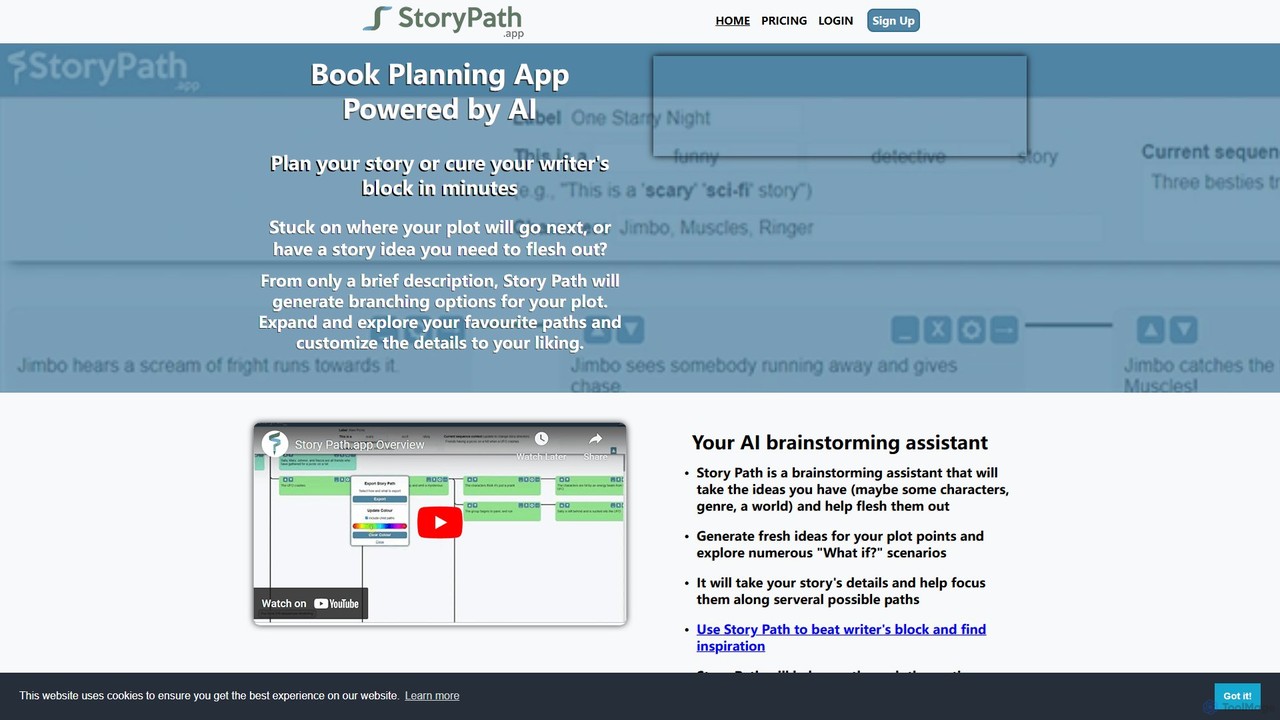
Storypath is an AI-powered brainstorming assistant designed for writers to plan their stories and overcome writer's block. By providing a brief description, genre, and character details, the tool generates branching plot options, allowing users to explore numerous "what if" scenarios. It helps flesh out ideas, outline entire stories or specific scenes, and organize plot points with color-coded paths. Users can customize suggestions, export their work, and find inspiration to keep their narrative moving forward.
About Idea Generation
AI Idea Generation tools are a specialized category of AI designed to spark creativity and overcome mental blocks. They use large language models and semantic analysis to process a simple prompt, such as a keyword or a problem statement, and generate a wide array of related concepts, topics, questions, and unique angles. This process helps users explore possibilities beyond their initial thinking, providing structured inspiration for various creative and strategic tasks. These tools are particularly valuable in the initial stages of a project, transforming a vague notion into a set of concrete, actionable ideas.
Core Features
- Topic Expansion: Takes a core keyword and generates a network of subtopics, related questions, and content clusters.
- Angle & Perspective Generation: Suggests different viewpoints to approach a subject, such as a contrarian argument, a historical analysis, or a beginner's guide.
- Conceptual Brainstorming: Generates novel product ideas, business names, marketing slogans, or solutions to a defined problem.
- Creative Analogy & Metaphor Suggestion: Finds unique comparisons to explain complex concepts in a more relatable way.
- Structured Outlining: Organizes generated ideas into logical structures like mind maps or outlines for further development.
Use Cases
These tools are widely used by content creators, marketers, entrepreneurs, and researchers. For instance, a marketing team can use them to brainstorm a quarter's worth of blog topics from a single product feature. An entrepreneur can input a market gap to generate potential startup ideas and value propositions. Writers and scriptwriters also use them to find new plot twists or character development paths.
How to Choose
When selecting an AI Idea Generation tool, consider the specificity of its output; some are better for content topics, while others excel at business ideas. Evaluate the tool's ability to generate diverse and non-obvious suggestions, avoiding generic results. Also, consider its integration capabilities with other writing or project management tools and whether its pricing model aligns with your usage frequency, such as pay-per-use versus a monthly subscription.

Idea GenerationUse Cases
Brainstorming a Content Marketing Calendar
A content marketer for a B2B SaaS company needs to plan blog posts for the next quarter. Their core topic is 'cybersecurity for small businesses'. Instead of starting from a blank page, they use an AI Idea Generation tool. They input the core topic and receive dozens of structured ideas, including long-tail keywords, common user questions, and unique angles. The output includes titles like 'Top 5 Ransomware Myths Debunked for SMBs', 'A Non-Technical Founder's Guide to Data Encryption', and 'Comparing the Top 3 Cloud Security Providers'. This process reduces brainstorming time from days to hours and provides a data-informed list of topics that directly address audience pain points.
Generating Novel Startup Ideas
An aspiring entrepreneur is passionate about sustainable technology but isn't sure what specific problem to solve. They use an AI Idea Generation tool, inputting prompts like 'circular economy for electronics' and 'reducing plastic waste with tech'. The AI generates a variety of business concepts, such as a platform for trading refurbished device components, an AI-powered scanner that identifies recyclable materials for consumers, or a subscription service for biodegradable packaging. For each idea, it might also suggest a potential target audience, a unique value proposition, and possible revenue models, providing a solid foundation for further market research.
Overcoming Writer's Block for a Novel
A fiction writer is halfway through their novel but is stuck on a major plot point. The protagonist needs to uncover a conspiracy, but the author can't devise a believable or surprising way for it to happen. They turn to an AI Idea Generation tool, inputting the current plot summary and the specific problem: 'How does the detective discover the corporation is a front?'. The tool generates multiple scenarios: an anonymous tip from a disgruntled employee, accidentally finding a hidden ledger during an unrelated investigation, or noticing a pattern in financial data that an AI analyst points out. These prompts help the author break through their creative block by presenting fresh, unexpected pathways for the story.
Developing a University Research Thesis
A graduate student is beginning their thesis in sociology and has a broad interest in 'the impact of social media on political polarization'. This topic is too vast for a thesis. Using an AI Idea Generation tool, they input this phrase to narrow it down. The tool suggests more focused research questions and sub-topics, such as: 'Analyzing the role of recommendation algorithms in creating echo chambers on Twitter', 'A comparative study of political discourse on Facebook vs. Reddit', or 'The effect of misinformation spread via WhatsApp on local elections'. This helps the student identify a viable, specific, and researchable thesis topic, saving weeks of preliminary literature review and exploration.
Crafting Marketing Angles and Slogans
A marketing team is launching a new brand of organic coffee. They need fresh angles beyond the usual 'rich flavor' and 'sustainably sourced'. They use an AI Idea Generation tool and input keywords like 'morning ritual', 'productivity boost', and 'farmer co-op'. The tool generates campaign concepts and slogans. Ideas might include a campaign focused on 'The 15-Minute Focus Ritual' using their coffee, or slogans like 'Your Ethical Energy Boost' and 'Taste the Story in Every Bean'. This provides the team with a diverse set of creative directions, allowing them to A/B test different messages and find what resonates most with their target audience.
Designing a Workshop or Training Session
A corporate trainer is tasked with creating a new workshop on 'Effective Leadership in a Hybrid Workplace'. To ensure the content is engaging and comprehensive, they use an AI Idea Generation tool. They input the workshop title and get suggestions for modules, interactive activities, and case studies. The AI might suggest a module on 'Digital Body Language', an activity like 'Role-playing a difficult conversation over video call', or a case study about a company that successfully transitioned to a hybrid model. This helps the trainer structure the workshop logically and incorporate creative elements that go beyond standard leadership theories, making the session more impactful for attendees.