ToolMage
Sign in

Best 1 Multi Model Platform for Ai Tools

Popular Multi Model Platform in Ai Tools include Flowhive, helping you work more efficiently.

Flowhive
Freemium

Flowhive

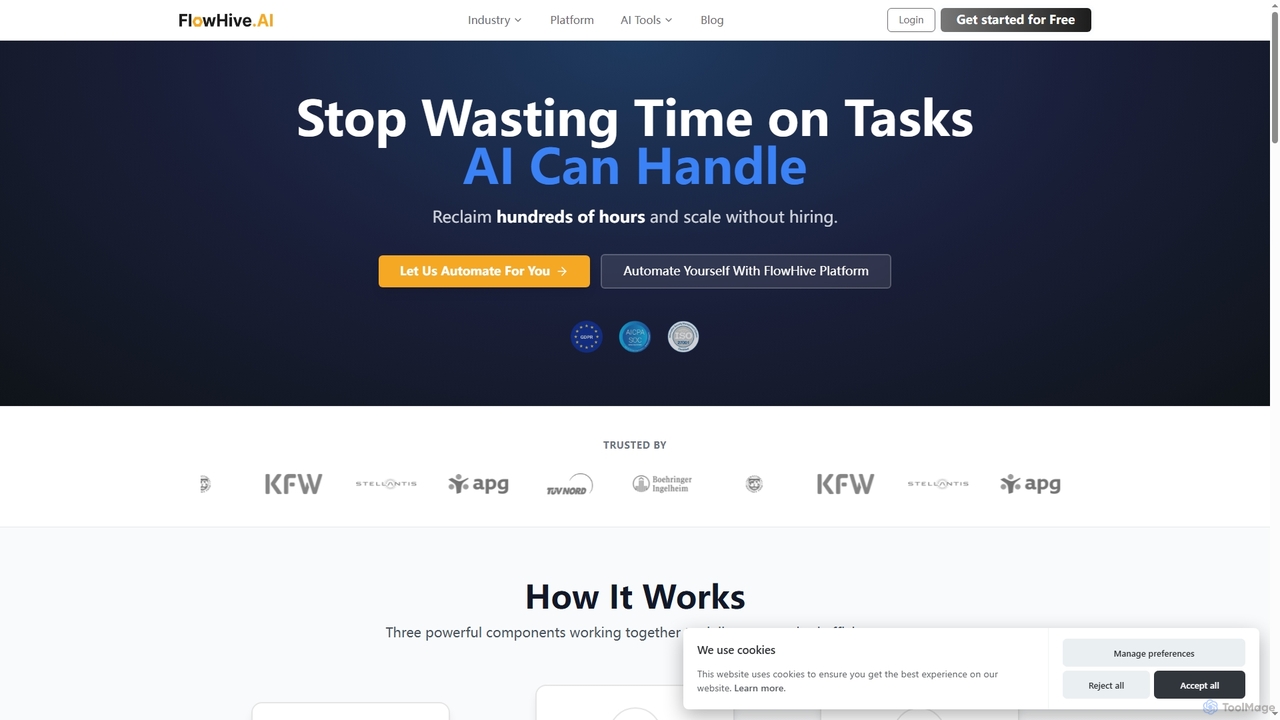
Flowhive is an AI workflow automation platform that integrates multiple AI models like GPT and Gemini, your company's knowledge bases, and existing tools. It allows you to build your own automated workflows or have their expert team build them for you, aiming to increase efficiency by 50% and reduce manual work.

Multi Model Platform
Visits 9.4KFavorites 141Likes 150

About Multi Model Platform

Multi Model Platforms are AI-powered tools that integrate and orchestrate various specialized AI models, such as text, image, audio, and video, within a single unified environment. These platforms leverage advanced APIs and orchestration layers to combine the strengths of diverse AI capabilities. They enable the creation of complex AI workflows, cross-modal content generation, and comprehensive data analysis, significantly streamlining development and fostering innovation by reducing integration complexity.

Core Features

  • Unified API & Interface: Provides a single access point for interacting with multiple underlying AI models.
  • Cross-modal Integration: Seamlessly combines outputs and inputs from different modalities (e.g., text-to-image, audio-to-text).
  • Workflow Orchestration: Allows users to design and automate complex AI pipelines involving sequential or parallel model execution.
  • Model Management: Offers tools for deploying, monitoring, and updating various AI models from a central dashboard.
  • Scalability & Performance: Designed to handle high volumes of requests and process diverse data types efficiently.

Applicable Scenarios

Multi Model Platforms are ideal for content creators needing to generate diverse media from a single prompt, data scientists combining structured and unstructured data for deeper insights, and businesses building intelligent automation solutions like advanced customer service agents that handle voice, text, and visual queries.

How to Choose

When selecting a Multi Model Platform, consider the range of supported modalities and specific AI models, the flexibility of its API and SDKs for integration, the depth of its workflow customization and orchestration features, and its scalability and cost-effectiveness for your operational needs. Also, evaluate its security protocols and data privacy policies.

Multi Model Platform use cases

1

Automated Multi-Content Generation for Marketing

A marketing team needs to create diverse content for a new product launch across various channels. Using a Multi Model Platform, they input a single product description. The platform then automatically generates marketing copy, social media posts, product images, short promotional videos, and even audio voiceovers, all tailored to different platforms and audiences, significantly reducing manual effort and accelerating content deployment.

2

Intelligent Customer Service Agent Deployment

A large e-commerce company aims to enhance its customer support by deploying an intelligent agent capable of handling diverse customer queries. A Multi Model Platform allows them to integrate a natural language processing (NLP) model for text chat, a speech-to-text model for voice calls, and an image recognition model for product-related inquiries. This enables the agent to understand customer intent across modalities, provide accurate responses, and even guide users visually, leading to faster resolution times and improved customer satisfaction.

3

Complex Data Analysis and Insights Generation

A financial analyst needs to derive comprehensive insights from market data, news articles, and analyst call transcripts. A Multi Model Platform can ingest structured numerical data, process unstructured text for sentiment analysis and entity extraction, and even analyze audio from earnings calls for tone and emphasis. By combining these different data types and analyses, the platform provides a holistic view of market trends and company performance, enabling more informed investment decisions.

4

Interactive Educational Content Creation

An e-learning platform wants to create engaging and personalized educational modules. Using a Multi Model Platform, educators can input lesson plans as text. The platform then generates interactive quizzes, creates explanatory diagrams and images, synthesizes audio lectures, and even produces short animated video clips to illustrate complex concepts. This approach caters to diverse learning styles and significantly speeds up the production of rich, multimedia educational content.

5

Product Design and Prototyping Acceleration

Product designers and engineers can leverage Multi Model Platforms to accelerate their design and prototyping phases. By inputting textual descriptions or rough sketches, the platform can generate 3D models, render photorealistic images, simulate material properties, and even create audio feedback for user interfaces. This allows for rapid iteration, visual exploration of design variations, and early identification of potential issues, significantly shortening the product development lifecycle.

6

Personalized Recommendation Systems Enhancement

E-commerce and media platforms aim to provide highly personalized recommendations to users. A Multi Model Platform can analyze user behavior data (clicks, purchases), text reviews for sentiment, visual data from previously viewed items, and even audio preferences (for music/podcast platforms). By combining these diverse signals, the platform builds a more nuanced user profile, leading to more accurate and engaging recommendations that significantly boost user engagement and conversion rates.

Multi Model Platform FAQ

What are Multi Model Platforms?

Multi Model Platforms are AI tools that integrate and orchestrate various specialized AI models (e.g., text, image, audio) within a single environment. They typically feature a unified API, cross-modal integration capabilities, and workflow orchestration tools. Their core purpose is to enable complex AI applications that require combining different types of AI processing, such as generating video from text and audio, or analyzing sentiment from both text and voice input.

How to choose the right Multi Model Platform?

To choose the right Multi Model Platform, evaluate the range of AI models and modalities it supports, ensuring they align with your project needs. Consider its integration capabilities, such as robust APIs and SDKs, for seamless connection with existing systems. Assess the flexibility of its workflow orchestration features for building custom AI pipelines. Finally, compare scalability, pricing models, security measures, and data privacy policies to ensure it meets your operational and compliance requirements.

What are the key benefits of using a Multi Model Platform?

Multi Model Platforms offer several key benefits. They simplify the development of complex AI applications by providing a unified interface for diverse models, reducing integration overhead. They enable richer, more dynamic content creation and data analysis by combining insights from multiple modalities. Furthermore, these platforms foster innovation by allowing users to experiment with novel combinations of AI capabilities, leading to more sophisticated and versatile solutions that single-model tools cannot achieve.

How do Multi Model Platforms differ from single-model AI tools?

Single-model AI tools specialize in one specific task or data type, like an image generator or a text summarizer. Multi Model Platforms, however, integrate multiple such specialized models, allowing them to process and generate content across different modalities simultaneously or in sequence. This enables more complex, holistic applications that leverage the combined intelligence of various AI capabilities, offering a broader scope for innovation and problem-solving than individual tools.

What are the common challenges when implementing Multi Model Platforms?

Implementing Multi Model Platforms can present several challenges. Data compatibility and synchronization across different modalities can be complex, requiring robust data pipelines. Orchestrating multiple models efficiently to avoid latency and ensure coherent outputs demands sophisticated workflow management. Additionally, managing the computational resources for diverse AI models and ensuring their interoperability, especially when models come from different vendors or frameworks, can be technically demanding and require specialized expertise.