ToolMage
Sign in

Best 1 Platform for Ai Tools

Popular Platform in Ai Tools include AgentsValley, helping you work more efficiently.

AgentsValley

AgentsValley

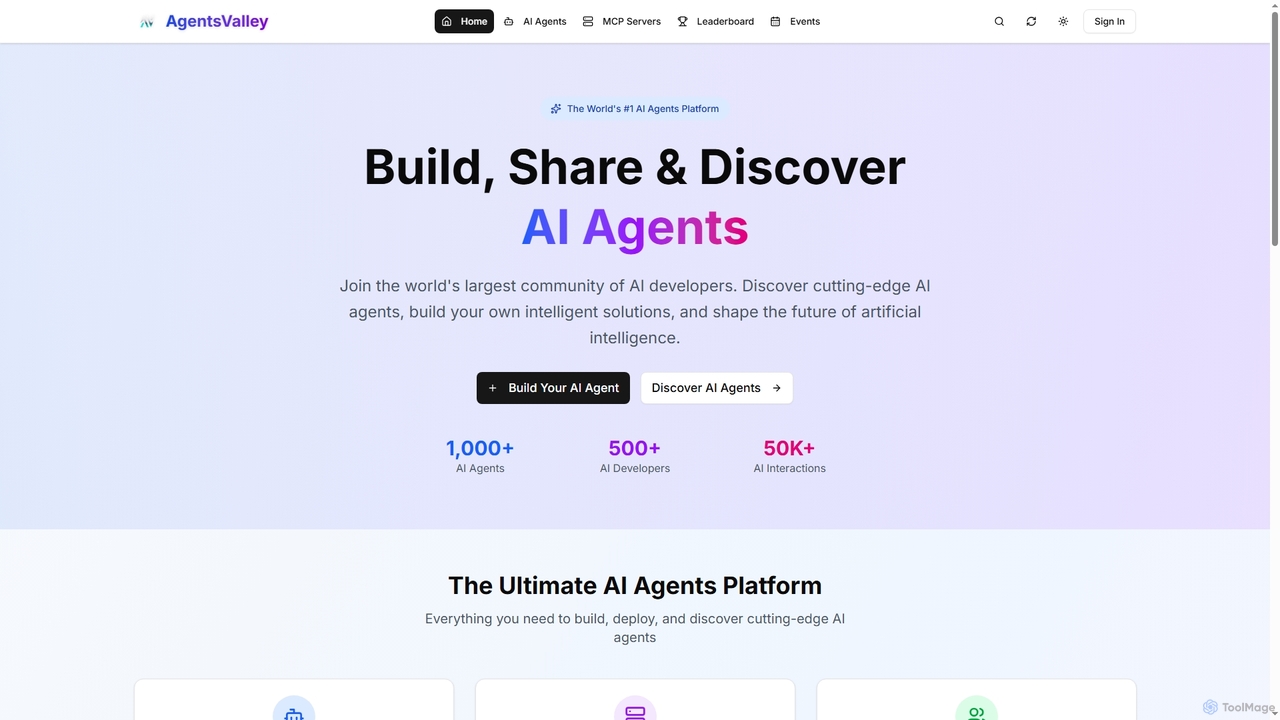
A comprehensive platform for AI developers to build, share, discover, and deploy intelligent AI agents. It fosters a global community, providing the infrastructure and tools needed to scale from prototype to production.

Platform
Visits 7.3KFavorites 130Likes 146

About Platform

AI Platforms are integrated environments providing a comprehensive suite of tools to build, deploy, and manage artificial intelligence applications. They typically bundle infrastructure, data management capabilities, pre-trained models, and APIs into a single cohesive system. This allows developers and data science teams to streamline the entire AI lifecycle, from experimentation to production. Unlike standalone AI tools that perform a specific task, AI platforms offer a scalable and centralized foundation for creating complex, enterprise-grade solutions.

Core Features

  • Integrated Toolsets: Combines various AI capabilities like machine learning, NLP, and computer vision in one place.
  • Model Lifecycle Management (MLOps): Provides tools for training, versioning, deploying, and monitoring AI models.
  • API & SDK Access: Enables developers to integrate platform capabilities into their own applications and workflows.
  • Data Management: Includes features for data ingestion, preparation, labeling, and storage to support model training.
  • Scalable Infrastructure: Offers access to the necessary cloud computing power for demanding AI workloads.

Use Cases

AI Platforms are widely used by enterprises to develop custom AI solutions, such as fraud detection systems or personalized recommendation engines. Startups and software companies leverage them to embed AI features into their products, while research teams use them to accelerate experimentation and model development. They are essential for any organization looking to operationalize machine learning at scale.

How to Choose

When selecting an AI Platform, consider the scope of its services—does it cover the full end-to-end lifecycle? Evaluate its integration capabilities with your existing tech stack and the quality of its APIs. Assess the balance between ease of use (low-code options) and flexibility for advanced customization. Finally, analyze the pricing model based on your expected usage of compute resources, data storage, and API calls.

Platform use cases

1

Developing Custom Enterprise AI Solutions

An enterprise data science team is tasked with building a custom fraud detection system for their financial services. Instead of assembling disparate tools, they use an AI Platform. They leverage the platform's data management features to ingest and process millions of transaction records. Using the integrated development environment, they train and compare several machine learning models, selecting the best performer. Finally, they deploy the model as a secure API endpoint via the platform's MLOps capabilities, allowing it to be integrated directly into their core banking application, reducing manual review by 70%.

2

Building AI-Powered SaaS Products

A startup is creating a new SaaS product for marketing automation that includes an AI-powered feature for generating social media copy. The development team uses an AI Platform's NLP API. This saves them from having to build and train their own language models from scratch, a process that would take months and require specialized expertise. They integrate the API into their application, allowing users to input a product description and receive multiple AI-generated ad copy variations. This use of a platform accelerates their time-to-market and allows them to focus on their core product features rather than underlying AI infrastructure.

3

Automating Business Processes with Low-Code AI

An operations manager in a logistics company needs to automate the process of extracting data from thousands of shipping invoices daily. Lacking a dedicated development team, they turn to a low-code AI Platform. Using a visual, drag-and-drop interface, the manager builds a workflow that automatically ingests invoice PDFs from an email inbox, uses a pre-trained document processing model to extract fields like invoice number, date, and total amount, and then populates this data into a spreadsheet. This empowers a non-technical user to build and deploy a robust AI automation, saving hundreds of hours of manual data entry per month.

4

Accelerating Machine Learning Research

A university research lab is exploring new architectures for computer vision models. An AI Platform provides them with access to powerful GPU computing resources on demand, which they couldn't afford to purchase outright. The platform's experiment tracking tools allow them to log every training run, compare model performance metrics systematically, and collaborate by sharing results. This structured environment accelerates their research cycle, enabling them to test more hypotheses and iterate on model designs much faster than if they were managing their own infrastructure and software stacks manually.

5

Managing the Full MLOps Lifecycle

A mature tech company has dozens of machine learning models in production for various features. Managing them has become complex. They adopt an AI Platform specifically for its MLOps capabilities. The platform provides a central model registry to track all model versions. It automates the deployment pipeline, ensuring that new models are tested and rolled out safely. Most importantly, it offers continuous monitoring to detect model drift or performance degradation, automatically triggering alerts or retraining jobs when necessary. This systematic approach ensures the reliability and performance of their AI-powered features at scale.

6

Large-Scale Data Analysis and Prediction

A retail corporation wants to forecast product demand across thousands of stores. This requires analyzing massive datasets of historical sales, promotions, and seasonal trends. They use an AI Platform that offers scalable data processing and automated machine learning (AutoML) features. Business analysts, who are not machine learning experts, can upload their data to the platform. The AutoML tool automatically builds, trains, and evaluates hundreds of forecasting models, presenting the most accurate one. This enables the company to optimize inventory, reduce waste, and improve sales without needing a large, specialized data science team.

Platform FAQ

What is an AI Platform?

An AI Platform is an integrated software environment designed to help developers and data scientists build, deploy, and manage AI applications. Unlike a single-purpose tool, it provides a comprehensive set of resources, including data storage, processing power, pre-built models, APIs, and model management (MLOps) tools. The primary goal of an AI platform is to streamline the entire machine learning lifecycle, from data preparation and model training to deployment and ongoing monitoring, all within a single, cohesive system.

What's the difference between an AI Platform and a standalone AI Tool?

The key difference lies in scope and integration. A standalone AI tool is designed for a specific task, like an AI image generator or a grammar checker. An AI Platform, however, is a broad, integrated environment. It provides the underlying infrastructure and a suite of connected tools to manage the entire AI development lifecycle. You would use a standalone tool for a direct result, whereas you would use a platform to build, deploy, and manage your own custom AI applications or complex workflows.

How do I choose the right AI Platform?

Choosing the right AI Platform depends on your specific needs. Consider the following factors:

  • Use Case: Are you building custom models, using pre-trained APIs, or managing MLOps? Select a platform that excels in your primary area of need.
  • Technical Skill Level: Is your team composed of expert data scientists, or do you need low-code/no-code options for business users?
  • Integration: How well does the platform integrate with your existing data sources, cloud services, and applications?
  • Scalability: Can the platform handle your expected data volume and computational load as your needs grow?
  • Cost: Analyze the pricing model. Is it based on usage (API calls, compute hours) or a flat subscription? Ensure it aligns with your budget.
Who are AI Platforms for?

AI Platforms serve a wide range of users. Data Scientists and Machine Learning Engineers use them for advanced model development, training, and experimentation. Software Developers leverage their APIs and SDKs to integrate AI capabilities into applications without needing deep ML expertise. Business Analysts and Operations Managers can use low-code/no-code platforms to build AI-powered automations and data analysis workflows. Finally, IT and MLOps teams use them to manage, monitor, and scale AI infrastructure and deployed models across an organization.

Do I need coding skills to use an AI Platform?

It depends on the platform and your goal. Many modern AI platforms offer different tiers of access. For developers and data scientists building custom models, coding skills in languages like Python are essential. However, a growing number of platforms provide low-code or no-code interfaces. These allow users with less technical expertise to leverage AI by using visual workflows, drag-and-drop components, and pre-trained models to build automations and analyze data. Always check a platform's features to see if it aligns with your team's technical capabilities.