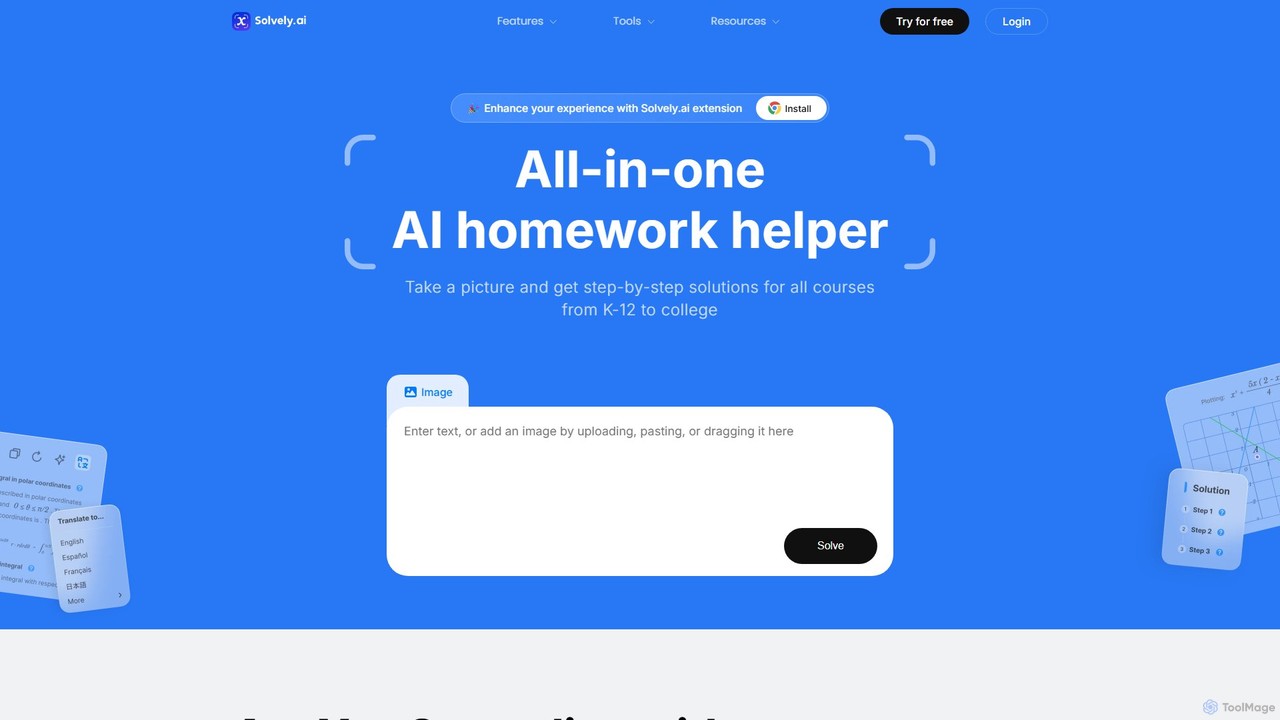
AI Problem Solvers are a class of tools designed to analyze complex questions or scenarios and generate structured, step-by-step solutions. These tools leverage advanced logical reasoning frameworks and large language models to deconstruct a problem, identify key variables, and synthesize a coherent answer. Their primary value lies in transforming ambiguous or difficult challenges into actionable insights, whether for academic, technical, or strategic purposes. They excel at tasks that require not just information retrieval, but genuine problem decomposition and solution synthesis.
Core Features
- Logical Reasoning: Follows a step-by-step logical process to arrive at a conclusion, showing its work.
- Problem Decomposition: Breaks down large, complex problems into smaller, manageable sub-problems.
- Knowledge Synthesis: Integrates information from various domains to formulate a comprehensive solution.
- Multi-format Output: Generates solutions in various formats, including text explanations, code snippets, mathematical formulas, or strategic outlines.
- Interactive Refinement: Allows users to provide feedback or additional constraints to refine the generated solution.
Use Cases
AI Problem Solvers are widely used by students, developers, researchers, and business strategists. For instance, a programmer can use it to debug complex code by describing the error, while a student can receive a detailed explanation for a difficult physics problem. In a business context, they can help outline market entry strategies or create logical frameworks for decision-making.
How to Choose
When selecting an AI Problem Solver, consider its specialization—some are optimized for mathematics and science, others for coding or business logic. Evaluate the clarity and accuracy of its explanations, as the reasoning process is as important as the final answer. Also, check its ability to handle the complexity of your typical problems and whether it integrates with other tools in your workflow.