ToolMage
Sign in

Best 1 Text AI tools for Ai Tools

Popular Text AI tools in Ai Tools include Prompttokencounter, helping you work more efficiently.

Prompttokencounter
Free

Prompttokencounter

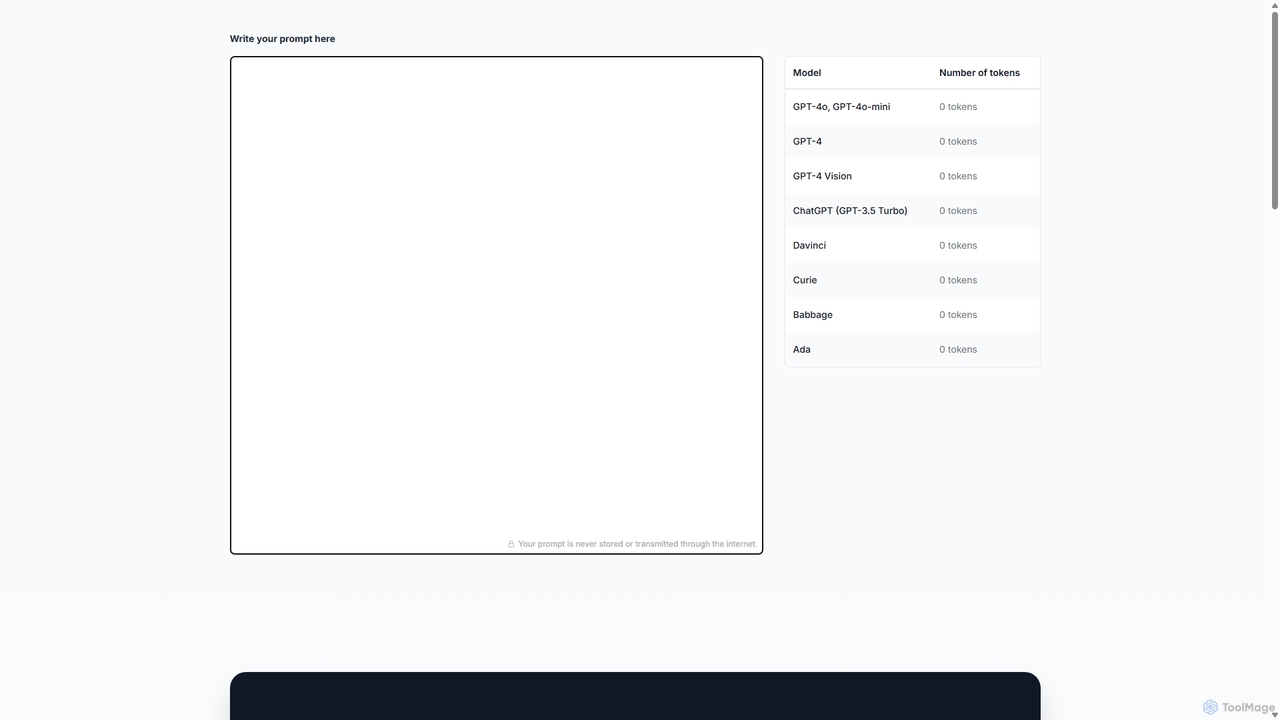
A free, online tool for developers and prompt engineers to accurately count tokens for various OpenAI models like GPT-4o, GPT-4, and GPT-3.5. It helps manage prompt length to stay within model limits, control API costs, and optimize interactions with LLMs. The tool operates entirely in your browser, ensuring your prompts remain private and are never transmitted over the internet.

Text
Visits 14.4KFavorites 131Likes 118

About Text

Text AI tools are AI-powered applications designed to process, generate, analyze, and transform human language. Leveraging advanced natural language processing (NLP) and machine learning models, these tools can understand context, sentiment, and intent within text data. They significantly enhance productivity and creativity across various industries by automating text-related tasks, from content creation to data analysis. These tools are a core component of the broader AI Tools category, specifically focusing on linguistic intelligence.

Core Features

  • Text Generation: Automatically creates human-like content such as articles, marketing copy, emails, and code snippets based on prompts.
  • Summarization: Condenses long documents, reports, or articles into concise summaries, extracting key information efficiently.
  • Translation: Converts text from one language to another with high accuracy, maintaining context and nuance.
  • Sentiment Analysis: Identifies and extracts emotional tones and opinions from text, useful for customer feedback and social media monitoring.
  • Paraphrasing & Rewriting: Restructures and rephrases existing text to improve clarity, avoid plagiarism, or adapt to different tones.

Applicable Scenarios

Text AI tools are indispensable for content creators, marketers, customer support teams, and researchers. They streamline the creation of diverse written materials, automate responses to customer inquiries, and accelerate the analysis of large text datasets. For example, a marketing team can generate multiple ad variations in minutes, while a customer service department can use AI to draft personalized email replies.

How to Choose

When selecting Text AI tools, consider the specific task (e.g., generation, analysis, translation) and the required output quality. Evaluate the tool's language support, integration capabilities with existing workflows, and customization options for tone and style. Pricing models, data privacy policies, and the availability of API access for developers are also crucial factors for making an informed decision.

Featured tool rankings

Text use cases

1

Generate Marketing Copy for Campaigns

A marketing specialist needs to create multiple ad headlines, product descriptions, and social media posts for an upcoming campaign. Using a Text AI tool, they input key product features and target audience details. The AI quickly generates dozens of creative and optimized copy variations, saving hours of manual brainstorming and drafting, allowing the specialist to focus on strategy and A/B testing.

2

Summarize Long Research Papers

An academic researcher needs to quickly grasp the core arguments of numerous lengthy research papers. By feeding these papers into a Text AI summarization tool, they receive concise summaries highlighting the main objectives, methodologies, results, and conclusions. This drastically reduces reading time, allowing the researcher to review more literature and identify relevant studies for their own work more efficiently.

3

Automate Customer Service Email Responses

A customer support agent is overwhelmed by a high volume of routine email inquiries. By integrating a Text AI tool, the system can analyze incoming emails, identify common questions (e.g., shipping status, password reset), and draft personalized, accurate responses. The agent then only needs to review and send, or intervene for complex cases, significantly reducing response times and improving customer satisfaction.

4

Translate Multilingual Business Communications

A global company frequently exchanges documents and emails with international partners in various languages. Instead of relying on human translators for every piece of communication, they use a Text AI translation tool. This enables instant, accurate translation of contracts, reports, and internal memos, ensuring smooth cross-cultural collaboration and reducing translation costs by up to 70% while maintaining confidentiality.

5

Analyze Customer Feedback for Insights

A product manager needs to understand customer sentiment from thousands of reviews, social media comments, and support tickets. A Text AI sentiment analysis tool processes this unstructured text data, categorizing feedback as positive, negative, or neutral, and identifying recurring themes or pain points. This provides actionable insights into product improvements and customer satisfaction trends, informing strategic decisions.

6

Generate Creative Content for Storytelling

A content creator or writer faces writer's block when developing new story ideas, blog posts, or scripts. By using a Text AI generation tool, they can input initial concepts, characters, or plot points. The AI then provides diverse creative prompts, outlines, or even full drafts, helping to overcome creative hurdles, explore new narrative directions, and accelerate the content creation process for various storytelling formats.

Text FAQ

What are Text AI tools?

Text AI tools are artificial intelligence applications that process, understand, generate, and manipulate human language. They leverage advanced natural language processing (NLP) and machine learning to perform tasks like writing articles, summarizing documents, translating languages, and analyzing sentiment. These tools are designed to automate and enhance text-based workflows, making them invaluable for content creation, data analysis, and communication across various sectors.

How do Text AI tools differ from traditional text editors?

Traditional text editors primarily facilitate manual text input, formatting, and basic editing. Text AI tools, however, go beyond this by actively understanding, interpreting, and generating text using AI algorithms. They can automate complex tasks like content creation, summarization, translation, and sentiment analysis, which are impossible with standard editors. While editors are for human input, AI tools augment or replace human effort in text processing.

What are the key benefits of using Text AI tools?

The key benefits of using Text AI tools include significant time savings through automation of repetitive tasks, enhanced content quality and consistency, and improved efficiency in processing large volumes of text data. They also boost creativity by providing new ideas and variations, enable global communication through accurate translation, and offer valuable insights from sentiment analysis, leading to better decision-making and increased productivity across various professional fields.

Who can benefit most from Text AI tools?

A wide range of professionals can benefit significantly from Text AI tools. This includes content creators, marketers, and copywriters who need to generate high-quality text efficiently; customer service teams looking to automate responses and analyze feedback; academic researchers and students for summarizing complex documents; and global businesses requiring accurate, instant translation. Essentially, anyone involved in generating, processing, or analyzing text can find immense value in these tools.

What should I consider when choosing a Text AI tool?

When choosing a Text AI tool, consider your primary use case (e.g., generation, summarization, translation) and the specific features required. Evaluate the tool's accuracy, language support, and customization options for tone and style. Look for integration capabilities with your existing software, user-friendliness, and scalability. Also, assess the pricing model, data privacy and security policies, and the availability of customer support or community resources to ensure it meets your long-term needs.