Data Best in category 1 results Data Catalog AI Tool

Popular AI tools in the Data Catalog field of Data include data.world, etc., helping you quickly improve efficiency.

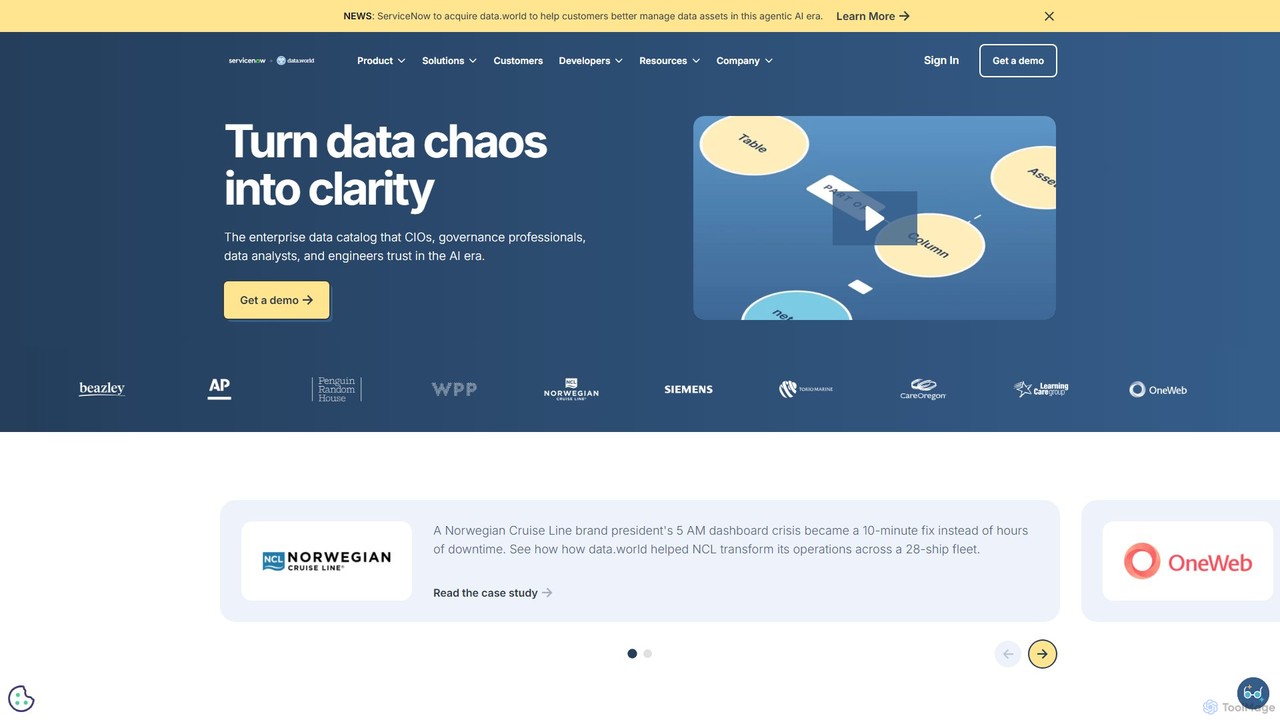
data.world

data.world

data.world is an enterprise-grade, AI-powered data catalog platform. It helps organizations discover, govern, and collaborate on data through …

136.7K

About Data Catalog

A Data Catalog is a tool that creates an organized inventory of all data assets within an organization, making them easy to find, understand, and trust. It works by automatically scanning various data sources to collect metadata—data about data—and presents it in a searchable, user-friendly interface. This centralized system empowers data professionals and business users to perform self-service analytics, enhances data governance, and accelerates AI development by providing a single source of truth for data. It bridges the gap between technical data storage and business user needs.

Core Features

  • Automated Metadata Harvesting: Automatically connects to and scans databases, data lakes, and BI tools to extract technical and operational metadata.
  • Intelligent Search & Discovery: Provides a powerful, Google-like search experience to find relevant data assets using keywords, tags, or business terms.
  • Data Lineage Visualization: Visually maps the entire journey of data from its source to consumption, showing all transformations and dependencies.
  • Business Glossary & Curation: Allows users to define and link business terms to technical data assets, adding context and fostering a common understanding.
  • Collaboration & Social Features: Enables users to rate, comment on, and certify data assets, sharing tribal knowledge and building data trust.

Use Cases

Data Catalogs are essential for organizations aiming to become data-driven. They are heavily used by data governance teams to enforce policies and track compliance (e.g., GDPR, CCPA). Data analysts and scientists rely on them to drastically reduce the time spent searching for and vetting data. In large enterprises, they support self-service BI initiatives by empowering business users to find certified data without IT intervention.

How to Choose

When selecting a Data Catalog, first evaluate its connector ecosystem to ensure it supports your data sources (e.g., Snowflake, BigQuery, Tableau). Assess the level of automation in metadata discovery and lineage generation, as this reduces manual effort. Consider the strength of its collaboration and governance features, such as workflows for data stewards and role-based access controls. Finally, check its integration capabilities with other tools in your data stack.

Data CatalogUse Cases

1

Accelerating Self-Service Analytics for Business Teams

A business analyst needs to create a quarterly sales performance report. Instead of emailing the IT department and waiting for days, they use the Data Catalog's search bar to find 'certified customer sales data'. The catalog provides a detailed profile of the dataset, including column descriptions, data quality scores, and its refresh frequency. By viewing the data lineage, the analyst confirms the data originates from the official CRM system, ensuring its trustworthiness. They can then directly connect this verified dataset to their BI tool, like Tableau, and build the report in hours instead of days, significantly boosting their productivity and autonomy.

2

Strengthening Data Governance and Regulatory Compliance

A Data Governance Officer is tasked with ensuring GDPR compliance across the organization. They use the Data Catalog to automatically scan all data sources and identify datasets containing Personally Identifiable Information (PII) using automated tagging. The catalog's lineage view allows them to track exactly how PII flows through different systems and who has access to it. They can then apply governance policies, such as data masking or access restrictions, directly through the catalog's interface. This provides a centralized, auditable record of compliance efforts, simplifying reporting to regulators and reducing the risk of data breaches.

3

Improving Data Scientist Productivity

A data scientist is starting a new project to build a customer churn prediction model. Instead of spending weeks understanding the data landscape, they use the Data Catalog. They search for 'customer activity' and 'subscription data', and the catalog returns several relevant, curated datasets. They can review user-provided ratings and comments to select the most reliable ones. The business glossary feature helps them understand complex business terms like 'active user definition'. This process reduces the data discovery and preparation phase from weeks to days, allowing them to focus more time on model development and experimentation, ultimately accelerating the delivery of AI projects.

4

Streamlining Data Engineering and Impact Analysis

A data engineering team plans to deprecate a column in a critical database table. Before making the change, they use the Data Catalog's end-to-end lineage feature to perform an impact analysis. The lineage graph visually displays all downstream assets that depend on this column, including data pipelines, BI dashboards, and machine learning models. This allows the team to proactively identify and notify all affected stakeholders. Without the catalog, this process would be a manual, error-prone effort of checking code and querying logs. With it, they can confidently manage changes to their data infrastructure, preventing unexpected breakages and maintaining data integrity.

5

Onboarding New Team Members to the Data Stack

A new data analyst joins a company and needs to quickly understand the complex data environment. Instead of relying on outdated documentation or taking up senior members' time, they are directed to the Data Catalog. They can explore the most frequently used and certified datasets, understand the relationships between different data assets through the lineage view, and learn company-specific terminology from the business glossary. This self-service approach empowers the new hire to become productive within their first week, reducing onboarding time and fostering a culture of data literacy from day one.

6

Fostering a Collaborative Data Culture

An organization wants to break down data silos and encourage knowledge sharing. They leverage the social features of their Data Catalog. When a marketing analyst discovers a particularly useful dataset for campaign analysis, they certify it and add comments with tips on how to use it effectively. A data engineer sees the comment and adds further context about the data's source. This creates a virtuous cycle where users enrich the catalog with their collective knowledge. The catalog becomes more than just an inventory; it transforms into a living, collaborative hub for data, building trust and fostering a community of practice around the organization's most valuable asset.

Data CatalogFrequently Asked Questions