RapidAPI
RapidAPI is the world's largest API Hub where over 7 million developers find, test, and connect to tens …
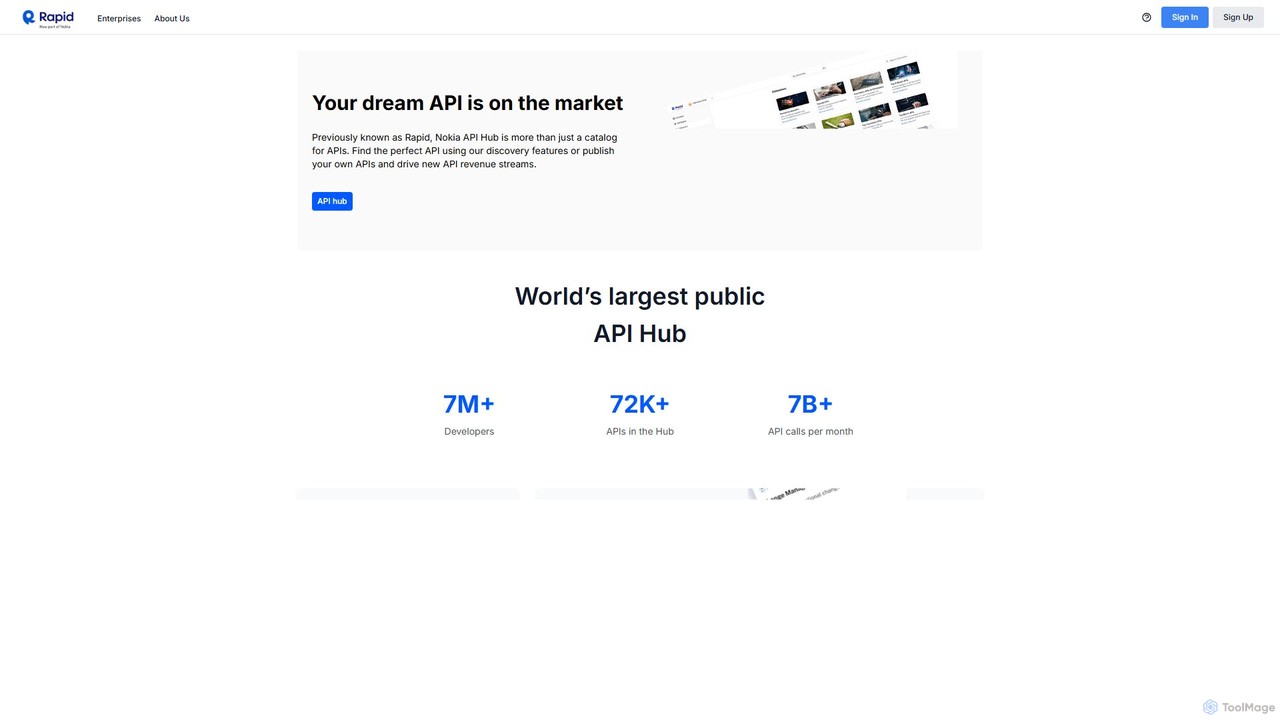
RapidAPI is the world's largest API Hub where over 7 million developers find, test, and connect to tens of thousands of APIs. It provides a unified platform for discovering public APIs and managing private ones, simplifying the entire development lifecycle from integration to management and monetization.
About Databases
AI Databases are specialized data management systems designed to store, process, and retrieve data optimized for artificial intelligence and machine learning workloads. These databases often incorporate advanced indexing, vector search capabilities, and real-time analytics to efficiently handle unstructured data, complex relationships, and high-dimensional vectors. They empower AI applications with faster data access, improved model performance, and enhanced decision-making, forming a crucial part of modern data infrastructure within the broader Data category.
Core Features
- Vector Search: Enables efficient similarity search across high-dimensional data embeddings for AI models.
- Real-time Analytics: Processes and analyzes large datasets instantly to support dynamic AI applications.
- Knowledge Graph Integration: Stores and queries complex, interconnected data to build intelligent knowledge bases.
- Scalable Data Ingestion: Handles massive volumes of diverse data types, including text, images, and sensor data.
- Semantic Indexing: Organizes data based on meaning, improving relevance for AI-driven queries.
Applicable Scenarios
AI Databases are essential for developers and data scientists building intelligent applications. They are widely used in scenarios requiring rapid data retrieval for AI models, such as powering personalized recommendation engines in e-commerce, enabling sophisticated fraud detection systems in finance, and managing vast datasets for scientific research and drug discovery.
How to Choose
When selecting an AI Database, consider its compatibility with your AI models and frameworks, scalability for future data growth, and specific data types it handles best (e.g., vector, graph, time-series). Evaluate its integration capabilities with existing data pipelines, security features, and the total cost of ownership, including operational complexity and vendor support.

DatabasesUse Cases
Real-time Personalized Recommendations
E-commerce platforms and streaming services leverage AI Databases to store user preferences, viewing history, and item embeddings. When a user interacts with the platform, the database performs lightning-fast vector similarity searches to identify and suggest highly relevant products or content in real-time, significantly enhancing user engagement and conversion rates. This allows for dynamic, context-aware recommendations that adapt instantly to user behavior.
Semantic Search for Enterprise Knowledge Bases
Large organizations use AI Databases to power intelligent search within their vast internal knowledge bases and documentation. Employees or customer service agents can ask natural language questions, and the database, using semantic indexing and vector search, retrieves the most relevant documents, paragraphs, or answers, even if exact keywords aren't present. This drastically reduces information retrieval time and improves accuracy.
Advanced Fraud Detection in Financial Services
Financial institutions deploy AI Databases to analyze complex transaction patterns, user behavior, and network relationships in real-time. By storing and querying graph data and time-series anomalies, these databases help AI models quickly identify suspicious activities, detect emerging fraud schemes, and flag high-risk transactions with greater precision than traditional systems, minimizing financial losses.
Intelligent IoT Device Data Management
For industrial IoT and smart city applications, AI Databases manage massive streams of sensor data from countless devices. They efficiently store, index, and allow for real-time querying of time-series data, enabling predictive maintenance, anomaly detection, and operational optimization. AI models can access this data rapidly to make immediate decisions, such as adjusting machinery settings or traffic flows.
Drug Discovery and Genomic Research
Life science researchers utilize AI Databases to manage and analyze vast, complex datasets including genomic sequences, protein structures, and scientific literature. These databases facilitate sophisticated queries for pattern recognition, drug target identification, and hypothesis generation by enabling efficient storage and retrieval of highly interconnected biological data, accelerating research breakthroughs.
Personalized Content Delivery for Media Outlets
Media companies use AI Databases to store and manage diverse content assets (articles, videos, images) along with user interaction data. By employing vector embeddings for content and user profiles, these databases enable AI algorithms to deliver highly personalized news feeds, article suggestions, and video recommendations, keeping audiences engaged and increasing content consumption.