HeyPat.ai
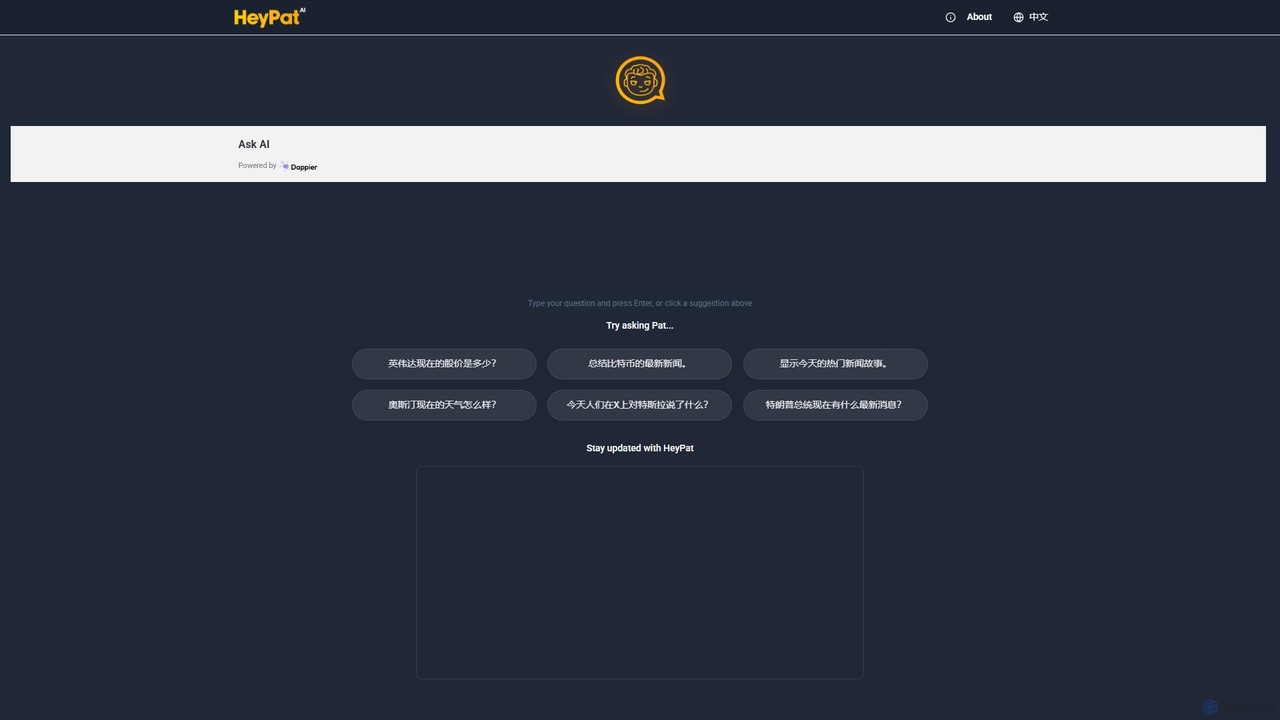
HeyPat.ai is a powerful AI assistant that integrates directly into your messaging apps like SMS, WhatsApp, and Telegram. …
HeyPat.ai is a powerful AI assistant that integrates directly into your messaging apps like SMS, WhatsApp, and Telegram. Get real-time information, news summaries, stock prices, weather updates, and more, simply by sending a message. It's your personal AI, always available in your pocket without needing a separate app.
About Information Retrieval
Information Retrieval (IR) tools are AI-powered systems designed to efficiently find and extract relevant information from vast, often unstructured, datasets in response to user queries. These tools leverage advanced Natural Language Processing (NLP) and machine learning algorithms to understand the semantic meaning of queries and content, moving beyond simple keyword matching. They enable users to quickly access precise, contextually relevant answers and documents, significantly enhancing knowledge discovery and decision-making processes. Information Retrieval is a critical component for building intelligent search experiences and empowering advanced AI applications like Retrieval Augmented Generation (RAG).
Core Features
- Semantic Search: Understands the meaning and intent behind queries, not just keywords, to deliver more relevant results.
- Vector Database Integration: Stores and queries high-dimensional vector embeddings of data, enabling similarity search and contextual matching.
- Relevance Ranking Algorithms: Utilizes machine learning to dynamically rank search results based on their contextual relevance to the user's query.
- Query Expansion & Rewriting: Automatically enhances or rephrases queries to improve search recall and precision across diverse data sources.
- Knowledge Graph Integration: Connects entities and concepts within data, allowing for deeper contextual understanding and more insightful retrieval.
Applicable Scenarios
Information Retrieval tools are indispensable for organizations managing large volumes of data, such as enterprises seeking to centralize internal knowledge, research institutions conducting extensive literature reviews, and customer support operations aiming to provide instant, accurate answers. They are also vital for developers integrating external knowledge into large language models.
How to Choose
When selecting an Information Retrieval tool, consider its ability to handle your specific data types and volume, the complexity of queries it can process (e.g., natural language, multi-modal), and its integration capabilities with existing data sources and applications. Evaluate the customization options for relevance ranking, security features, and scalability to meet future demands. Prioritize tools that offer robust APIs and support for advanced AI paradigms like RAG.
Information RetrievalUse Cases
Enhanced Enterprise Knowledge Base Search
Employees in large organizations often struggle to find specific information across disparate internal systems. AI-powered Information Retrieval tools allow them to use natural language queries to instantly locate relevant documents, policies, or project details from internal wikis, shared drives, and databases, significantly reducing time spent searching and improving operational efficiency.
Contextual Customer Support Automation
Customer service departments can deploy IR tools to empower AI chatbots or agents. When a customer asks a question, the IR system retrieves precise answers from product manuals, FAQs, and past support tickets. This ensures consistent, accurate, and rapid responses, reducing agent workload and improving customer satisfaction without human intervention for common queries.
Accelerated Academic & Scientific Research
Researchers and scientists face an overwhelming volume of publications. Information Retrieval tools enable them to move beyond keyword-based searches, posing complex, natural language questions to discover highly relevant papers, patents, and datasets across vast academic databases. This accelerates literature reviews, helps identify emerging trends, and supports evidence-based decision-making.
Legal Document Discovery & Analysis
Legal professionals spend countless hours sifting through massive repositories of legal documents during discovery phases. IR tools allow them to quickly identify pertinent clauses, precedents, case facts, and evidence by understanding the semantic context of their queries, drastically reducing manual review time and improving the accuracy of legal analysis.
Personalized Content & Product Recommendation
Media companies, e-commerce platforms, and streaming services utilize IR to provide highly personalized recommendations. By analyzing user preferences, viewing history, and explicit feedback, IR systems retrieve and suggest relevant articles, videos, music, or products from vast catalogs, enhancing user engagement and driving sales.
Retrieval Augmented Generation (RAG) for LLMs
Developers building applications with Large Language Models (LLMs) use IR systems to provide LLMs with up-to-date, factual, and domain-specific information from private or proprietary data sources. This process, known as RAG, prevents LLM hallucinations, grounds responses in verifiable facts, and allows LLMs to answer questions beyond their initial training data.