Formaloo
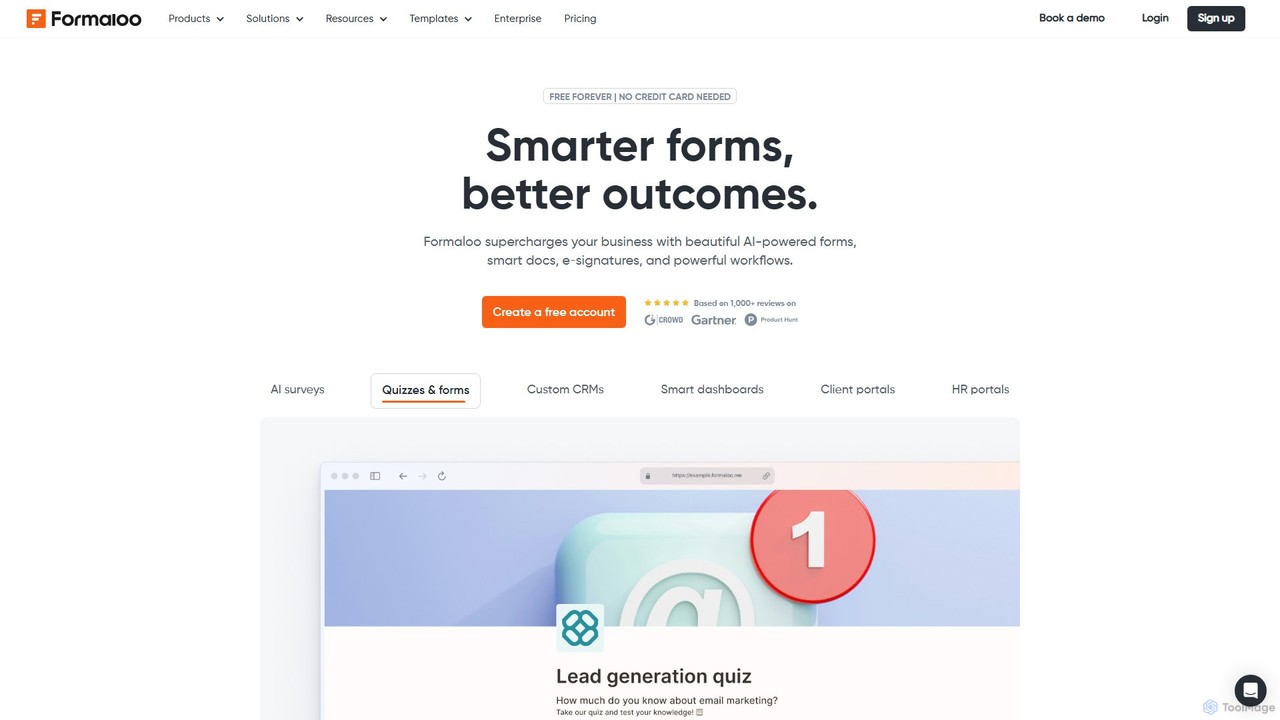
Formaloo is a powerful no-code platform that enables users to build custom business applications, including forms, surveys, CRMs, …
Formaloo is a powerful no-code platform that enables users to build custom business applications, including forms, surveys, CRMs, and client portals. It integrates AI to create intelligent quizzes, generate reports, and automate workflows. Designed for businesses of all sizes, it provides a unified workspace to collect data, manage customer relationships, and build internal tools without writing a single line of code, streamlining operations and enhancing engagement.
About Survey & Form
AI Survey & Form tools are applications that use artificial intelligence to create, distribute, and analyze surveys and forms. They leverage technologies like natural language processing (NLP) and machine learning to generate relevant questions, create conversational experiences, and automatically extract insights from open-ended responses. This allows organizations to gather higher-quality data and accelerate the analysis process, turning qualitative feedback into structured intelligence. Unlike traditional form builders, these tools can understand context and sentiment, providing deeper insights from the collected data.
Core Features
- Intelligent Question Generation: AI suggests relevant and unbiased questions based on the survey's goal.
- Conversational Forms: Creates interactive, chat-like experiences that adapt to user responses in real-time.
- Automated Response Analysis: Uses NLP to perform sentiment analysis, topic modeling, and keyword extraction on text answers.
- Dynamic Branching Logic: Automatically adjusts the survey path based on the user's input, making it more personal and relevant.
- Insight Summarization: Generates concise summaries and visualizations from large volumes of qualitative and quantitative data.
Use Cases
These tools are valuable for marketing teams conducting in-depth market research, product managers gathering nuanced user feedback, and HR departments analyzing employee engagement. For instance, a company can deploy a conversational feedback form on its website that not only collects ratings but also understands the sentiment behind user comments, automatically flagging critical issues for the support team.
How to Choose
When selecting an AI Survey & Form tool, consider the sophistication of its analytical capabilities, such as the accuracy of its sentiment analysis. Evaluate its integration options with other platforms like CRMs or data visualization tools. Also, assess the user-friendliness of the form builder and the quality of its conversational interface. Finally, consider the pricing model and whether it aligns with your expected volume of responses and analysis needs.
Survey & FormUse Cases
Automated Market Research Analysis
A marketing manager needs to understand consumer sentiment about a new product concept. Instead of manually coding hundreds of open-ended survey responses, they use an AI survey tool. The tool helps draft neutral questions and then, after collecting responses, its NLP capabilities automatically categorize feedback, identify key themes like 'pricing' or 'design', and perform sentiment analysis on text answers. This generates a summary report in minutes, reducing manual analysis time by over 90% and uncovering subtle trends that might otherwise be missed.
Dynamic Customer Feedback Collection
A SaaS company wants to collect in-app feedback without disrupting the user experience. They implement an AI-powered conversational form that triggers after a user completes a key action. The form starts with a simple question and, based on the user's response, asks relevant follow-up questions in a chat-like interface. If a user expresses frustration, the form can dynamically ask for more details and offer to create a support ticket, improving engagement and capturing more contextual feedback than a static multi-page form.
Intelligent Employee Engagement Surveys
An HR department wants to move beyond simple satisfaction scores to understand the root causes of employee sentiment. They use an AI survey platform to create an anonymous engagement survey. The tool's AI analyzes open-text comments to identify recurring themes (e.g., 'work-life balance', 'management communication') and their associated sentiment. This provides actionable insights for HR to develop targeted improvement initiatives, rather than relying on generic quantitative data alone. The anonymity encourages more honest and detailed feedback.
Interactive Lead Generation Forms
A B2B company aims to improve its lead qualification process on its website. They replace their static 'Contact Us' form with an AI-driven conversational form. This form engages visitors by asking questions about their needs, company size, and role. Based on the answers, the AI can instantly qualify the lead, provide relevant resources (like a whitepaper or case study), and even schedule a demo with the appropriate sales representative. This creates a smoother user journey and delivers higher-quality, pre-qualified leads to the sales team.
Structuring Complex Academic Research Data
A university researcher is conducting a qualitative study involving interviews. Manually transcribing and coding hours of audio is time-consuming. They use an AI form tool that can accept audio uploads. The AI transcribes the interviews and then performs topic modeling and sentiment analysis on the text. It helps the researcher quickly identify key themes, patterns, and quotes across dozens of interviews, significantly speeding up the data analysis phase of their research project and ensuring a more systematic review of the material.
Prioritizing Product Feature Requests
A product team receives hundreds of feature requests through various channels. To streamline this, they create a centralized AI-powered form for submitting ideas. The form asks users to describe the problem they are trying to solve. The AI then analyzes all submissions, groups similar requests together, identifies the most frequently mentioned pain points, and analyzes the sentiment associated with each request. This provides the product manager with a data-driven overview to help prioritize the development roadmap based on genuine user needs and impact.