MONAI
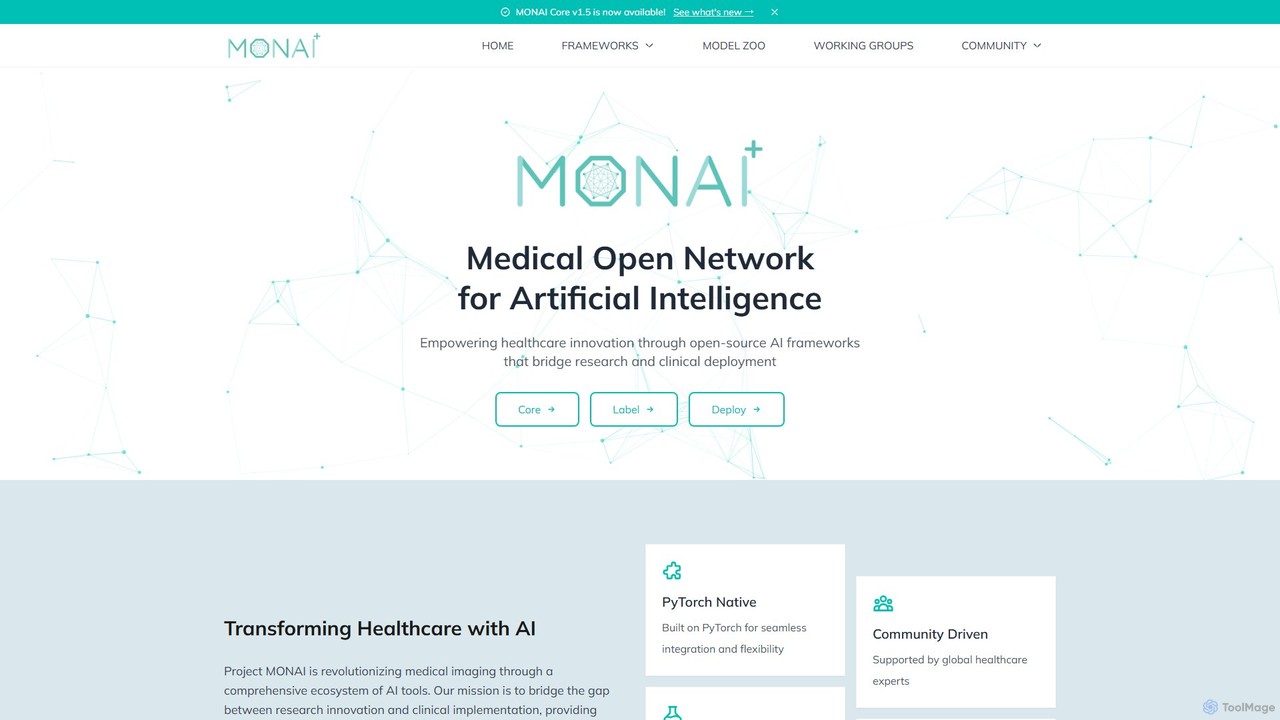
MONAI (Medical Open Network for AI) is a free, open-source, PyTorch-based framework designed to accelerate AI in healthcare. …
MONAI (Medical Open Network for AI) is a free, open-source, PyTorch-based framework designed to accelerate AI in healthcare. It provides a comprehensive ecosystem of tools for researchers and clinicians, covering the entire AI lifecycle from data annotation and model training (MONAI Core, MONAI Label) to clinical deployment (MONAI Deploy), bridging the gap between research and real-world application.
MindSpore
MindSpore is an open-source, all-scenario AI computing framework designed for developers and data scientists. It provides a developer-friendly …
MindSpore is an open-source, all-scenario AI computing framework designed for developers and data scientists. It provides a developer-friendly experience with flexible deployment across cloud, edge, and device environments. It excels in distributed training for large models and offers specialized toolkits for scientific computing (AI4S), ensuring high performance and efficiency, especially on Ascend hardware.
About Machine Learning Framework
A Machine Learning Framework is a specialized developer tool that provides a structured environment and high-level APIs for building, training, and deploying machine learning models. These frameworks abstract complex mathematical operations and hardware optimizations, allowing developers to focus on model architecture and logic. By offering pre-built components like neural network layers, optimizers, and data loaders, they significantly accelerate the development lifecycle from research to production. This makes creating sophisticated AI systems more accessible and efficient.
Core Features
- Tensor Libraries & Autograd: Provides multi-dimensional array structures (tensors) and an automatic differentiation engine to calculate gradients for model training.
- Model Building APIs: Offers high-level, modular interfaces (like Keras or PyTorch's nn.Module) for constructing and customizing complex model architectures.
- GPU/TPU Acceleration: Automatically utilizes specialized hardware to drastically speed up the computationally intensive training process.
- Deployment & Serving Tools: Includes utilities for exporting trained models into optimized formats and deploying them on servers, edge devices, or in the cloud.
- Ecosystem & Pre-trained Models: Offers a rich ecosystem of tools, visualization libraries, and access to a vast repository of pre-trained models that can be used for transfer learning.
Use Cases
Machine Learning Frameworks are fundamental for data scientists, ML engineers, and researchers. They are used to develop computer vision systems for image recognition, build natural language processing models for chatbots and translation, and create predictive analytics models for finance and marketing. In academia, they are essential for experimenting with new AI architectures and pushing the boundaries of research.
How to Choose
When selecting a Machine Learning Framework, consider the ecosystem and community support (e.g., TensorFlow vs. PyTorch). Evaluate the trade-off between ease of use (high-level APIs) and flexibility (low-level control). Also, consider the target deployment platform—whether it's for servers, mobile devices (like TensorFlow Lite), or web browsers (like TensorFlow.js). Finally, assess the framework's performance and scalability for distributed training on large datasets.

Machine Learning FrameworkUse Cases
Develop a Custom Image Recognition Model
A computer vision engineer is tasked with creating a system to identify specific product defects on an assembly line. Using a framework like PyTorch or TensorFlow, they can design a Convolutional Neural Network (CNN). The framework provides tools to efficiently load and preprocess thousands of images, define the network architecture layer by layer, and leverage GPU acceleration to train the model in hours instead of days. After training, the framework's utilities help in exporting the model for real-time inference on the production line.
Fine-tuning a Large Language Model (LLM)
A research scientist needs to adapt a pre-trained language model like BERT or GPT for a specific task, such as analyzing legal documents. Using a framework like JAX or Hugging Face Transformers (which builds on PyTorch/TensorFlow), they can load the pre-trained model and fine-tune it on a custom dataset of legal texts. The framework handles the complex memory management and distributed training required for these massive models, allowing the researcher to focus on the experiment's methodology and achieve state-of-the-art results on their niche task.
Deploying a Model on Edge Devices
A mobile app developer wants to add a real-time object detection feature to their application. Training a large model requires significant resources, but running it on a phone requires it to be small and efficient. They use a framework like TensorFlow to train the model on a powerful server. Then, they use a specific tool within the framework, TensorFlow Lite, to convert and optimize the trained model. This process quantizes the model's weights and prunes unnecessary connections, creating a lightweight version that can run directly on a smartphone's hardware with low latency.
Building a Predictive Analytics System
A data scientist at an e-commerce company aims to predict customer churn. They use a framework like scikit-learn for initial exploration with simpler models like Logistic Regression. For more complex patterns, they might switch to a deep learning framework like Keras to build a neural network. The framework provides utilities for data splitting, feature scaling, and model evaluation (e.g., calculating accuracy and precision). This structured approach allows for rapid experimentation and iteration, leading to a reliable model that can be integrated into the company's CRM system.
Accelerating Scientific Research and Simulation
A physicist is researching complex particle interactions that are difficult to model with traditional equations. They can use a machine learning framework like JAX, known for its high-performance computing capabilities, to build a neural network that learns the simulation's dynamics from data. The framework's ability to compile code for GPUs/TPUs and perform automatic differentiation on complex functions allows the researcher to create and test novel simulation models far more quickly than manual coding would permit, potentially leading to new scientific discoveries.
Creating a Natural Language Processing (NLP) Chatbot
An ML engineer is tasked with building an intelligent customer service chatbot. They use a framework like PyTorch along with a library like Hugging Face Transformers. The framework provides the core components for building a Transformer-based model, such as attention mechanisms and embedding layers. It also offers efficient data loaders to handle large text corpora for training. This allows the engineer to focus on the chatbot's specific logic, like intent recognition and dialogue management, rather than implementing the complex underlying neural network from scratch.