
OrgaFile
OrgaFile is an AI-powered tool that automatically analyzes, renames, and organizes your files into smart, customizable categories. Designed …
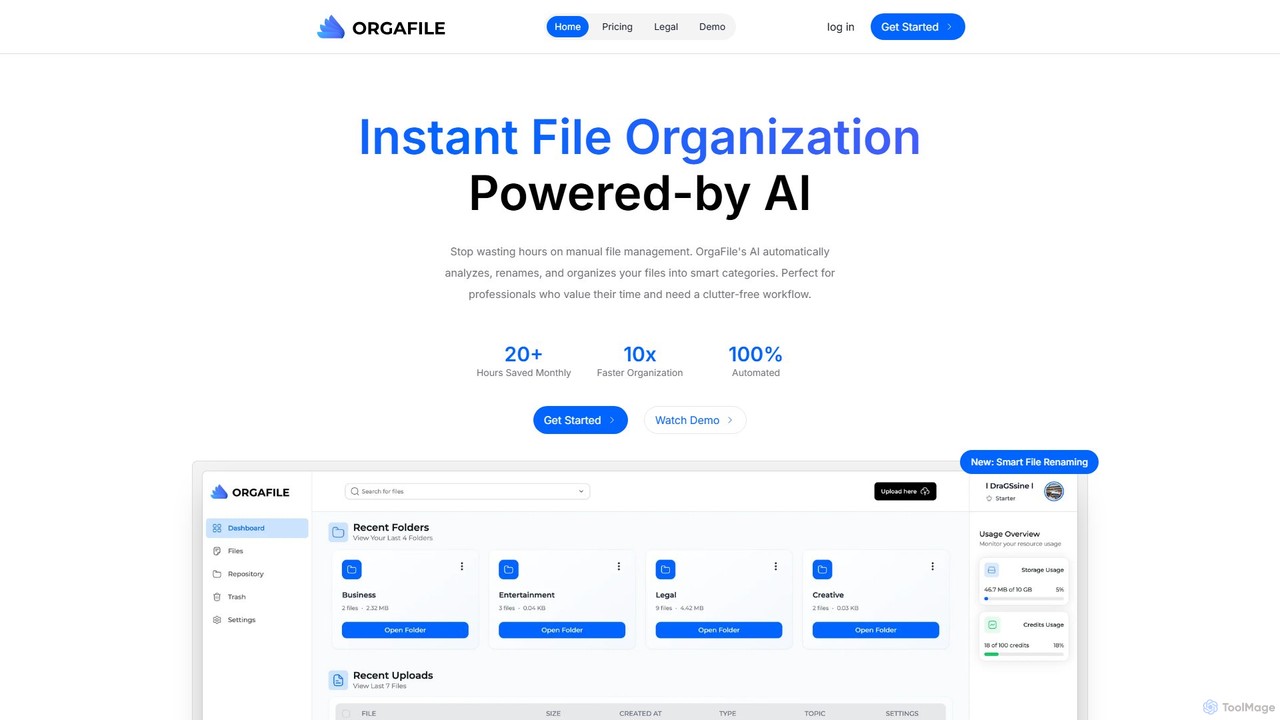
OrgaFile is an AI-powered tool that automatically analyzes, renames, and organizes your files into smart, customizable categories. Designed for professionals and individuals, it saves hours of manual work, enhances productivity with a 10x faster organization process, and ensures your digital workspace remains clutter-free and secure.
About Organization
AI Organization tools are a specialized category within document management that use artificial intelligence to automatically structure, classify, and index digital files. Leveraging Natural Language Processing (NLP) and machine learning, these tools analyze document content and metadata to create logical order from unstructured information. This enables teams to find information significantly faster, maintain consistency across large repositories, and reduce manual administrative work. They excel at building searchable, intelligent archives without constant human intervention.
Core Features
- Automated Categorization & Tagging: Analyzes document content to automatically assign relevant tags and sort files into predefined folders.
- Metadata Extraction: Identifies and extracts key data points like dates, names, invoice numbers, or project codes from documents.
- Smart Folder Structuring: Suggests or creates logical folder hierarchies based on document content, relationships, and usage patterns.
- Semantic Search Enablement: Organizes data in a way that supports searching by concept and context, not just exact keywords.
- Duplicate Detection: Scans repositories to identify and flag identical or near-identical files to maintain a clean database.
Use Cases
These tools are invaluable for industries handling vast amounts of documentation, such as legal, finance, and research. Law firms use them to organize case files by client and matter, while accounting departments automatically sort invoices and receipts. Research institutions can classify thousands of academic papers by topic and author, making knowledge retrieval highly efficient.
How to Choose
When selecting an AI Organization tool, consider its integration capabilities with your existing cloud storage or document management system. Evaluate the accuracy and customization options of its AI models for your specific document types. Also, assess its scalability to handle your current and future document volume, and ensure its security protocols meet your compliance requirements.
OrganizationUse Cases
Automated Case File Management for Law Firms
A paralegal at a busy law firm is tasked with organizing hundreds of incoming documents for multiple cases daily, including contracts, emails, and court filings. Using an AI Organization tool, they set up rules to automatically scan documents for case numbers, client names, and document types. The tool then tags each file accordingly and moves it to the correct client and case folder in their document management system. This eliminates hours of manual sorting, reduces the risk of misfiling critical documents, and ensures all case materials are consistently organized and instantly searchable for the legal team.
Structuring a Corporate Knowledge Base
A knowledge manager at a large corporation needs to organize thousands of internal documents, including project reports, research papers, and meeting minutes, into a centralized, searchable knowledge base. They deploy an AI Organization tool that analyzes the content of each document. The AI identifies key themes, projects, and departments mentioned, then automatically creates a logical folder structure and applies relevant tags like 'Q3-Marketing-Strategy' or 'Product-Launch-Checklist'. This transforms a chaotic collection of files into a structured asset, allowing employees to easily find relevant information and preventing knowledge loss.
Automated Invoice and Receipt Processing
An accounting department receives hundreds of invoices and receipts weekly via email. Manually saving, naming, and sorting these files is time-consuming and prone to error. By integrating an AI Organization tool with their email inbox, each incoming attachment is automatically processed. The tool uses OCR and NLP to extract key metadata like vendor name, invoice number, amount, and date. It then renames the file using a standard convention (e.g., 'Vendor_Invoice_Date.pdf') and files it into the appropriate 'Accounts Payable' subfolder, streamlining the entire reconciliation and payment process.
Curating Academic Research Papers
A university research department maintains a digital library with tens of thousands of academic papers. A librarian uses an AI Organization tool to automatically classify new submissions. The AI reads the abstract and content to identify the field of study, methodologies used, and key concepts. It then applies hierarchical tags (e.g., 'Computer Science > Machine Learning > Deep Learning') and extracts author names and publication years as metadata. This allows students and faculty to perform highly specific searches, such as finding all papers on 'Deep Learning' published after 2020 by a specific author, dramatically improving research efficiency.
Managing Digital Assets for Creative Projects
A project manager at a marketing agency oversees multiple campaigns, each with hundreds of digital assets like images, videos, and copy drafts. They use an AI Organization tool to maintain order. When a designer uploads a new image, the tool analyzes its content and metadata, automatically tagging it with the client name, campaign ID, and asset type (e.g., 'social-media-banner'). It also detects and flags potential duplicates or older versions of the same asset. This ensures that the team always uses the correct, most up-to-date files and can quickly locate all assets related to a specific campaign.
Compliance and Audit Trail Preparation
A compliance officer in a financial services firm must ensure that all client communication and transaction records are properly stored and categorized according to regulatory retention policies. They implement an AI Organization tool to automatically classify documents based on their content's sensitivity and type. The tool assigns retention periods (e.g., '7-Year Hold') and access control tags. When an audit occurs, the officer can instantly generate a report of all documents related to a specific regulation or time period, demonstrating organized compliance and significantly reducing the time and stress of audit preparation.