
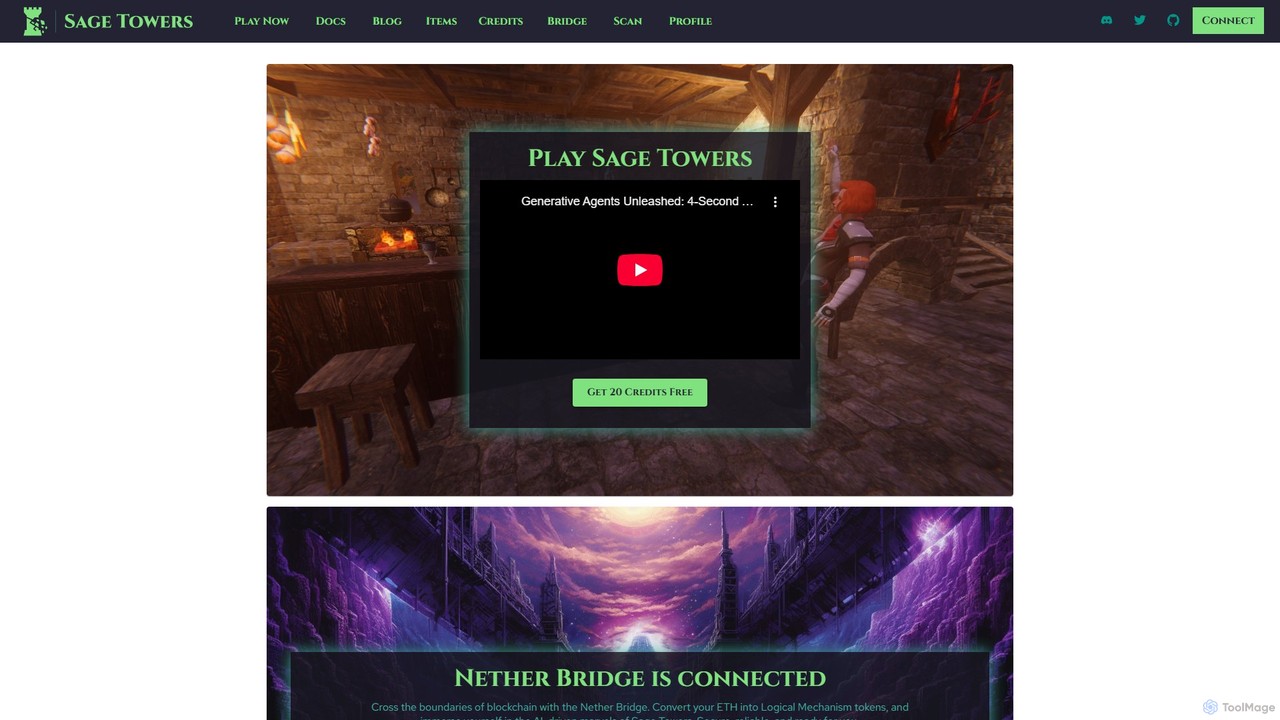
Sage Towers
Sage Towers is a revolutionary User-Generated MMO that merges AI-driven gameplay with blockchain technology. Players can interact with …
Sage Towers is a revolutionary User-Generated MMO that merges AI-driven gameplay with blockchain technology. Players can interact with 'living' NPCs through voice, create unique items using generative AI, and participate in a player-driven economy powered by the Logical Mechanism (LLM) token.
About Mmorpg
MMORPG AI tools are specialized applications designed to create, manage, and enhance massive multiplayer online role-playing games. These tools leverage artificial intelligence for tasks like procedural content generation, creating dynamic NPC behaviors, and balancing complex in-game economies. They enable developers to build vast, evolving virtual worlds that offer unique and personalized experiences for thousands of players simultaneously. This approach significantly reduces manual development effort while increasing the depth and replayability of the game.
Core Features
- Procedural Content Generation (PCG): Automatically creates vast landscapes, dungeons, quests, and items, ensuring a unique world for exploration.
- Intelligent NPC Behavior: Powers non-player characters with dynamic routines, adaptive combat tactics, and realistic social interactions.
- Player Behavior Analytics: Analyzes player data to balance game mechanics, predict economic trends, and detect abnormal activities like botting.
- Dynamic Quest Systems: Generates quests that adapt to player actions, world events, or individual progress, creating a living narrative.
- AI-Powered Moderation: Automates the detection of toxic behavior, cheating, and exploits to maintain a healthy community environment.
Use Cases
These tools are primarily used by game development studios, from indie teams to large AAA companies. Narrative designers use them to create branching, responsive storylines, while level designers employ PCG to build expansive game worlds. Game masters and community managers utilize analytics and moderation tools to oversee the live game environment and ensure fair play.
How to Choose
When selecting an MMORPG AI tool, consider its integration capabilities with your chosen game engine (e.g., Unreal Engine, Unity). Evaluate the scalability of the AI models for handling thousands of concurrent players. Assess the depth of customization available for NPC behaviors and content generation rules. Finally, consider the quality of documentation and community support, as these are critical for complex development projects.
MmorpgUse Cases
Generating Dynamic and Adaptive Quests
A narrative designer for an MMORPG studio needs to create a living world where player actions have consequences. Instead of manually scripting thousands of static quests, they use an AI tool's dynamic quest system. The designer sets up quest templates, objectives, and reward pools. The AI then generates unique quest chains for players based on their location, reputation with factions, and recent world events. For example, after a dragon is defeated, the AI generates quests related to rebuilding a village or hunting down remaining dragon cultists, making the world feel responsive and increasing player engagement.
Creating Believable NPC Ecosystems
A world designer wants to populate a major city in their MMORPG with NPCs that feel alive. Using an AI behavior tool, they define high-level goals for different NPC types (e.g., merchants want to earn money, guards want to maintain order). The AI then generates individual daily schedules and social interactions. A baker NPC will wake up, go to the market for flour, bake bread, sell it at their stall, and go to the tavern at night. These NPCs react to players and each other; if a player causes trouble, guards will converge, and citizens will flee, creating an immersive and dynamic urban environment without scripting every single action.
Balancing In-Game Economy with AI
A game economist on an MMORPG team is tasked with preventing hyperinflation of the in-game currency. They use an AI analytics tool that monitors millions of transactions, crafting activities, and resource gathering rates in real-time. The AI model identifies which items are becoming too common (sinks) and which are too rare (faucets). Based on these insights, the AI can suggest adjustments, such as slightly increasing the drop rate of a rare material or introducing a new gold sink like player housing taxes. This data-driven approach helps maintain a stable and engaging economy for all players over the long term.
Automated Game Moderation and Anti-Cheat
A community management team for a popular MMORPG is overwhelmed with reports of cheating and toxic chat. They implement an AI moderation tool that analyzes chat logs and player actions in real-time. The AI is trained to detect patterns associated with gold farming bots, speed hacks, and abusive language. When a high-confidence violation is detected, the system can automatically issue a temporary suspension and flag the account for human review. This frees up the community managers to focus on more complex community engagement tasks and appeals, improving the overall health and fairness of the game environment.
Procedural Generation of Game Worlds
An indie development team with limited resources wants to create an MMORPG with a vast, explorable world. Manually designing hundreds of square kilometers is not feasible. They use a Procedural Content Generation (PCG) tool. The lead designer inputs parameters like biome types (forest, desert, mountains), elevation ranges, and rules for placing points of interest like villages or ruins. The AI then generates a complete, seamless world map with varied terrain and logical resource distribution. This allows the small team to produce a world of a scale comparable to AAA titles, focusing their manual efforts on unique, handcrafted locations.
Personalizing Player Experience with AI
A game director wants to increase long-term player retention by making the game feel unique to each individual. They integrate an AI system that analyzes a player's playstyle (e.g., prefers solo exploration, group dungeons, or crafting). Based on this profile, the AI subtly adjusts the game. For an explorer, it might increase the chance of finding hidden lore objects. For a dungeon-crawler, it might offer more relevant group-finding suggestions. For a crafter, an NPC might offer a unique, high-level recipe. This personalization makes the player feel understood and rewarded for their preferred way of playing, fostering a stronger connection to the game world.