ToolMage
Sign in

Best 2 Simulation AI tools for Gaming

Popular Simulation AI tools in Gaming include SheliApp and Meme is Game, helping you work more efficiently.

Meme is Game
Freemium

Meme is Game

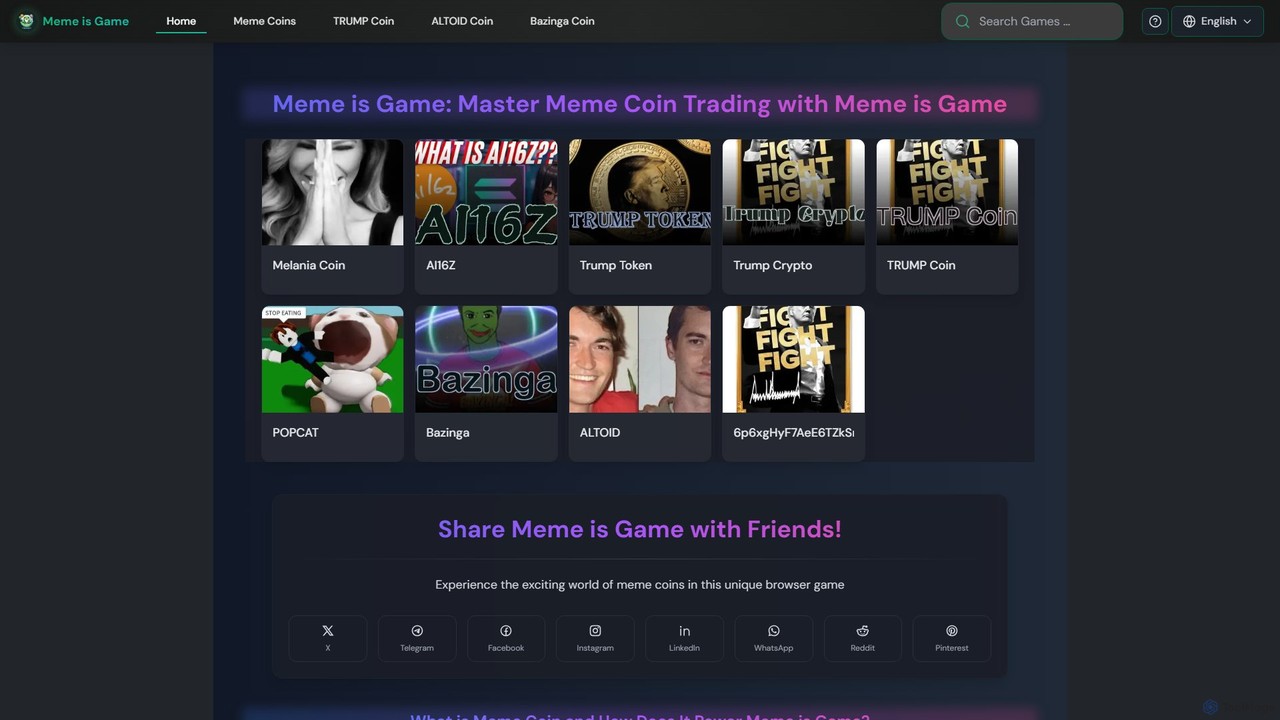
Meme is Game is a browser-based trading simulation game that allows users to experience the thrill of meme coin trading in a risk-free environment. Learn market dynamics, develop trading strategies, and connect with a community of players without risking real money. Master the art of crypto trading through engaging gameplay.

Finance
Visits 4.8KFavorites 111Likes 104

About Simulation

AI Simulation tools are a specialized category within gaming that use artificial intelligence to create dynamic, interactive, and realistic virtual environments. These tools leverage complex algorithms and machine learning models to generate emergent behaviors, realistic physics, and procedural content. Their primary value lies in building immersive game worlds where non-player characters (NPCs), environments, and in-game systems react intelligently and unpredictably to player actions. This moves beyond simple scripting to create truly living, breathing digital experiences.

Core Features

  • Dynamic NPC Behavior: Enables NPCs to have unique goals, memories, and decision-making processes, leading to unscripted interactions.
  • Procedural Content Generation (PCG): Automatically generates game levels, terrains, quests, or assets based on a set of rules and simulation parameters.
  • Complex System Modeling: Simulates intricate systems like economies, ecosystems, or social dynamics within the game world.
  • Realistic Physics Simulation: Applies AI to model and render complex physical phenomena like fluid dynamics, soft-body physics, or material fractures.

Use Cases

These tools are primarily used by game developers and designers to create sophisticated single-player and multiplayer experiences. For instance, in open-world RPGs, they can populate a city with thousands of unique NPCs, each with their own daily routine. In strategy games, they can simulate complex economic models or battlefield tactics that adapt to the player's strategy.

How to Choose

When selecting an AI Simulation tool, consider the specific needs of your game. Key factors include the complexity of the behavior you need to model (e.g., individual NPC AI vs. large-scale crowd simulation), integration with your chosen game engine (like Unity or Unreal Engine), performance overhead, and the level of customization available for algorithms and parameters.

Simulation use cases

1

Creating Living Cities with Dynamic NPCs

A game designer working on an open-world RPG uses an AI simulation tool to populate a large city. Instead of manually scripting paths for thousands of NPCs, the designer sets up rules and motivations (e.g., jobs, family relationships, daily needs). The AI then simulates the daily lives of each citizen, creating emergent crowd behaviors, realistic traffic patterns, and unique, unscripted encounters for the player. This saves hundreds of development hours and results in a more believable and immersive game world.

2

Simulating Complex Game Economies

For a massively multiplayer online (MMO) game, developers need to ensure a balanced and stable economy. They use an AI simulation tool to model the entire economic system, including resource generation, crafting, player trading, and NPC vendors. By running thousands of accelerated simulations with different parameters, they can identify potential exploits, predict inflation, and balance item drop rates before the game goes live. This proactive approach helps prevent economic collapses that could ruin the player experience.

3

Procedural Generation of Game Worlds

A small indie development team wants to create a vast, explorable universe for their space exploration game but lacks the resources to design it all by hand. They use an AI simulation tool with procedural content generation (PCG) capabilities. By defining rules for star formation, planetary physics, and potential for life, the tool generates billions of unique star systems, each with distinct planets, moons, and alien ecosystems. This allows a small team to create a game of immense scale and replayability, as each new game starts with a newly generated universe.

4

Testing and Balancing Game Mechanics

A developer of a competitive strategy game needs to ensure that all playable factions are balanced. Instead of relying solely on human playtesters, they use an AI simulation tool to pit different AI agents, each using a specific faction and strategy, against each other millions of times. The simulation collects vast amounts of data on win rates, unit effectiveness, and common strategies. This data-driven approach allows developers to identify and fix imbalances with much greater speed and accuracy than traditional methods.

5

Realistic Environmental and Physics Simulation

In a survival game, environmental realism is key to immersion. A developer uses an AI simulation tool to create a dynamic weather system and realistic fluid dynamics. The AI simulates weather patterns that affect gameplay, such as storms that make travel difficult or droughts that reduce water sources. It also models how water flows realistically across the terrain, forming rivers and flooding low-lying areas after heavy rain. This creates an unpredictable and challenging environment that players must adapt to, rather than a static, predictable world.

6

Generating Adaptive Enemy Tactics in Strategy Games

A developer for a real-time strategy (RTS) game wants an AI opponent that feels human-like and challenging. They use an AI simulation tool to train a computer opponent that learns from player strategies. The simulation runs thousands of game scenarios, allowing the AI to analyze common player tactics (like rushing or turtling) and develop effective counter-strategies. The result is an AI that doesn't just follow a script but adapts its army composition, build orders, and battlefield maneuvers in response to the player's actions, providing a consistently engaging challenge.

Simulation FAQ

What are AI Simulation tools in gaming?

AI Simulation tools for gaming are advanced software used by developers to create dynamic and realistic game worlds. Unlike traditional scripting, which dictates specific actions, these tools simulate underlying systems, allowing for emergent behavior. Key features include creating intelligent NPCs with their own motivations, modeling complex in-game economies, and procedurally generating vast environments. They are essential for building immersive, unpredictable, and highly replayable games.

How do AI Simulation tools differ from standard game AI?

Standard game AI often relies on finite state machines or behavior trees, which are pre-scripted and predictable. AI Simulation tools take a different approach. Instead of scripting every possible action, they model systems and agent motivations. This leads to emergent behavior, where complex and unscripted situations arise naturally from simple rules. For example, a simulated NPC might decide to steal food because a simulated economy has made prices too high, an action that was never explicitly programmed.

Who should use AI Simulation tools for game development?

AI Simulation tools are valuable for a wide range of game developers. They are particularly useful for:

  • Designers of open-world games: To create believable cities, ecosystems, and NPC populations.
  • Developers of strategy and management games: To model and balance complex systems like economies, politics, or warfare.
  • Indie developers: To generate large amounts of content (like levels or universes) with a small team.
  • QA and balancing teams: To automate testing and gather data on game balance by running thousands of simulated matches.
What are the main challenges of using AI Simulation in games?

While powerful, AI simulation presents challenges. The primary one is performance, as simulating complex systems for many agents can be computationally expensive. Another challenge is controlling the emergent behavior; sometimes, simulations can lead to unintended or game-breaking outcomes that are difficult to debug. Finally, designing good simulation rules requires a deep understanding of both game design and the underlying AI principles to create behavior that is believable and fun, not just chaotic.

How do I choose the right AI Simulation tool for my game?

Choosing the right tool depends on your project's specific needs. Consider the following factors:

  • Engine Compatibility: Ensure the tool integrates well with your game engine (e.g., Unity, Unreal Engine).
  • Scalability: Can the tool handle the number of agents and complexity you require, from a small village to a massive city?
  • Customization: How much control do you have over the simulation's rules, parameters, and AI logic?
  • Performance: Review benchmarks and documentation to understand the tool's performance impact on your game.
  • Documentation and Support: Good documentation and an active community or support team are crucial for troubleshooting and implementation.