
ToolMage
Sign in

Best 1 Text Based AI tools for Gaming

Popular Text Based AI tools in Gaming include GPT Games, helping you work more efficiently.

GPT Games
Freemium

GPT Games

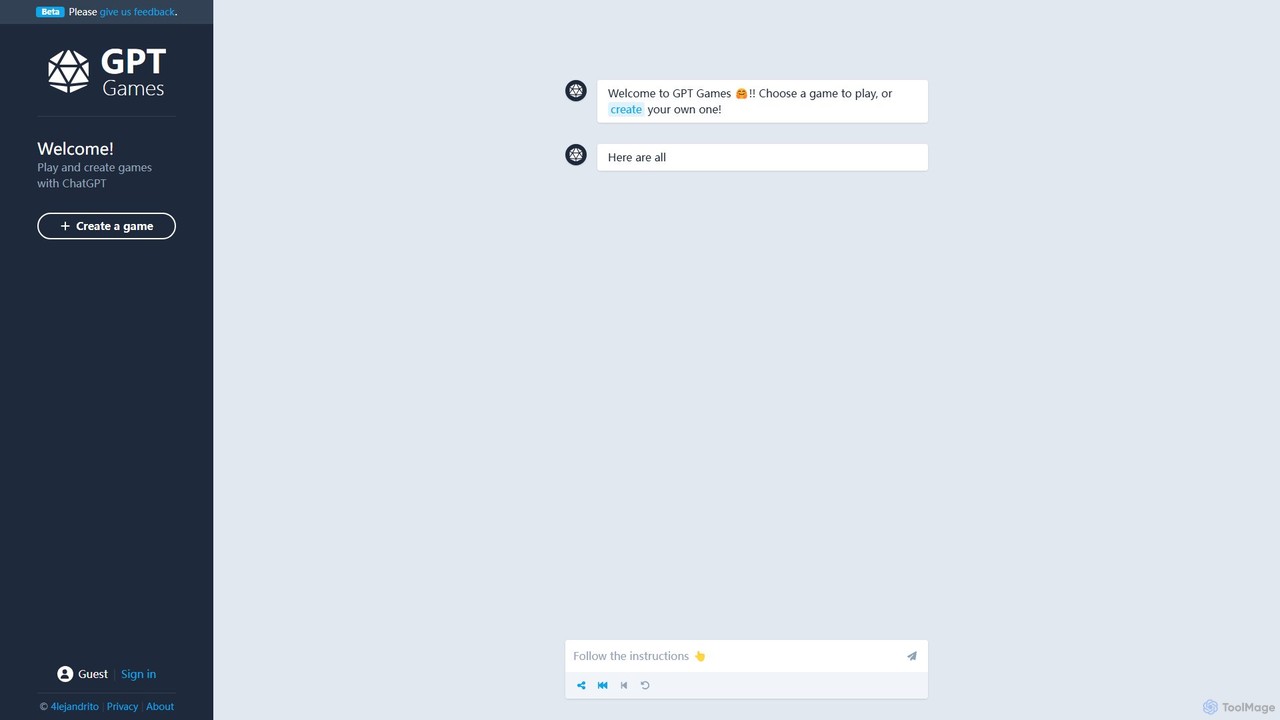
An innovative platform for playing and creating text-based games powered by AI. Choose from a library of existing games or unleash your creativity by designing unique interactive adventures with simple text prompts. No coding skills required.

Simulations
Visits 4.9KFavorites 116Likes 126

About Text Based

AI Text-Based Gaming tools are applications that use artificial intelligence to generate and manage interactive narratives experienced entirely through text. These tools leverage large language models (LLMs) to create dynamic stories, responsive characters, and complex worlds that react to player input in real-time. Their primary value lies in offering boundless narrative possibilities and deep immersion, allowing each playthrough to be a unique adventure. Unlike traditional games, the experience is shaped directly by the player's words and imagination.

Core Features

  • Dynamic Narrative Generation: Creates unique, branching storylines and plot points on the fly based on player actions, ensuring no two games are the same.
  • AI-Driven NPCs: Populates the game world with non-player characters (NPCs) who have unscripted, context-aware conversations and memories.
  • Unrestricted Player Agency: Allows players to type any action or dialogue, with the AI interpreting the input and generating a corresponding outcome.
  • Procedural World-Building: Generates detailed descriptions of locations, items, and lore as the player explores, creating a vast and consistent game world.

Use Cases

These tools are primarily used by solo role-players seeking an AI Dungeon Master, writers and indie developers prototyping interactive fiction, and gamers who prioritize deep storytelling over graphics. They are also valuable in educational settings for creating immersive historical or ethical simulations.

How to Choose

When selecting an AI Text-Based Gaming tool, consider the quality and coherence of its underlying language model, as this directly impacts story quality. Evaluate the level of customization available for genres, rules, and world settings. Also, check for features like memory retention (how well the AI remembers past events) and community platforms for sharing stories.

Text Based use cases

1

Solo Role-Playing with an AI Game Master

A fantasy enthusiast wants to play a role-playing game but doesn't have a group. They use an AI Text-Based Gaming tool to act as the Game Master (GM). The user defines their character, like 'a cunning rogue in a medieval city,' and the AI generates the setting, NPCs, and quests. The player types actions like 'I attempt to pickpocket the merchant' or says 'I ask the guard about the strange noises from the sewer.' The AI dynamically narrates the outcomes, controls all NPCs, and adapts the story to the player's choices, providing a complete, personalized RPG experience without needing other people.

2

Prototyping Interactive Fiction for Writers

An author is developing a complex 'choose your own adventure' novel and wants to test different plotlines quickly. Instead of manually mapping out every branch, they use an AI tool. They input a starting scenario and key plot points. The AI then generates multiple narrative paths and character interactions. The author can play through these paths, asking the AI 'what if the character betrayed their friend here?' to instantly see a new branch unfold. This process allows for rapid iteration and discovery of compelling storylines, saving weeks of planning and writing time before committing to a final draft.

3

Dynamic World-Building for Authors and GMs

A fantasy author or a tabletop RPG Game Master (GM) is creating a new world but is experiencing writer's block. They use an AI Text-Based tool as a creative partner. By providing a basic premise, such as 'a desert city powered by ancient magic,' the AI can generate detailed lore, descriptions of unique locations, factions with complex motivations, and interesting NPCs to populate the world. The user can ask follow-up questions like 'Describe the black market in this city' or 'Generate a creation myth for this world' to flesh out details, significantly accelerating the world-building process and providing inspiration for their novel or campaign.

4

Creating Immersive Educational Simulations

A history teacher wants to create an interactive simulation for students to understand the complexities of a historical event, like the Cuban Missile Crisis. Using an AI Text-Based tool, the teacher sets up the scenario, defining key roles (e.g., President Kennedy, Khrushchev). Students take on these roles and must make decisions by typing their intended actions and diplomatic messages. The AI, acting as a moderator and world simulator, describes the global reactions and consequences of their choices based on historical context. This creates a highly engaging and memorable learning experience that goes beyond textbook reading.

5

Generating Dynamic Dialogue for Game NPCs

An indie game developer is creating an open-world RPG but lacks the resources to write thousands of lines of unique dialogue for every NPC. They integrate an AI text-generation tool via an API. The developer provides each NPC with a personality profile, background, and knowledge base. When a player interacts with an NPC in the game, the AI generates dialogue in real-time that is consistent with the NPC's character and aware of recent game events. This allows a small team to create a world that feels alive and reactive, where players can have unique conversations instead of hearing repeated, pre-scripted lines.

6

Collaborative Storytelling with an AI Partner

A group of friends wants to write a story together but struggles with coordinating ideas. They use a text-based AI tool as a neutral facilitator and co-author. One person starts the story, and then others take turns adding to it. When they get stuck, they can ask the AI to introduce a plot twist, describe a new character, or suggest the next scene. The AI ensures the narrative remains coherent and can even play the role of certain characters or describe the environment, allowing the group to focus on creativity and collaboration without getting bogged down in logistical details.

Text Based FAQ

What are AI Text-Based Games?

AI Text-Based Games are interactive experiences, similar to 'choose your own adventure' books, where the entire world, story, and characters are generated and managed by an artificial intelligence. Unlike traditional games with pre-written scripts, these tools use large language models (LLMs) to create dynamic narratives that respond in unique ways to whatever the player types. This allows for unparalleled freedom and replayability, as the story evolves based on the player's specific actions and dialogue.

How do AI Text-Based Games differ from traditional interactive fiction?

The key difference is dynamism versus pre-scripted paths. Traditional interactive fiction (like Zork) operates on a fixed set of commands and pre-written responses. If you type something the developer didn't anticipate, you get an error. In contrast, AI Text-Based Games use LLMs to understand and react to almost any natural language input. This means you can attempt creative, unexpected actions, and the AI will generate a new, unique outcome, rather than forcing you down a limited number of branching paths.

What are the key features to look for in an AI Text-Based Gaming tool?

When choosing a tool, focus on these aspects:

  • Model Quality: How coherent, creative, and consistent is the AI's writing? A better model leads to a more immersive experience.
  • Customization and Control: Can you set the genre, tone, and specific world rules? Can you edit the AI's responses to steer the story?
  • Memory: How well does the AI remember key characters, plot points, and player actions from earlier in the game? Good memory is crucial for long-term narrative consistency.
  • User Interface: Is the platform easy to navigate and use for long sessions? Features like lore books or character sheets are a plus.
Who are AI Text-Based Gaming tools for?

These tools appeal to a diverse audience. They are ideal for:

  • Solo RPG Players: Individuals who want a Dungeons & Dragons-like experience without needing to schedule a group.
  • Writers and Authors: Creative professionals use them for brainstorming, overcoming writer's block, and prototyping interactive narratives.
  • Gamers Prioritizing Story: Players who value deep, emergent narrative and character interaction over high-fidelity graphics.
  • Educators and Trainers: For creating engaging, interactive simulations for learning purposes.
Is it possible to 'win' an AI Text-Based Game?

Winning is often not the primary goal. Unlike traditional video games with defined objectives and win/loss conditions, most AI text-based experiences are more like open-ended simulations or collaborative storytelling. The focus is on the journey, exploration, and creating a unique narrative. While you can set personal goals within the story (e.g., 'defeat the dragon' or 'solve the mystery'), the game itself usually doesn't end until you decide it does. The 'win' is the compelling story you create along the way.