ToolMage
Sign in

Best 1 Data Infrastructure AI tools for It

Popular Data Infrastructure AI tools in It include FactoryDB, helping you work more efficiently.

FactoryDB
Paid

FactoryDB

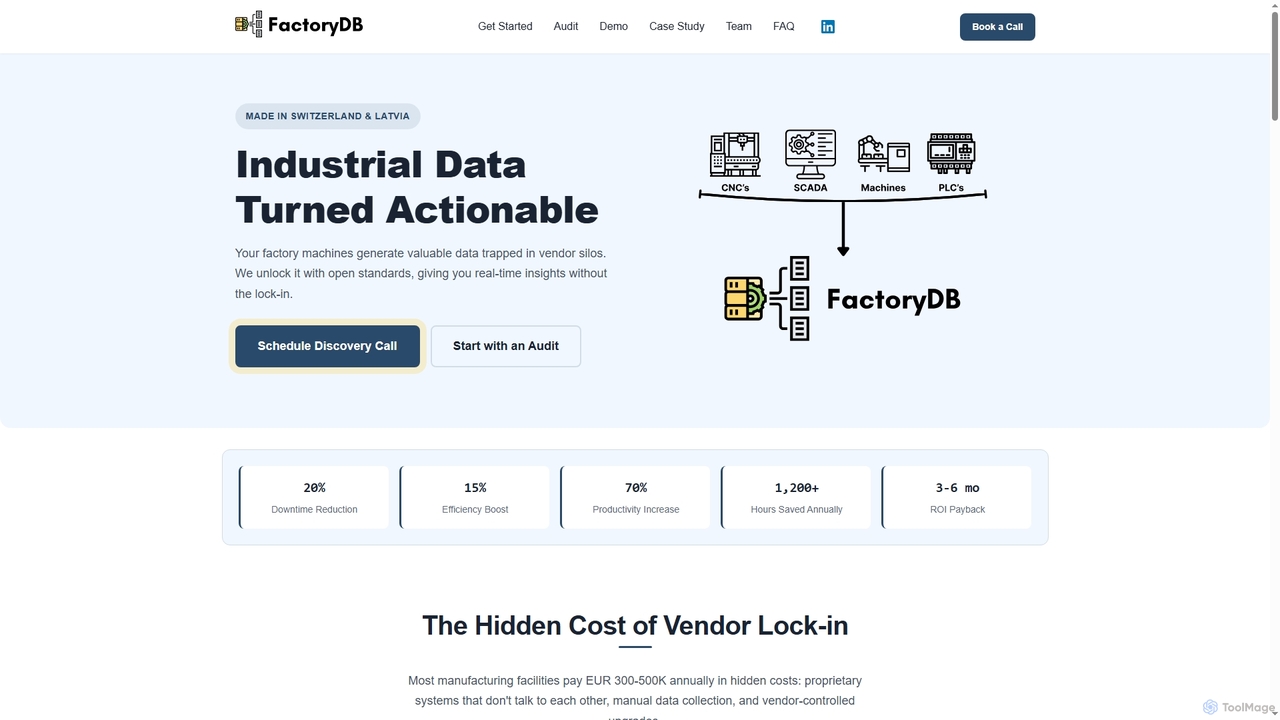
FactoryDB is an industrial data infrastructure platform designed to eliminate vendor lock-in for manufacturers. Using open standards like MQTT, it unifies data from PLCs, SCADA, and MES systems into a single, vendor-neutral layer. This enables real-time analytics, predictive maintenance, and significant efficiency gains, particularly for regulated industries such as pharmaceuticals, food & beverage, and energy.

3D
Visits 6.5KFavorites 136Likes 133

About Data Infrastructure

Data Infrastructure tools are specialized AI-powered solutions that provide the foundational systems for collecting, storing, processing, and managing the vast datasets essential for artificial intelligence and machine learning operations. These tools ensure data availability, integrity, and performance, enabling efficient training, deployment, and scaling of AI models within the broader IT landscape. They are critical for handling the unique demands of AI workloads, from real-time data ingestion to complex analytical processing.

Core Features

  • Scalable Data Storage: Provides high-performance, distributed storage solutions optimized for large-scale AI datasets, supporting various data types and access patterns.
  • Automated Data Pipelines: Facilitates the creation and management of automated data ingestion, transformation, and loading (ETL) pipelines to prepare data for AI model training.
  • Real-time Data Processing: Enables low-latency processing and analysis of streaming data, crucial for real-time AI applications like fraud detection or recommendation systems.
  • Data Governance & Security: Implements robust security measures, access controls, and compliance frameworks to protect sensitive AI training data and model outputs.
  • Resource Orchestration: Manages and optimizes computational resources (GPUs, CPUs) and storage across distributed environments for efficient AI workload execution.

Applicable Scenarios

Data Infrastructure is indispensable for organizations building and deploying AI. For instance, a large tech company developing a new language model requires robust infrastructure to store petabytes of text data and manage distributed training jobs across thousands of GPUs. Similarly, financial institutions use it for real-time processing of transaction data to power AI-driven fraud detection systems, ensuring immediate analysis and response. E-commerce platforms leverage it to collect and process customer interaction data, feeding recommendation engines that personalize user experiences.

How to Choose

Selecting the right Data Infrastructure tools involves evaluating several key factors. Consider the required scalability to handle future data growth and increasing AI model complexity. Assess performance needs, including data ingestion rates, processing speed, and query latency, especially for real-time applications. Evaluate integration capabilities with existing AI/ML platforms, data sources, and cloud environments. Finally, scrutinize security features, compliance certifications, and the total cost of ownership, including operational overhead and maintenance.

Data Infrastructure use cases

1

Building Scalable Data Lakes for AI Training

Data scientists and machine learning engineers require a robust data lake to store diverse, raw datasets (images, text, audio, sensor data) at scale for training complex AI models. Data infrastructure tools facilitate the creation of such lakes, providing flexible storage, metadata management, and efficient data retrieval mechanisms. This enables iterative model development and experimentation without data bottlenecks, ensuring high-quality input for deep learning algorithms and reducing training times.

2

Building Scalable AI Model Training Pipelines

Machine learning engineers and data scientists utilize robust data infrastructure to construct efficient and scalable pipelines for AI model training. This involves automating the ingestion of vast datasets from various sources, performing necessary data cleaning and transformation, and delivering prepared data to ML platforms. A well-designed infrastructure ensures consistent data quality and availability, significantly reducing the time and effort required for iterative model development and deployment, leading to faster innovation and improved model performance.

3

Building Scalable AI/ML Training Pipelines

Data scientists and machine learning engineers leverage data infrastructure to establish robust and scalable pipelines for training AI models. This involves efficiently ingesting vast datasets from various sources, performing complex data transformations (ETL), and storing the prepared data in optimized data lakes or warehouses. The infrastructure ensures data quality, lineage, and accessibility, allowing for rapid iteration of model training, version control, and seamless integration with AI platforms, ultimately accelerating the development and deployment of high-performing AI solutions.

4

Building Scalable Data Pipelines for AI Training

Data scientists and ML engineers utilize data infrastructure tools to construct automated pipelines that ingest raw data from various sources, clean, transform, and store it in optimized formats. This ensures a continuous supply of high-quality, pre-processed data essential for training and fine-tuning complex AI models, significantly reducing manual data preparation time and improving model accuracy.

5

Building Scalable Data Pipelines for AI Training

Data scientists and ML engineers require robust data pipelines to feed clean, pre-processed data into AI models. Data infrastructure tools enable the automated ingestion, transformation, and loading (ETL) of massive datasets from various sources into data lakes or warehouses. This ensures a continuous supply of high-quality data, significantly reducing manual data preparation time and accelerating the iterative process of model training and refinement, leading to more accurate and efficient AI systems.

6

Powering Real-time Business Intelligence Dashboards

Business analysts and operations managers rely on data infrastructure to feed real-time business intelligence (BI) dashboards. The infrastructure processes streaming data from sales, customer interactions, and operational systems with low latency, ensuring that BI tools display the most current metrics. This enables immediate insights into key performance indicators (KPIs), allowing decision-makers to react swiftly to market changes, identify emerging trends, and optimize operational strategies without delay, significantly enhancing business agility and responsiveness.

7

Real-time Analytics and Business Intelligence

Business analysts and decision-makers need immediate insights from operational data to respond quickly to market changes. Data infrastructure provides the backbone for real-time data streaming and processing, allowing for instant aggregation and analysis of incoming data from sales, customer interactions, or IoT sensors. This capability supports dynamic dashboards, fraud detection, and personalized customer experiences, enabling proactive business strategies and competitive advantages.

8

Enabling Real-time Analytics for Business Operations

Business analysts and operations managers leverage data streaming and warehousing solutions within the data infrastructure to process and analyze incoming data streams instantly. This allows for real-time monitoring of key performance indicators, immediate fraud detection, and dynamic inventory management, providing critical insights for agile decision-making and rapid response to market changes.

9

Real-time Data Ingestion for AI-Powered Analytics

For applications like fraud detection, personalized recommendations, or IoT monitoring, AI models need access to fresh, real-time data streams. Data infrastructure tools provide high-throughput ingestion pipelines that capture, process, and deliver streaming data with minimal latency. This allows AI systems to make immediate, data-driven decisions, responding to events as they happen and significantly enhancing the responsiveness and accuracy of real-time AI applications.

10

Real-time Analytics for Business Intelligence

Business analysts and data engineers leverage real-time data infrastructure to gain immediate insights into operational performance and customer behavior. By processing streaming data from applications, IoT devices, or transactional systems, organizations can monitor key metrics as they happen. This capability enables proactive decision-making, such as identifying emerging market trends, detecting anomalies in financial transactions, or personalizing customer experiences instantly, providing a competitive edge through timely intelligence.

11

Ensuring Data Governance and Compliance

Compliance officers and data stewards implement data infrastructure components like data catalogs, metadata management, and access controls to enforce data governance policies. This ensures data quality, lineage tracking, and adherence to regulations such as GDPR or HIPAA, mitigating risks associated with data breaches and non-compliance while maintaining data integrity across the enterprise.

12

Secure Data Storage and Governance for Compliance

Organizations handling sensitive customer or proprietary data, particularly in regulated industries like finance or healthcare, must ensure strict data security and compliance. Data infrastructure solutions offer encrypted storage, granular access controls, data masking, and audit trails to meet regulations like GDPR or HIPAA. This protects against data breaches, maintains customer trust, and avoids hefty fines, ensuring legal and ethical data handling practices.

13

Ensuring Data Governance and Compliance

Compliance officers and data stewards rely on data infrastructure to establish and enforce comprehensive data governance policies, meeting regulatory requirements like GDPR or HIPAA. These tools provide mechanisms for data lineage tracking, access control, data masking, and auditing, ensuring data integrity and security. By centralizing governance efforts, organizations can minimize compliance risks, maintain data quality, and build trust with customers and stakeholders, avoiding costly penalties and reputational damage.

14

Achieving a 360-Degree Customer View for Personalization

Marketing and customer service teams utilize data infrastructure to consolidate disparate customer data from CRM, sales, social media, and web analytics platforms into a unified customer profile. This comprehensive 360-degree view enables businesses to understand customer behavior, preferences, and journey across all touchpoints. By leveraging this integrated data, companies can deliver highly personalized marketing campaigns, tailored product recommendations, and proactive customer support, significantly improving customer satisfaction and driving higher conversion rates and loyalty.

15

Orchestrating Distributed AI Model Training Workloads

Training large-scale AI models, especially deep neural networks, often requires significant computational resources distributed across multiple GPUs or clusters. Data infrastructure solutions include orchestration capabilities that manage these distributed workloads, allocating resources efficiently, monitoring job progress, and handling failures. This ensures that complex training runs are completed reliably and optimally, maximizing resource utilization and accelerating the development cycle for advanced AI.

16

Migrating Legacy Data to Cloud-Native Platforms

IT administrators and cloud architects often face the challenge of moving vast amounts of historical data from on-premise systems to modern cloud environments. Data infrastructure tools facilitate this complex migration by providing robust connectors, data validation mechanisms, and scalable transfer capabilities. This transition enables organizations to leverage cloud elasticity, reduce operational costs, and unlock new analytical possibilities with cloud-based AI services, modernizing their data landscape.

17

Ensuring Regulatory Compliance and Data Auditing

Compliance officers and legal teams in regulated industries, such as finance and healthcare, rely on robust data infrastructure to meet stringent regulatory requirements like GDPR, HIPAA, or CCPA. The infrastructure provides secure data storage with encryption, detailed data lineage tracking, and comprehensive auditing capabilities. This ensures that all data operations are transparent, traceable, and compliant, minimizing legal risks and enabling quick responses to audit requests by demonstrating proper data handling, access controls, and retention policies.

18

Consolidating Disparate Data Sources into a Unified Lake

Enterprise architects and data engineers use data lake solutions to centralize vast amounts of structured and unstructured data from various departmental systems, IoT devices, and external feeds. This unified repository facilitates comprehensive data exploration and advanced analytics, breaking down data silos and providing a holistic view for strategic planning and innovation.

19

Consolidating Data from Disparate Sources

Data architects and IT managers use data infrastructure to integrate and consolidate information from various siloed systems, such as CRM, ERP, and marketing platforms, into a unified data repository. This process involves designing efficient ETL/ELT workflows to extract, transform, and load data, creating a single source of truth. A consolidated view of data facilitates comprehensive reporting, cross-functional analysis, and supports the development of holistic AI applications that leverage all available organizational data.

20

Ensuring Data Governance and Security for AI Datasets

AI models are only as good as the data they're trained on, and this data often contains sensitive information. Data infrastructure tools provide critical features for data governance, including access control, encryption, data masking, and audit trails. This helps organizations comply with regulations like GDPR or HIPAA, protect proprietary data, and maintain the integrity and privacy of datasets used for AI development, building trust and mitigating risks.

21

Optimizing Data Storage for Cost and Performance

IT administrators and cloud architects deploy tiered storage solutions and data archiving within the data infrastructure to manage data lifecycle efficiently. By categorizing data based on access frequency and retention policies, they can move less frequently accessed data to more cost-effective storage tiers, balancing performance requirements with budget constraints and ensuring long-term data availability.

22

Automating ETL Pipelines for Machine Learning Feature Engineering

Before data can be used for machine learning, it often needs extensive cleaning, transformation, and feature engineering. Data infrastructure tools automate these Extract, Transform, Load (ETL) processes, allowing data engineers to build repeatable pipelines that prepare data for model consumption. This reduces manual effort, ensures data consistency, and accelerates the time-to-insight for machine learning projects, providing well-structured features for optimal model performance.

23

Optimizing Data Storage for Cost and Performance

Cloud architects and data operations teams employ data infrastructure solutions to optimize storage strategies, balancing cost-efficiency with performance requirements. This includes implementing tiered storage, data compression, and intelligent data lifecycle management policies to move less frequently accessed data to cheaper storage tiers while keeping critical data readily available. Effective storage optimization reduces cloud spending, improves data retrieval speeds, and ensures that resources are allocated efficiently based on data value and access patterns.

24

Supporting Large-Scale Machine Learning Model Deployment

After training, deploying machine learning models into production requires a stable and performant data serving layer. Data infrastructure ensures that models can access necessary features and inference data with low latency and high throughput. This involves optimized data stores, caching mechanisms, and integration with model serving platforms. A well-designed infrastructure guarantees that deployed AI applications deliver consistent, real-time predictions and recommendations to end-users.

25

Managing High-Volume IoT Data for Predictive Maintenance

Industrial engineers and operations managers in manufacturing or logistics leverage data infrastructure to ingest and process massive volumes of data generated by IoT sensors on machinery, vehicles, or infrastructure. This real-time data stream, including temperature, vibration, and performance metrics, is analyzed to identify anomalies and predict potential equipment failures. By implementing predictive maintenance strategies based on these insights, companies can minimize downtime, reduce repair costs, and extend the lifespan of critical assets, optimizing operational efficiency and preventing costly disruptions.

26

Monitoring and Managing AI Application Performance

Once AI models are deployed, their performance and the underlying data infrastructure need continuous monitoring. Tools in this category offer comprehensive monitoring, logging, and alerting capabilities for data pipelines, storage systems, and computational resources. This allows operations teams to quickly identify and resolve bottlenecks, ensure data flow health, and maintain the reliability and efficiency of AI-powered applications in production environments, preventing service disruptions.

27

Supporting Large-scale Data Migration Projects

IT project managers and migration specialists utilize robust data infrastructure to plan and execute large-scale data migration projects, such as moving data from on-premise systems to the cloud or consolidating multiple legacy databases. These tools provide capabilities for data profiling, cleansing, mapping, and secure transfer, minimizing downtime and ensuring data integrity throughout the migration process. A well-managed data migration infrastructure mitigates risks, accelerates project completion, and ensures a smooth transition to new data environments.

28

Supporting Hybrid and Multi-Cloud Data Environments

Cloud architects and DevOps teams utilize data infrastructure tools that offer seamless integration and management across on-premises and multiple cloud platforms. This enables organizations to leverage the best features of different environments, ensure data portability, and maintain business continuity, providing flexibility and resilience for evolving data strategies without vendor lock-in.

29

Establishing a Scalable Data Lake for Big Data Analytics

Enterprise architects and data engineers design and implement data infrastructure to create scalable data lakes capable of storing diverse data types, including raw, semi-structured, and unstructured data, at massive scales. This serves as a central repository for big data analytics, allowing data scientists to perform exploratory analysis, build new data models, and prepare datasets for future AI projects without the constraints of traditional data warehouses. The data lake infrastructure supports flexible schema-on-read approaches, enabling agility in data exploration and fostering innovation across the organization.

30

Data Lake Management for Unstructured Data

Data engineers and researchers frequently work with diverse, unstructured data types such as images, videos, audio, and text, which are critical for advanced AI applications like computer vision and natural language processing. Data infrastructure provides data lake solutions that can store raw, schema-on-read data at scale. This allows for flexible exploration and experimentation with various data formats, enabling the development of innovative AI models that can derive insights from previously inaccessible information.

Data Infrastructure FAQ

What is Data Infrastructure?

Data Infrastructure refers to the comprehensive set of systems, tools, and processes that enable organizations to manage, store, process, and analyze large volumes of data efficiently and securely. It forms the backbone for all data-driven initiatives, including advanced analytics, business intelligence, and the development and deployment of AI and machine learning models. Key components often include data ingestion pipelines, various storage solutions (like data lakes and warehouses), processing engines, and tools for data governance and security.

What is Data Infrastructure?

Data Infrastructure refers to the complete ecosystem of hardware, software, network, and processes that manage an organization's data assets. It encompasses systems for data storage, processing, integration, governance, and security, providing the foundational framework for all data-driven activities, including business intelligence, analytics, and advanced AI/ML applications. Its primary goal is to ensure data is accessible, reliable, and scalable for various organizational needs.

What is Data Infrastructure?

Data Infrastructure refers to the integrated set of hardware, software, and network components designed to manage, store, process, and analyze an organization's data. It includes databases, data warehouses, data lakes, ETL tools, and data governance frameworks, providing the foundation for data-driven applications, analytics, and AI/ML initiatives. Its primary goal is to ensure data is accessible, reliable, and secure for various business needs.

What is Data Infrastructure in the context of AI?

Data Infrastructure in the context of AI refers to the comprehensive set of hardware, software, and network resources specifically designed to support the demanding data needs of artificial intelligence and machine learning workloads. It encompasses systems for efficient data collection, scalable storage, high-performance processing, and robust management of vast and diverse datasets. Its core purpose is to provide a reliable, secure, and performant foundation that ensures AI models have continuous access to high-quality data for training, validation, and inference, enabling the development and deployment of intelligent applications.

What are Data Infrastructure tools in the context of AI?

Data Infrastructure tools are the foundational systems and software that enable the efficient collection, storage, processing, and management of data specifically for AI and machine learning workloads. They provide the necessary backbone for handling large volumes of diverse data, ensuring its quality, accessibility, and security throughout the AI lifecycle, from model training to deployment and inference.

Why is robust Data Infrastructure crucial for AI and ML?

Robust Data Infrastructure is crucial for AI and ML because these technologies are inherently data-intensive, requiring massive volumes of high-quality, accessible data for training and inference. It ensures that AI models receive clean, consistent, and timely data, preventing "garbage in, garbage out" scenarios. Furthermore, it provides the scalable processing power and storage necessary to handle complex algorithms and large datasets, enabling efficient model development, deployment, and continuous improvement.

How does AI enhance Data Infrastructure?

AI significantly enhances data infrastructure by automating complex tasks, optimizing resource utilization, and extracting deeper insights. AI-powered tools can automate data ingestion, cleansing, and transformation processes, reducing manual effort and errors. Machine learning algorithms can optimize data storage by identifying hot and cold data, improving query performance, and predicting storage needs. Furthermore, AI can enhance data security by detecting anomalies and potential threats in real-time, and it enables advanced analytics capabilities that transform raw data into predictive and prescriptive intelligence, making the infrastructure more intelligent and responsive.

How do Data Infrastructure tools differ from general IT infrastructure?

While general IT infrastructure provides broad computing and storage capabilities, Data Infrastructure tools are specifically optimized for the unique demands of AI. They often feature specialized components for high-performance computing (e.g., GPU clusters), scalable data lakes, real-time streaming analytics, and robust data governance tailored for machine learning datasets. Their focus is on data-intensive, often distributed, and computationally heavy AI workloads, whereas general IT infrastructure serves a wider range of enterprise applications.

How do I choose the right Data Infrastructure tools for my AI project?

Choosing the right Data Infrastructure involves several key considerations. First, assess your data volume, velocity, and variety to ensure the infrastructure can scale adequately. Second, evaluate its compatibility and integration capabilities with your existing AI/ML frameworks and tools. Third, prioritize robust data governance, security, and compliance features, especially for sensitive data. Fourth, consider the total cost of ownership, including operational complexity and maintenance. Finally, look for solutions that offer flexibility and ease of use, aligning with your team's technical expertise and future growth plans.

How do I choose the right Data Infrastructure for my organization?

Choosing the right data infrastructure involves assessing several factors: your current and future data volume and velocity, specific analytical needs (real-time vs. batch), budget, existing IT ecosystem for integration, and compliance requirements. Consider scalability, performance, security features, ease of management, and vendor support. A modular approach that allows for growth and adaptation is often beneficial.

How does Data Infrastructure differ from traditional IT Infrastructure?

While Data Infrastructure is a subset of broader IT Infrastructure, it specifically focuses on the specialized components and processes for managing data, whereas traditional IT infrastructure covers all computing resources like servers, networks, and operating systems. Data infrastructure emphasizes data pipelines, databases, data lakes, data warehouses, and governance tools tailored for data lifecycle management, analytics, and AI workloads, going beyond general compute and network connectivity to optimize for data-centric operations.

What are the key components of a modern AI Data Infrastructure?

A modern AI Data Infrastructure typically comprises several key components. These include scalable data storage solutions like data lakes and data warehouses for diverse data types. High-performance data processing engines (e.g., Spark, Flink) are crucial for transformation and analysis. Data ingestion tools facilitate real-time and batch data collection from various sources. Data governance and security frameworks ensure compliance and protection. Additionally, metadata management, data cataloging, and monitoring tools are essential for maintaining data quality, discoverability, and operational efficiency across the entire data lifecycle.

What's the difference between Data Infrastructure and general IT Infrastructure?

General IT Infrastructure encompasses all hardware, software, networks, and facilities that support an organization's IT operations, including servers, operating systems, and networking equipment. Data Infrastructure is a specialized subset of IT infrastructure, specifically focused on the systems and tools for managing data assets. While IT infrastructure provides the overall operational environment, data infrastructure directly handles data lifecycle, from ingestion to analysis, ensuring data-specific needs are met.

What are the key components of an AI Data Infrastructure?

A robust AI Data Infrastructure typically includes several key components. These encompass scalable data storage solutions (like data lakes or data warehouses), powerful data processing engines (for ETL, streaming, and batch processing), workflow orchestration tools for managing data pipelines and ML operations (MLOps), robust data governance and security frameworks, and monitoring/observability platforms to ensure system health and performance. Specialized hardware like GPUs and high-speed networking are also crucial.

What are the key components of a modern Data Infrastructure?

A modern data infrastructure typically comprises several key components working in concert. These include data ingestion tools (for collecting data from various sources), data storage solutions (such as data lakes for raw data and data warehouses for structured, refined data), data processing engines (for transforming and analyzing data, often supporting real-time streams), data governance frameworks (for ensuring quality, compliance, and security), and integration layers (to connect with analytics platforms, AI/ML tools, and business applications). Cloud-native services often form the backbone of these components for scalability and flexibility.

How does Data Infrastructure differ from traditional IT infrastructure?

While data infrastructure is a subset of broader IT infrastructure, its primary distinction lies in its specialized focus on data. Traditional IT infrastructure provides the general computing, networking, and storage resources for all enterprise applications. Data infrastructure, however, is specifically optimized for the unique challenges of managing large, diverse datasets, supporting high-volume data ingestion, complex transformations, and advanced analytics, often with real-time requirements. It incorporates specialized tools like data lakes, data warehouses, and stream processing engines, which are not typically central to general IT infrastructure, to enable data-driven decision-making and AI capabilities.

Who benefits most from using Data Infrastructure tools?

Data Infrastructure tools primarily benefit data scientists, machine learning engineers, data engineers, and IT operations teams in organizations that heavily rely on AI. Data scientists gain reliable access to high-quality data for model training. ML engineers can efficiently deploy and scale models. Data engineers build and manage robust data pipelines. IT operations ensure the underlying systems are performant, secure, and cost-effective, ultimately enabling the entire organization to leverage AI effectively.

How does Data Infrastructure support the development and deployment of AI models?

Data Infrastructure is fundamental to the entire AI model lifecycle. During development, it provides the necessary environment for data scientists to access, clean, and prepare large datasets for model training, often involving complex feature engineering. It ensures data quality and consistency, which are critical for model accuracy. For deployment, a robust infrastructure guarantees that trained models can access real-time inference data with low latency and high availability, enabling AI applications to deliver consistent performance in production. It also supports model monitoring and retraining by continuously feeding new data back into the system.

What are the key components of a robust Data Infrastructure?

A robust data infrastructure typically includes several key components:

  • Data Storage: Databases (SQL/NoSQL), data warehouses, data lakes.
  • Data Integration: ETL/ELT tools, data streaming platforms.
  • Data Processing: Batch processing (e.g., Spark) and real-time processing engines.
  • Data Governance: Metadata management, data cataloging, access control, security.
  • Monitoring & Management: Tools for performance, health, and cost management.

These components work together to ensure efficient data flow and utilization.

What are the key components of a modern Data Infrastructure?

A modern Data Infrastructure typically includes several key components: scalable data storage solutions (like data lakes and data warehouses), robust data ingestion and processing engines (for ETL/ELT and streaming data), data integration tools, metadata management systems, and comprehensive data governance frameworks. It also often incorporates cloud computing resources for flexibility and scalability, along with security measures to protect sensitive information throughout its journey.

How can I choose the right Data Infrastructure for my AI project?

Choosing the right Data Infrastructure for your AI project requires careful consideration of several factors. First, assess your data volume, velocity, and variety (3Vs) to determine storage and processing needs. Second, evaluate the specific AI/ML frameworks and tools you plan to use for compatibility. Third, consider scalability requirements for future growth and the need for real-time processing. Finally, factor in budget, security compliance, ease of management, and whether a cloud-based, on-premise, or hybrid solution best fits your organizational strategy.

How does Data Infrastructure support AI and Machine Learning initiatives?

Data Infrastructure is fundamental to AI/ML by providing the necessary foundation for data collection, preparation, and delivery. It ensures AI models have access to large volumes of high-quality, clean, and well-structured data for training. Features like scalable storage, efficient data pipelines, and real-time data streaming enable continuous model retraining and deployment, directly impacting the accuracy and performance of AI applications. Without a solid data infrastructure, AI/ML projects struggle with data availability and quality.

What are the main challenges in building Data Infrastructure?

Building robust data infrastructure presents several challenges. One major hurdle is managing the ever-increasing volume, velocity, and variety of data (Big Data challenges). Ensuring data quality, consistency, and governance across disparate sources is another significant task. Security and compliance with evolving data privacy regulations (e.g., GDPR, CCPA) are paramount and complex. Furthermore, integrating new data tools and AI/ML platforms with existing legacy systems can be difficult, and finding skilled professionals to design, implement, and maintain these complex systems remains a persistent challenge for many organizations.

What challenges does Data Infrastructure help solve?

Data Infrastructure helps solve critical challenges such as managing ever-increasing data volumes, ensuring data quality and consistency across disparate sources, and providing timely access to data for analytics and AI. It addresses issues of data security and compliance, reduces data silos, and enables organizations to scale their data operations efficiently. By providing a reliable foundation, it mitigates risks associated with data loss, poor decision-making, and inefficient resource utilization.

What's the difference between traditional data infrastructure and AI-specific data infrastructure?

While traditional data infrastructure focuses on general business intelligence and operational reporting, AI-specific data infrastructure is optimized for the unique demands of machine learning. Traditional systems often prioritize structured data and batch processing, whereas AI infrastructure handles massive volumes of diverse data (structured, unstructured, semi-structured) with a strong emphasis on real-time processing and high-performance computing. AI infrastructure also integrates more deeply with ML platforms, offering specialized tools for data versioning, feature stores, and GPU/TPU acceleration, all designed to streamline the AI development and deployment workflow.