getdynamiq
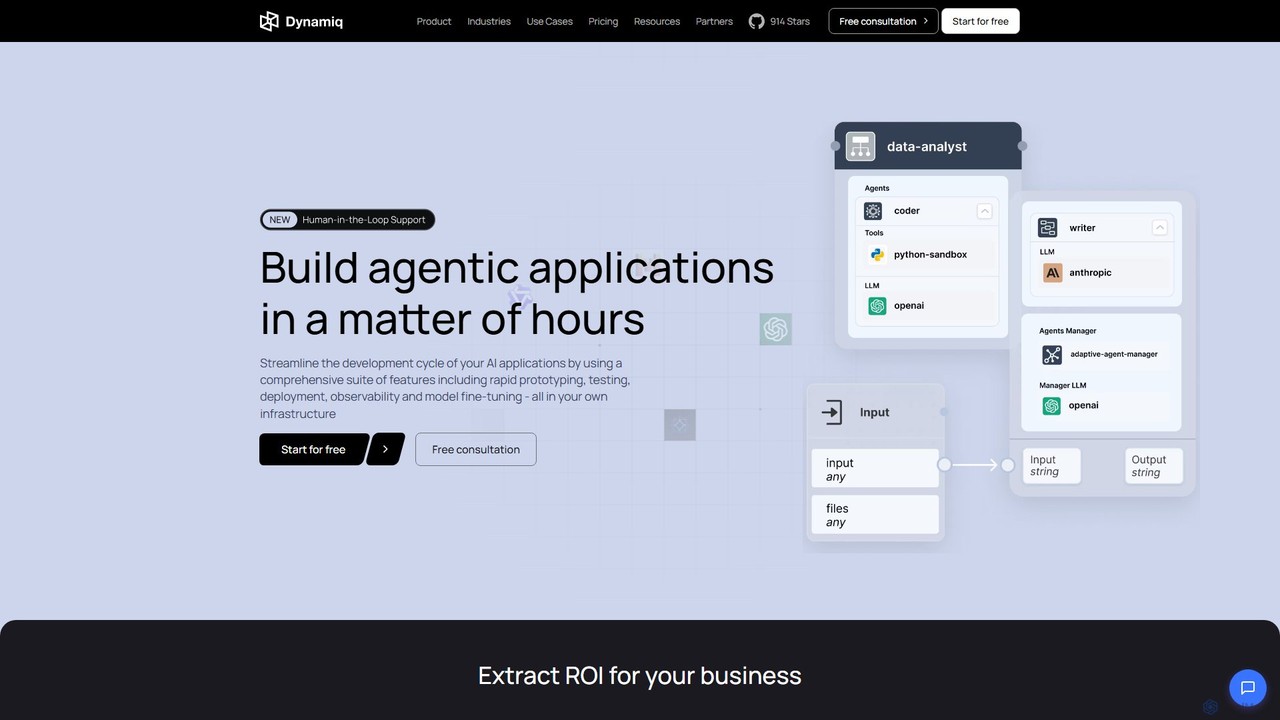
Dynamiq is an end-to-end operating platform for enterprises to build, deploy, and manage agentic AI applications. It streamlines …
Dynamiq is an end-to-end operating platform for enterprises to build, deploy, and manage agentic AI applications. It streamlines the entire development lifecycle, from rapid prototyping and data integration with RAG to secure on-premise deployment and LLM fine-tuning, all within your own infrastructure.
About Mlops
MLOps (Machine Learning Operations) tools provide a set of practices and technologies to deploy and maintain machine learning models in production reliably and efficiently. They combine principles from machine learning, DevOps, and data engineering to automate and streamline the entire ML lifecycle. This approach accelerates the delivery of models from experimentation to production, improves operational stability, and ensures governance. MLOps tools bridge the critical gap between model development by data scientists and deployment by operations teams.
Core Features
- CI/CD for ML: Automates the building, testing, and deployment of both ML models and the data pipelines that feed them.
- Model Monitoring: Continuously tracks the performance, data drift, and prediction accuracy of models in a live environment.
- Experiment Tracking: Logs and versions code, data, parameters, and metrics for every training run to ensure reproducibility.
- Model Registry: Provides a centralized repository to store, version, and manage trained models for deployment and auditing.
- Feature Store: Manages and serves curated data features consistently for both model training and real-time inference.
Use Cases
MLOps tools are essential for organizations scaling their AI initiatives. They are widely used in industries like finance for managing fraud detection models, e-commerce for maintaining real-time recommendation engines, and healthcare for deploying and monitoring diagnostic models under strict regulatory compliance.
How to Choose
When selecting an MLOps tool, consider the scale of your ML projects, integration with your existing cloud infrastructure (e.g., AWS, Azure, GCP), and the technical expertise of your team. Evaluate whether you need an end-to-end platform or specific components like experiment tracking or model monitoring. Also, assess the tool's support for governance, security, and collaboration features.
MlopsUse Cases
Automating Model Retraining and Deployment
A retail company's data science team uses an MLOps platform to build a CI/CD pipeline for their demand forecasting model. When new weekly sales data is ingested, the pipeline automatically triggers a retraining job. The tool then validates the new model's performance against a test set. If it meets the predefined accuracy threshold, it is automatically packaged and deployed to the production environment, replacing the old version with zero downtime. This ensures the forecast is always based on the most recent data without manual intervention.
Monitoring for Model Drift and Performance Degradation
A fintech company deploys a credit scoring model using an MLOps tool. The tool's monitoring feature continuously tracks the distribution of input data (e.g., applicant income, age) and the model's prediction outputs. It automatically raises an alert when it detects significant data drift, meaning the production data no longer resembles the training data. This early warning allows the ML team to investigate the cause, such as changing economic conditions, and trigger a retraining process before the model's accuracy degrades and leads to poor lending decisions.
Managing and Versioning ML Experiments
A research team at a biotech firm is developing a model to predict protein structures. They use an MLOps tool with experiment tracking capabilities. For each training run, the tool automatically logs the Git commit of the code, the dataset version, all hyperparameters, and the resulting performance metrics. This creates a complete and immutable record, allowing researchers to easily compare different approaches, reproduce past results reliably, and collaborate by sharing specific experiment runs. It eliminates the need for manual spreadsheets and ensures full auditability of the research process.
Centralizing Features to Prevent Training-Serving Skew
An e-commerce platform uses a feature store, a key component of their MLOps stack, to manage user activity data. Data engineers create features like 'average_purchase_value' and 'last_seen_days_ago' and store them in the feature store. The data science team then uses these exact same features for training their recommendation model. When a user visits the site, the live recommendation service queries the same feature store for real-time features. This ensures perfect consistency between training and serving data, eliminating training-serving skew, a common cause of model performance issues in production.
Ensuring Governance and Compliance in Model Deployment
A healthcare organization must comply with strict regulations for its diagnostic AI models. They use an MLOps platform with a model registry to maintain a full audit trail. Every model version is stored in the registry with associated metadata, including the data it was trained on, its validation results, and the approvals from the clinical review board. When deploying a model, the platform ensures only approved versions can be pushed to production. This provides complete traceability and accountability, simplifying regulatory audits and ensuring patient safety.
Collaborative Model Development Across Teams
A large enterprise has separate data science, data engineering, and IT operations teams. An MLOps platform acts as a central hub for collaboration. Data scientists can develop models in their preferred notebooks and use the platform's SDK to package them. Data engineers then define and automate the data pipelines that feed these models within the same platform. Finally, the IT ops team uses the platform's interface to manage deployments, monitor performance, and set up alerts, all within a standardized and unified workflow. This breaks down silos and accelerates the path from idea to production.