It & Security Best in category 1 results Infrastructure Monitoring AI Tool

Popular AI tools in the Infrastructure Monitoring field of It & Security include Site24x7, etc., helping you quickly improve efficiency.

Site24x7

Site24x7

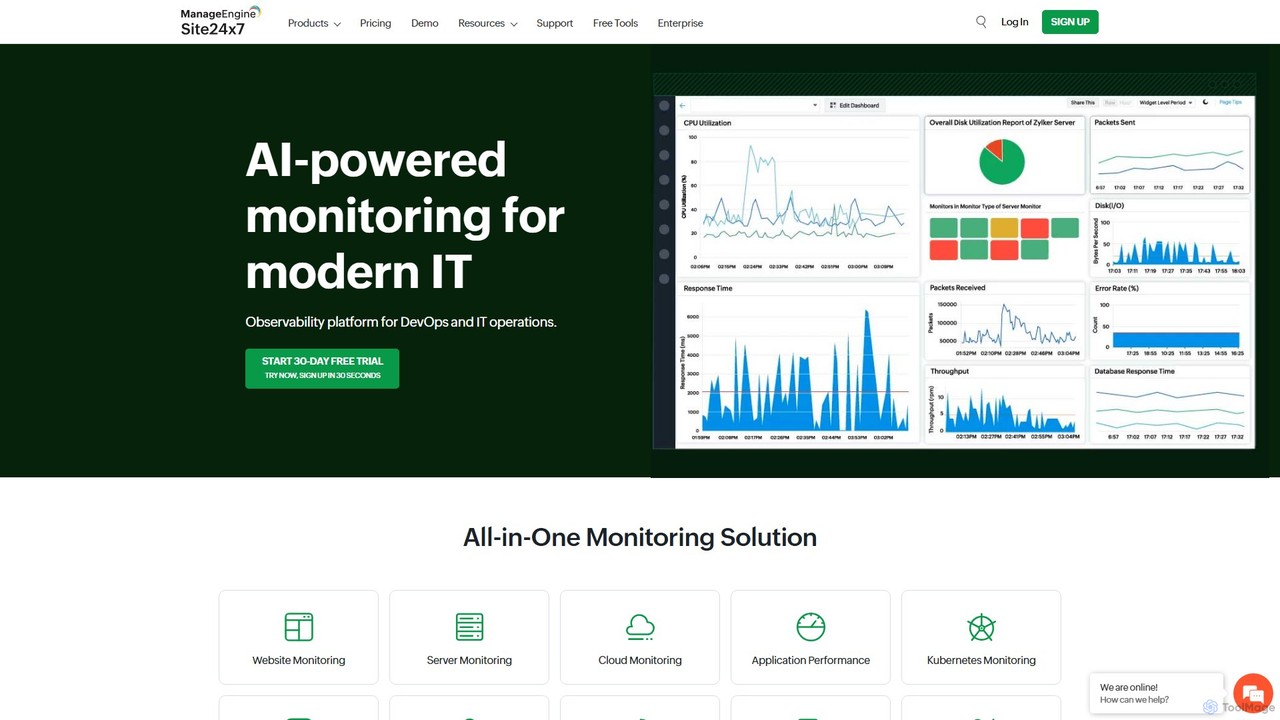
Site24x7 is an AI-powered, all-in-one observability platform for DevOps and IT operations. It provides comprehensive monitoring for websites, …

1.0M

About Infrastructure Monitoring

AI Infrastructure Monitoring tools are platforms that use artificial intelligence to automatically observe, analyze, and manage the health and performance of IT systems. These tools leverage machine learning algorithms to detect anomalies, predict potential failures, and identify root causes in real-time across servers, networks, and cloud services. Their primary value lies in shifting IT operations from a reactive to a proactive model, significantly reducing downtime and optimizing resource allocation. This advanced monitoring is a critical component of modern IT & Security, ensuring system reliability and stability.

Core Features

  • Predictive Anomaly Detection: Uses machine learning to identify unusual patterns and potential issues before they escalate into critical failures.
  • Automated Root Cause Analysis (RCA): Automatically correlates data from various sources to pinpoint the exact origin of a problem, reducing manual investigation time.
  • Intelligent Alerting: Groups related alerts and suppresses noise, reducing alert fatigue and allowing teams to focus on high-priority incidents.
  • Capacity Planning & Forecasting: Analyzes historical trends to predict future resource needs, helping to prevent performance bottlenecks and optimize costs.

Use Cases

These tools are essential for DevOps engineers, Site Reliability Engineers (SREs), and IT operations teams managing complex, dynamic environments. They are widely used in sectors like e-commerce to ensure uptime during peak traffic, in financial services for maintaining transaction system stability, and by SaaS companies to meet service-level agreements (SLAs).

How to Choose

When selecting an AI Infrastructure Monitoring tool, consider its integration capabilities with your existing tech stack (e.g., Kubernetes, AWS, Azure). Evaluate the depth of its AI features—does it offer true predictive analytics or just basic anomaly detection? Also, assess its scalability to handle your data volume and the clarity of its data visualizations and dashboards for effective decision-making.

Infrastructure MonitoringUse Cases

1

Proactive Outage Prevention for E-commerce Platforms

An SRE team at a major e-commerce company uses an AI infrastructure monitoring tool to prepare for a large-scale sales event. The tool's predictive analytics model, trained on historical traffic data, forecasts a 300% spike in database load. Based on this prediction, the team proactively scales up database resources and optimizes query performance two hours before the event begins. As a result, the platform handles the peak traffic without any performance degradation or downtime, ensuring a smooth customer experience and maximizing revenue.

2

Automated Root Cause Analysis in Microservices

A DevOps team manages a complex application built on hundreds of microservices. When users report slow response times, the AI monitoring tool automatically analyzes metrics, logs, and traces across all services. Instead of engineers manually sifting through data, the tool's RCA feature pinpoints a specific 'payment-service' microservice with a memory leak as the root cause within minutes. It presents a correlated view of the issue's impact, allowing the team to immediately focus their efforts, deploy a fix, and restore service performance 90% faster than with traditional methods.

3

Optimizing Cloud Costs with Capacity Forecasting

An IT manager is tasked with reducing a company's monthly cloud computing bill. By using an AI infrastructure monitoring tool, they analyze historical usage patterns of their virtual machine instances. The tool's forecasting feature predicts that 20% of their instances are consistently over-provisioned and underutilized, even during peak hours. Based on this data-driven insight, the manager confidently right-sizes the instances, leading to a direct 15% reduction in their monthly cloud expenditure without impacting application performance.

4

Reducing Alert Fatigue for NOC Teams

A Network Operations Center (NOC) team was overwhelmed by thousands of individual alerts daily from their legacy monitoring system, leading to missed critical incidents. After implementing an AI monitoring tool, its intelligent alerting feature automatically correlates related events. For example, a single network switch failure that previously generated 50 separate 'server unreachable' alerts is now consolidated into one high-priority incident titled 'Network Switch Failure Impacting 50 Servers'. This reduces alert volume by over 80%, allowing the NOC team to focus on root problems instead of symptoms.

5

Ensuring SLA Compliance for a SaaS Provider

A B2B SaaS provider has a strict 99.9% uptime Service Level Agreement (SLA) with its enterprise clients. They use an AI infrastructure monitoring tool to continuously track key performance indicators (KPIs) like application response time, server CPU utilization, and database latency. The tool's AI detects a subtle, gradual increase in database latency that could lead to an SLA breach within 24 hours. It alerts the operations team with a high-priority notification, enabling them to identify and resolve a poorly performing database index before any customers are impacted, thus successfully upholding their SLA commitment.

6

Dynamic Resource Allocation in a Cloud-Native Environment

A financial tech company runs its trading platform on a Kubernetes cluster. The workload fluctuates unpredictably throughout the day. An AI monitoring tool continuously analyzes resource consumption patterns and predicts upcoming demand spikes with high accuracy. It integrates with the Kubernetes Horizontal Pod Autoscaler to dynamically adjust the number of running pods in real-time. This ensures that the platform always has sufficient resources to handle trading volumes without delay, while also automatically scaling down during quiet periods to save over 25% on cloud costs.

Infrastructure MonitoringFrequently Asked Questions