
Elastic
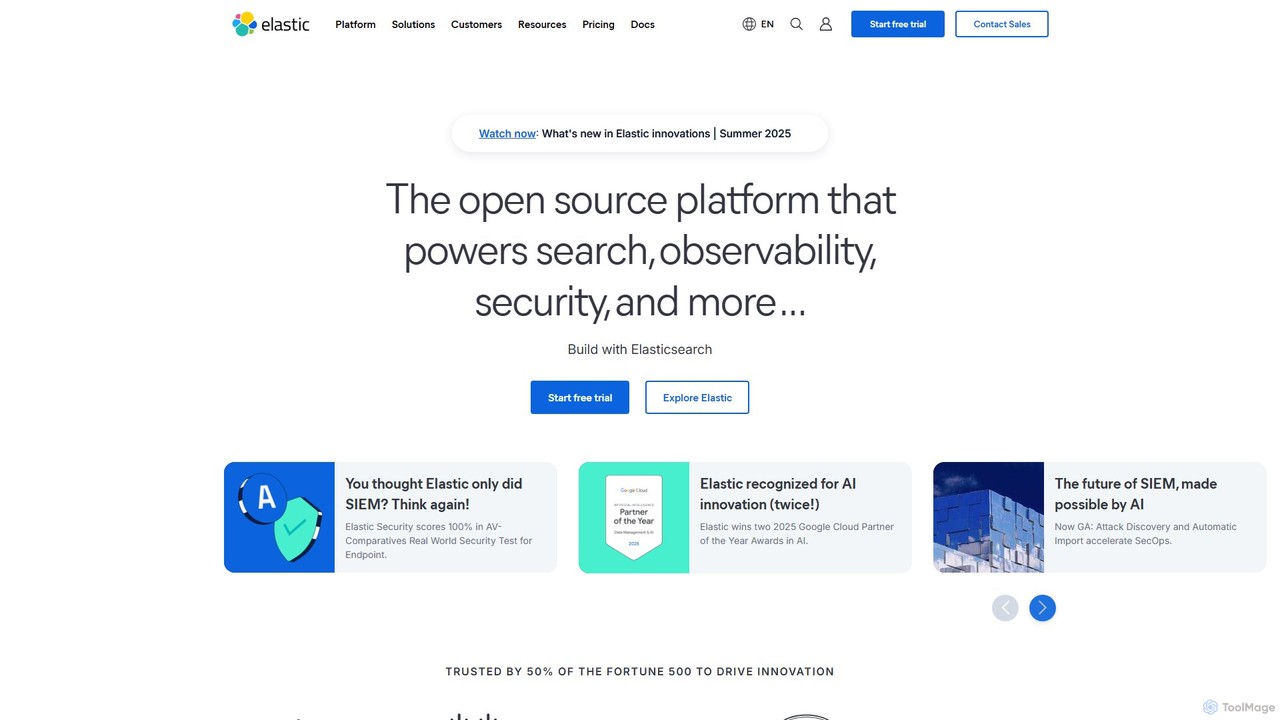
Elastic is a comprehensive Search AI platform built on Elasticsearch. It provides powerful solutions for enterprise search, observability, …
Elastic is a comprehensive Search AI platform built on Elasticsearch. It provides powerful solutions for enterprise search, observability, and security, integrating generative AI and a leading vector database to help organizations analyze data, monitor systems, and protect against threats in real-time.
About Cybersecurity
AI Cybersecurity tools are a specialized category of software that leverages machine learning to proactively detect, analyze, and respond to digital threats. Unlike traditional security systems that rely on known signatures, these tools analyze vast datasets to identify anomalous patterns and predict potential attacks before they occur. Their primary value lies in automating threat hunting, reducing response times, and uncovering sophisticated, zero-day vulnerabilities that evade conventional defenses. This makes them a critical component of modern security operations within the broader IT & Security landscape.
Core Features
- Predictive Threat Analytics: Uses machine learning models to analyze historical data and current trends to forecast potential cyberattacks.
- Automated Incident Response: Automatically isolates infected systems, blocks malicious IP addresses, and executes predefined security playbooks.
- Behavioral Analytics (UEBA): Establishes baseline behaviors for users and devices, flagging significant deviations that may indicate a compromise.
- AI-Powered Vulnerability Management: Intelligently scans systems for weaknesses and prioritizes patching based on exploit likelihood and potential business impact.
Applicable Scenarios
These tools are essential for Security Operations Centers (SOCs), financial institutions protecting transactional data, and healthcare organizations safeguarding patient records. They are also widely adopted in e-commerce to prevent fraud and in cloud environments to manage complex security configurations and compliance requirements.
Selection Criteria
When choosing an AI Cybersecurity tool, evaluate its integration capabilities with your existing security stack (e.g., SIEM, SOAR). Assess the accuracy of its detection models and its false positive rate. Consider the level of automation it offers for incident response and whether it aligns with your team's technical expertise and operational workflows.
CybersecurityUse Cases
Automated Phishing and Spear-Phishing Detection
An IT security team in a large corporation uses an AI Cybersecurity tool to defend against advanced email threats. The tool analyzes incoming emails in real-time, examining not just sender reputation and keywords but also linguistic patterns, link destinations, and attachment behaviors. It can distinguish between a legitimate invoice and a sophisticated spear-phishing attempt disguised as one. When a malicious email is detected, it is automatically quarantined, and the intended recipient is notified, preventing credential theft or malware infection without manual intervention from an analyst.
Real-time Zero-Day Malware Identification
A Security Operations Center (SOC) analyst is tasked with protecting endpoints from unknown malware. Instead of relying on signature databases, an AI-powered endpoint detection and response (EDR) tool monitors process behavior. When a user downloads a new application, the AI observes its actions—such as attempts to modify system files, encrypt data, or communicate with suspicious servers. If the behavior matches patterns associated with ransomware or spyware, the tool instantly terminates the process and isolates the endpoint from the network, containing the threat before it can spread.
Detecting Insider Threats with Behavioral Analytics
A financial institution needs to protect sensitive customer data from internal risks. They deploy a User and Entity Behavior Analytics (UEBA) platform. The AI establishes a baseline of normal activity for each employee, learning their typical login hours, data access patterns, and locations. If an employee's account suddenly starts accessing unusual volumes of client records late at night from a foreign IP address, the system flags this as a high-risk anomaly. It alerts the security team, enabling them to investigate a potential compromised account or a malicious insider before a data breach occurs.
AI-Driven Autonomous Penetration Testing
A cybersecurity consulting firm uses an AI platform to conduct more efficient penetration tests for its clients. The AI tool autonomously maps the client's network, identifies assets, and probes for vulnerabilities. It mimics the decision-making process of a human hacker, selecting attack vectors, attempting to escalate privileges, and moving laterally across the network to find critical weaknesses. This process runs continuously, providing a real-time view of the organization's security posture and allowing the human testers to focus on complex, strategic vulnerabilities that require creative thinking.
Managing Cloud Security and Compliance
A DevOps team managing a multi-cloud infrastructure uses an AI-powered Cloud Security Posture Management (CSPM) tool. The AI continuously scans configurations across AWS, Azure, and GCP, comparing them against industry best practices and compliance frameworks like GDPR or HIPAA. It automatically detects and alerts on misconfigurations, such as publicly accessible storage buckets or overly permissive access controls. The tool can also suggest or automatically apply remediations, ensuring the cloud environment remains secure and compliant without constant manual audits.
Automated Security Log Analysis
A small security team at a mid-sized company is overwhelmed by the volume of security logs from firewalls, servers, and applications. They implement an AI-powered Security Information and Event Management (SIEM) system. The AI automatically ingests and normalizes terabytes of log data. It then uses machine learning to identify correlated events that indicate a complex attack, such as a brute-force login attempt followed by unusual data exfiltration from the same IP. This surfaces critical threats from the noise, allowing the team to focus their investigation on genuine incidents instead of manually sifting through endless logs.