
UniHosted
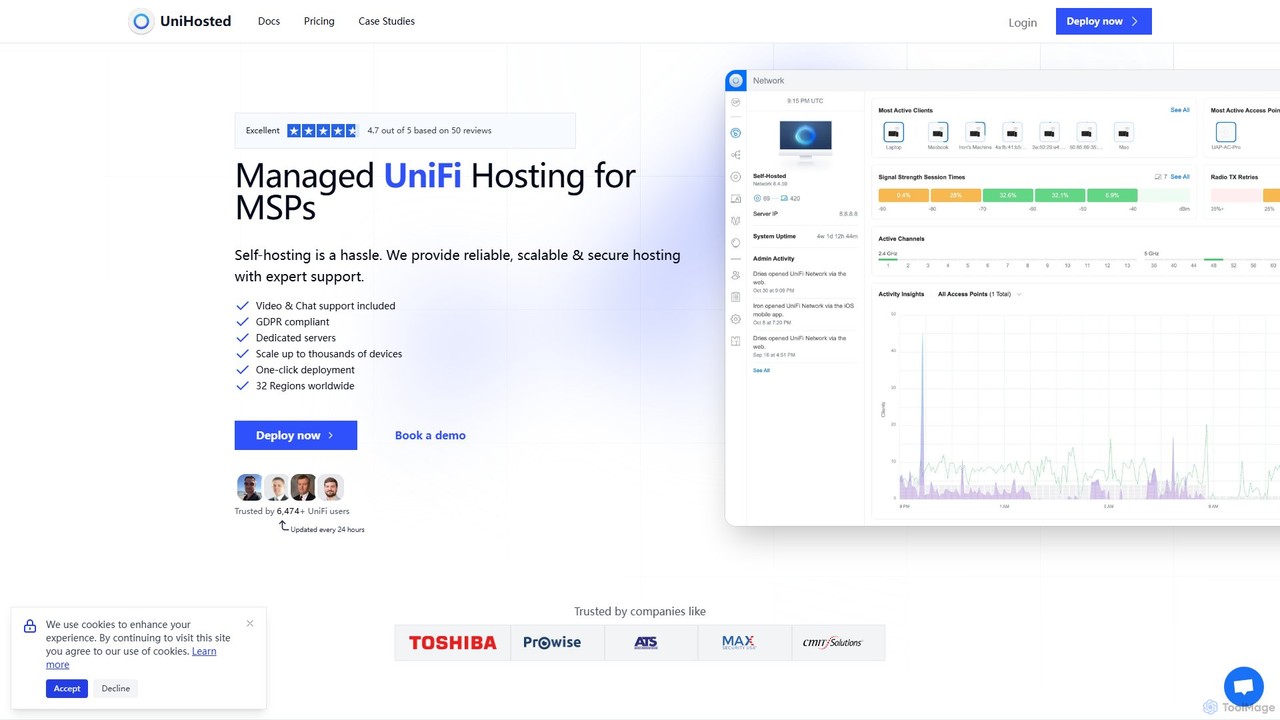
UniHosted offers specialized, managed UniFi hosting for MSPs and IT professionals. It provides a reliable, scalable, and secure …
UniHosted offers specialized, managed UniFi hosting for MSPs and IT professionals. It provides a reliable, scalable, and secure cloud-based platform to deploy and manage UniFi controllers, eliminating the complexities and security risks of self-hosting. Features include one-click deployment, daily backups, advanced security, and expert support.
About Network Management
AI Network Management tools are advanced solutions that leverage machine learning and artificial intelligence to proactively monitor, analyze, and optimize network performance and security. These tools go beyond traditional monitoring by using predictive analytics to identify potential issues like bottlenecks or hardware failures before they impact users. They automate complex tasks such as root cause analysis and threat detection, significantly reducing manual intervention. This intelligent approach helps organizations maintain high network availability, enhance security posture, and optimize resource allocation within the broader IT & Security framework.
Core Features
- Predictive Analytics: Utilizes historical data and ML models to forecast network congestion, device failures, and performance degradation.
- Automated Root Cause Analysis (RCA): Instantly analyzes thousands of data points to pinpoint the exact source of a network issue, reducing mean time to resolution (MTTR).
- Intelligent Anomaly Detection: Identifies unusual traffic patterns or device behavior that may indicate a security breach or operational problem.
- Automated Remediation: Automatically executes corrective actions, such as re-routing traffic or adjusting configurations, to resolve detected issues.
- Dynamic Traffic Shaping: Prioritizes and allocates bandwidth in real-time based on application needs and business policies to ensure quality of service.
Use Cases
These tools are essential for organizations with complex, mission-critical networks. They are widely used in data centers to prevent outages, by enterprises to ensure stable connectivity for employees and applications, and by Managed Service Providers (MSPs) to efficiently manage multiple client networks. Industries like finance, e-commerce, and healthcare rely on them to guarantee service uptime and data security.
How to Choose
When selecting an AI Network Management tool, consider its integration capabilities with your existing infrastructure (routers, firewalls, cloud services). Evaluate the sophistication and transparency of its AI models for accurate predictions and analysis. Assess the level of automation it offers for remediation and its scalability to grow with your network. Finally, examine its reporting and visualization features for clear insights into network health.
Network ManagementUse Cases
Proactive Outage Prevention in a Data Center
A data center operations team is responsible for maintaining 99.999% uptime for critical client services. Instead of reacting to failures, they use an AI Network Management tool. The tool's predictive analytics engine analyzes performance metrics from thousands of devices and forecasts a core switch is 85% likely to fail within the next 48 hours due to rising temperature and packet drop rates. The team receives an automated alert, allowing them to schedule a replacement during a planned maintenance window, completely avoiding an unexpected outage and preserving service level agreements (SLAs).
Automated Security Threat Isolation
A corporate security analyst is tasked with protecting the network from internal and external threats. An AI Network Management tool with anomaly detection capabilities continuously monitors traffic flows. It flags a workstation that suddenly starts communicating with a known malicious IP address and exhibits unusual data exfiltration patterns. Instead of manual intervention, the tool's automated remediation policy instantly quarantines the device by reconfiguring its switch port, preventing the potential threat from spreading across the network. The analyst receives a detailed report for investigation, having already contained the risk.
Optimizing Video Conferencing Quality of Service (QoS)
A large enterprise relies heavily on video conferencing for global team collaboration. Employees frequently complain about poor call quality and lag. A network engineer uses an AI tool to analyze traffic patterns. The AI identifies that non-critical background processes, like large data backups, are consuming significant bandwidth during peak business hours, conflicting with real-time video traffic. The tool automatically implements dynamic QoS policies to prioritize video and VoIP traffic, de-prioritizing the backup traffic. As a result, call quality improves dramatically, and employee productivity is restored without manual configuration changes.
Rapid Troubleshooting for E-commerce Platform Slowdowns
During a major sales event, an e-commerce website experiences intermittent slowdowns, causing cart abandonment. The IT team is under pressure to find the cause quickly. They use an AI Network Management tool with automated root cause analysis. The tool ingests logs, metrics, and traffic data from across the infrastructure. Within minutes, it correlates a spike in latency with a misconfigured load balancer that is incorrectly routing traffic to an overloaded server. The AI provides a clear diagnosis and suggests a configuration change, allowing the team to resolve the issue in under 15 minutes, a task that could have taken hours of manual log analysis.
Managing Wi-Fi Performance Across a Retail Chain
An IT manager for a national retail chain needs to ensure reliable in-store Wi-Fi for customers and point-of-sale (POS) systems across hundreds of locations. Using an AI Network Management tool, they gain a centralized view of all wireless networks. The AI analyzes usage patterns, identifying stores with chronic connectivity issues or dead zones. It recommends optimal access point placements and channel configurations to improve coverage. Furthermore, it predicts peak customer traffic times for each store, allowing for proactive bandwidth adjustments to ensure POS transactions are never delayed, enhancing the customer experience.
Optimizing Multi-Cloud Network Performance
A DevOps team manages applications deployed across multiple public cloud providers (AWS, Azure, GCP). They face challenges in diagnosing latency issues between services running in different clouds. An AI Network Management tool provides end-to-end visibility across their entire multi-cloud environment. It uses machine learning to baseline normal network behavior and automatically detects performance deviations. When an application slows down, the tool identifies the specific inter-cloud network path causing the latency and suggests alternative routing configurations or region placements to optimize performance and reduce data transfer costs.