EmailEngine
EmailEngine is a self-hosted email API that allows developers to integrate their applications with existing email accounts. It …
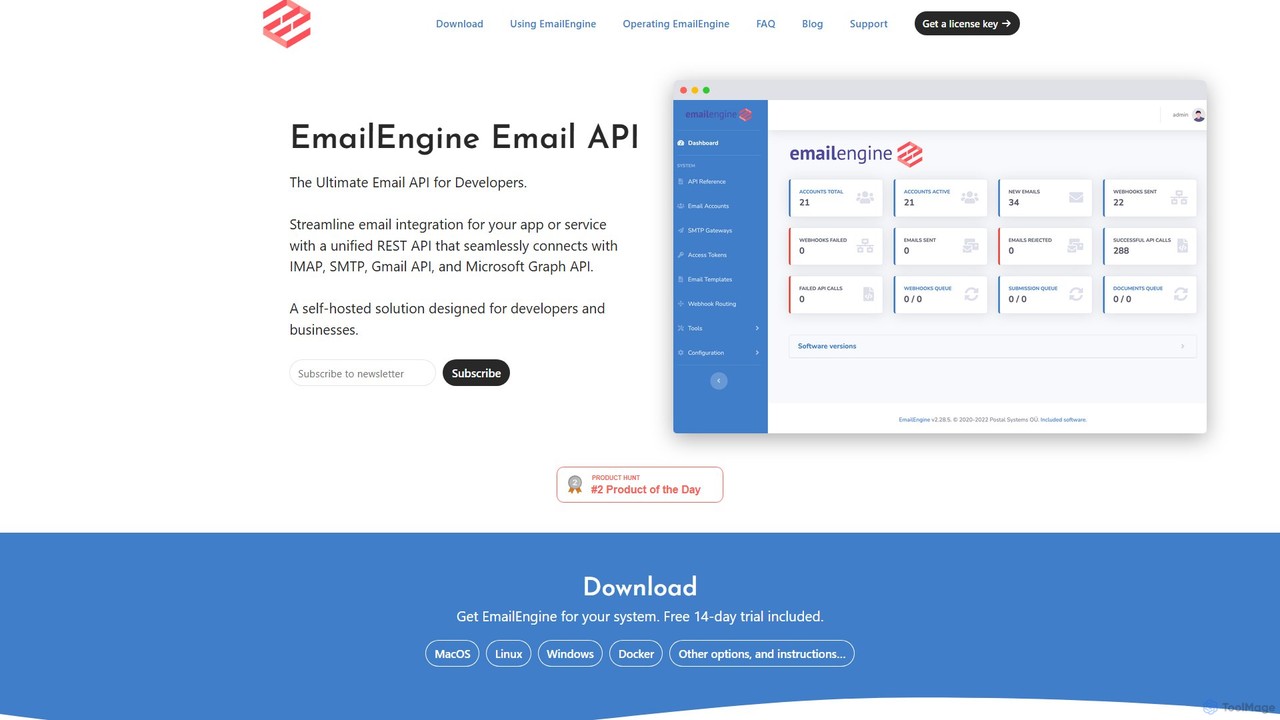
EmailEngine is a self-hosted email API that allows developers to integrate their applications with existing email accounts. It provides a RESTful API for reading and sending emails via IMAP, SMTP, Gmail API, and MS Graph API, ensuring data privacy and compliance by keeping all information on your own servers.
About Self Hosted
Self-hosted AI tools are applications that you install and manage on your own servers or private cloud infrastructure. This deployment model grants you complete control over your data, security protocols, and system configurations. It is particularly valuable for organizations with stringent data privacy requirements or those needing to deeply integrate AI into their proprietary IT ecosystem. While offering maximum autonomy, these tools require internal technical expertise for initial setup, maintenance, and updates.
Core Features
- Data Sovereignty: Ensures all data, including sensitive information, remains within your own network infrastructure, never transmitted to third parties.
- Full Customization: Allows for modification of the software's environment, configurations, and sometimes source code to fit specific workflows.
- Cost Control: Often involves a one-time license fee or is open-source, potentially reducing long-term costs compared to recurring SaaS subscriptions.
- Offline Operation: Capable of functioning within a closed network without requiring a constant external internet connection.
Use Cases
Self-hosted AI tools are frequently adopted in sectors with high data sensitivity, such as finance, healthcare, government, and legal services. They are also ideal for technology companies that need to protect intellectual property while developing AI-powered features, or for enterprises that require custom integrations with existing on-premise legacy systems.
How to Choose
When selecting a self-hosted AI tool, first assess your team's technical capacity for server management, deployment, and security. Evaluate the total cost of ownership (TCO), including hardware, licensing, and maintenance personnel. Ensure the tool meets your specific compliance and data governance standards (e.g., GDPR, HIPAA). Finally, consider its scalability and compatibility with your existing technology stack.
Self HostedUse Cases
Secure In-House Document Analysis for Legal Firms
A legal technology team needs to analyze thousands of sensitive client contracts for specific clauses without exposing the data to third-party cloud services. By deploying a self-hosted Natural Language Processing (NLP) model on the firm's private server, lawyers can upload and process documents entirely within their secure network. This approach ensures absolute client confidentiality, complies with legal data protection regulations, and significantly accelerates the due diligence and discovery processes.
On-Premise AI Chatbot for Internal IT Support
A corporate IT department aims to automate common employee queries, such as password resets and software access requests. To maintain data privacy and integrate with internal systems like Active Directory, they install a self-hosted chatbot framework. This bot operates exclusively within the company's firewall, accessing internal knowledge bases securely. The result is a 24/7 support channel that reduces the IT helpdesk's workload while ensuring sensitive employee and system data never leaves the corporate network.
Private Code Generation to Protect Intellectual Property
A software development team at a tech company is working on a proprietary algorithm. They want to use an AI code assistant to speed up development but cannot risk exposing their source code to a public, cloud-based service. They set up a self-hosted AI coding tool on a secure, air-gapped server. This allows their developers to generate, refactor, and debug code with AI assistance, knowing that all their code and the logic behind it remains confidential and protected as valuable intellectual property.
Offline Image Recognition for Manufacturing Quality Control
A factory production line needs to automatically detect defects in products, but the facility has unreliable or no internet connectivity. A self-hosted computer vision model is deployed on a local edge server connected directly to cameras on the assembly line. The AI analyzes images in real-time to identify anomalies, triggering alerts without any reliance on external networks. This ensures continuous, high-speed quality control, maintains operational privacy, and prevents production halts due to connectivity issues.
Custom AI Model Training for Financial Risk Assessment
Data scientists at a financial institution need to train a machine learning model on highly confidential customer transaction data to predict credit risk. Due to strict regulations like PCI DSS, this data cannot be uploaded to a public cloud. They use a self-hosted machine learning platform within their secure data center. This allows them to process, analyze, and train proprietary models on sensitive data, ensuring full compliance and creating a highly accurate, custom risk assessment tool that provides a competitive advantage.
Building a Private Generative AI for Internal Content Creation
A corporate communications team wants to use a large language model (LLM) to draft internal reports and press releases based on confidential strategic plans. To prevent this sensitive information from being exposed to public AI models, they deploy a private instance of an LLM on internal servers. They can then fine-tune this model with their own company data, creating a secure and highly relevant generative AI assistant. This empowers employees to create content efficiently without compromising corporate secrets.