KowboyKit
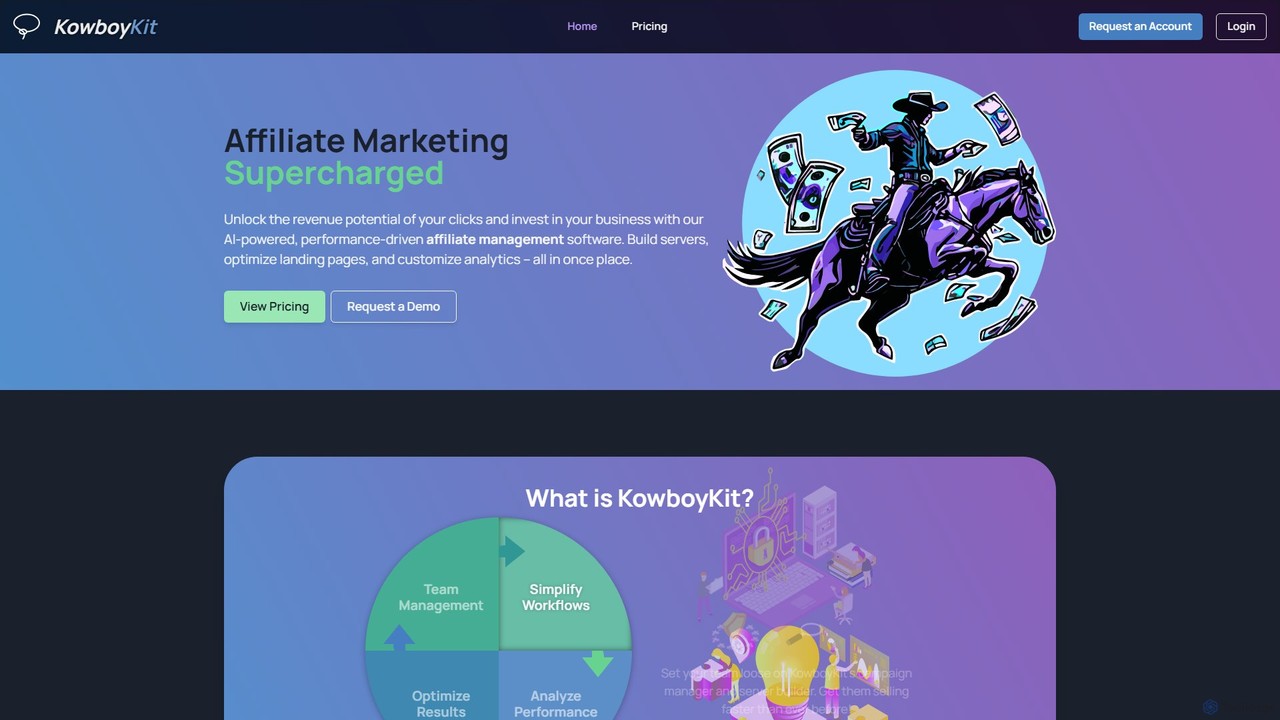
KowboyKit is an AI-powered, performance-driven affiliate management software designed to supercharge your marketing efforts. It provides an all-in-one …
KowboyKit is an AI-powered, performance-driven affiliate management software designed to supercharge your marketing efforts. It provides an all-in-one platform for building servers, optimizing landing pages, managing campaigns, and analyzing performance. Ideal for media buying teams and affiliate marketers looking to scale their operations and maximize revenue.
About Server Management
AI Server Management tools are a class of software that uses artificial intelligence to automate and optimize the monitoring, maintenance, and security of server infrastructures. These tools leverage machine learning models to analyze performance metrics, logs, and network traffic in real-time, moving beyond simple threshold-based alerts. Their primary value lies in proactively identifying potential issues, automating complex administrative tasks, and providing deep insights for resource optimization. This predictive approach helps organizations reduce downtime, enhance security, and control operational costs in complex IT environments.
Core Features
- Predictive Maintenance: Analyzes historical data and system health metrics to forecast potential hardware failures or performance degradation before they occur.
- Automated Resource Scaling: Dynamically adjusts server resources like CPU, RAM, and storage based on real-time workload demands to maintain performance and optimize costs.
- AI-Powered Anomaly Detection: Identifies unusual patterns or deviations from normal behavior in system logs and performance data that may indicate security threats or operational issues.
- Automated Root Cause Analysis: Rapidly processes vast amounts of data from multiple sources to pinpoint the underlying cause of an incident, significantly reducing troubleshooting time.
Use Cases
These tools are particularly valuable for DevOps teams managing microservices architectures, e-commerce platforms requiring high availability during traffic spikes, and large enterprises operating hybrid or multi-cloud environments. They help system administrators and SREs shift from reactive problem-solving to a proactive and predictive management strategy.
How to Choose
When selecting an AI Server Management tool, consider its integration capabilities with your existing infrastructure (e.g., AWS, Azure, Kubernetes). Evaluate the sophistication of its AI models for predictive accuracy and anomaly detection. Also, assess the level of automation it offers for remediation and scaling, and ensure its dashboards provide clear, actionable insights.

Server ManagementUse Cases
Proactive Hardware Failure Prediction
A data center manager oversees hundreds of physical servers critical for business operations. Instead of waiting for a server's hard drive to fail and cause an outage, they use an AI server management tool. The tool continuously analyzes health metrics like temperature, vibration patterns, and read/write error rates. Based on historical failure data, its machine learning model predicts that a specific drive has an 85% probability of failing within the next 72 hours. This allows the manager to schedule a preemptive replacement during a low-traffic maintenance window, completely avoiding downtime and data loss risk.
Automated Scaling for E-commerce Peaks
A DevOps engineer for an online retail platform prepares for a major holiday sale. Manually provisioning servers for peak traffic is inefficient and costly. By using an AI server management tool, the system learns from past sales events to predict traffic patterns. As the sale begins and user traffic surges, the tool automatically scales up the number of web server instances in real-time. It precisely matches capacity to demand, ensuring a smooth shopping experience without over-provisioning. Once the peak passes, it automatically scales down the instances, optimizing cloud costs.
Intelligent Security Threat Detection
A security analyst is tasked with protecting a company's cloud infrastructure from cyberattacks. Sifting through millions of log entries daily is impossible for a human. An AI server management tool automates this by establishing a baseline of normal network traffic and user behavior. When it detects an anomaly, such as a user logging in from an unusual geographic location and attempting to access sensitive files, it immediately flags the activity as suspicious. It can automatically trigger a response, like temporarily blocking the user's access and alerting the security team, enabling a much faster response to potential breaches.
Optimizing Cloud Infrastructure Costs
An IT manager is concerned about the company's rising monthly cloud bill. Many virtual machines seem over-provisioned. An AI server management tool is deployed to analyze resource utilization (CPU, memory, disk I/O) across all instances over several weeks. The AI identifies that 30% of servers are consistently using less than 20% of their allocated CPU. It generates a report recommending specific instance types to 'rightsize' these servers to, projecting a 25% reduction in monthly costs without impacting performance. It also identifies idle resources that can be safely terminated.
Automated Performance Tuning for Databases
A database administrator (DBA) manages a critical production database where performance is key. Manually identifying slow queries and optimizing indexes is a continuous, time-consuming task. They implement an AI management tool that monitors database performance in real-time. The AI analyzes query execution plans, identifies inefficient queries, and recommends new or modified indexes to improve speed. For routine optimizations, the DBA can configure the tool to automatically apply the recommended changes during off-peak hours, ensuring the database remains performant with minimal manual intervention.
Rapid Root Cause Analysis in Microservices
A Site Reliability Engineer (SRE) receives an alert that the checkout service in their e-commerce application is failing. In a complex microservices architecture, the failure could originate from dozens of interdependent services. Instead of manually checking logs and dashboards for each service, the SRE uses an AI tool. The AI correlates performance degradation, error logs, and deployment events across the entire system. Within minutes, it identifies the root cause: a recent update to a downstream payment processing service introduced a latency issue, causing timeouts in the checkout service. This reduces the mean time to resolution (MTTR) from hours to minutes.