It Best in category 1 results Software Management AI Tool

Popular AI tools in the Software Management field of It include leania.ai, etc., helping you quickly improve efficiency.

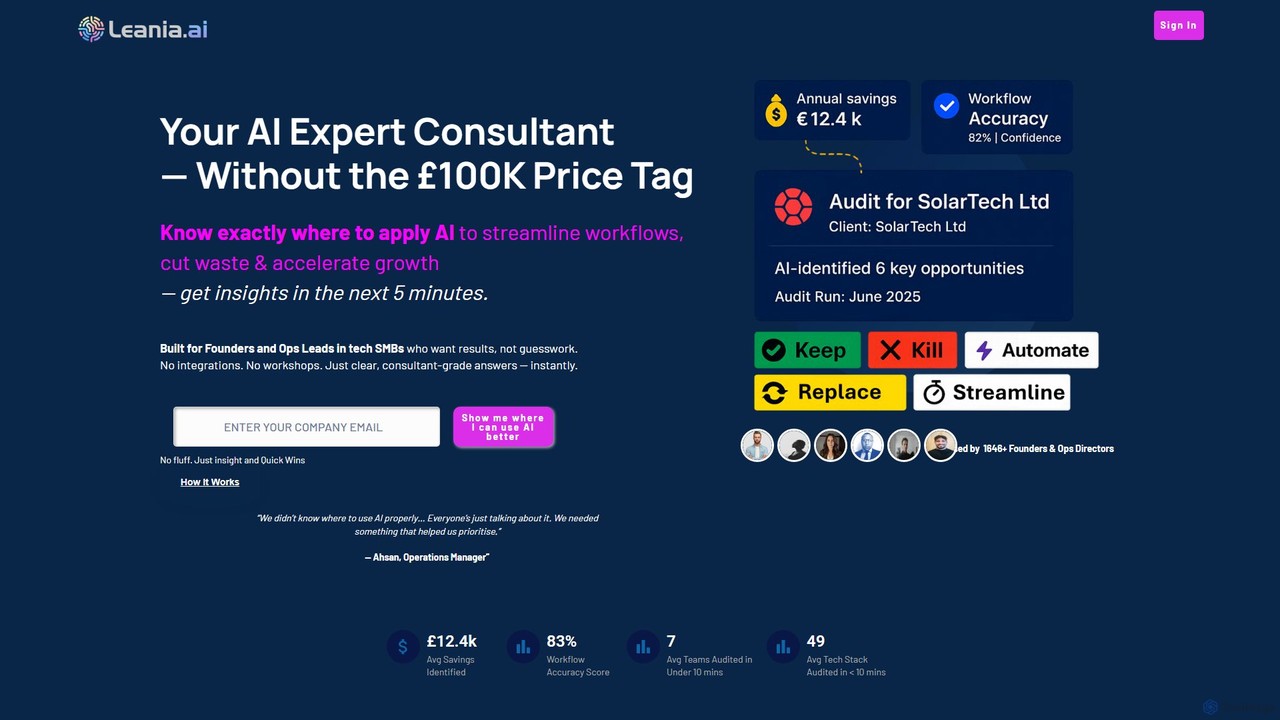
leania.ai

leania.ai

Leania.ai is an AI-powered consultant that analyzes your company's software stack and workflows to identify inefficiencies, cut costs, …

9.4K

About Software Management

AI Software Management tools are a class of intelligent systems designed to automate and optimize the entire software development lifecycle (SDLC). Leveraging machine learning and data analysis, these tools go beyond traditional automation by providing predictive insights, intelligent suggestions, and automated code generation. They help development teams accelerate delivery, improve code quality, and enhance security by identifying potential issues before they impact users. This proactive approach transforms software creation and maintenance from a reactive process to an intelligent, data-driven operation.

Core Features

  • Predictive Bug Detection: Analyzes code patterns and historical data to forecast and pinpoint potential bugs before compilation or deployment.
  • Automated Code Generation & Refactoring: Generates boilerplate code, unit tests, or documentation from natural language prompts and suggests intelligent code improvements.
  • Intelligent CI/CD Pipeline Optimization: Monitors and analyzes build and test processes to identify bottlenecks and automatically optimize resource allocation for faster delivery.
  • AI-Powered Security Scanning: Uses advanced algorithms to detect complex security vulnerabilities and anomalies that rule-based scanners may miss.
  • Automated Dependency Management: Intelligently analyzes project dependencies, recommends safe updates, and identifies potential version conflicts or security risks.

Use Cases

These tools are primarily used by software development teams, DevOps engineers, and IT departments in technology companies and large enterprises. They are applied to streamline agile development workflows, manage complex microservices architectures, and ensure the reliability of mission-critical applications. For instance, a team can use AI to automatically prioritize which tests to run in a CI/CD pipeline, significantly reducing build times.

How to Choose

When selecting an AI Software Management tool, consider its integration capabilities with your existing toolchain (e.g., Git, Jira, Jenkins). Evaluate the specific programming languages and frameworks it supports. Assess the accuracy and relevance of its AI models for your specific needs, such as code completion or vulnerability detection. Finally, review its security protocols, data privacy policies, and pricing model to ensure it aligns with your organizational requirements.

Software ManagementUse Cases

1

Automated Code Review and Quality Assurance

A software developer working on a tight deadline uses an AI Software Management tool integrated into their IDE. Before creating a pull request, the tool automatically scans the new code. It identifies a potential null pointer exception, suggests a more efficient algorithm for a data processing function, and flags a non-compliance with the team's coding style guide. The developer addresses these points in minutes, improving code quality and preventing a potential production bug, a process that would have taken a senior developer much longer during a manual review.

2

Optimizing CI/CD Pipeline Performance

A DevOps team manages a complex application with thousands of automated tests, causing build times to exceed 45 minutes. They implement an AI Software Management tool that analyzes historical test results and code changes. The AI intelligently selects and prioritizes a subset of the most relevant tests to run for each specific change, rather than the entire suite. This reduces the average build and test cycle time to under 15 minutes, enabling faster feedback loops for developers and accelerating the overall deployment frequency by over 60%.

3

Proactive Security Vulnerability Detection

A cybersecurity team at a financial services company integrates an AI-powered security scanning tool into their software development lifecycle. The tool analyzes code not just for known vulnerabilities (CVEs) but also for complex logical flaws and insecure coding patterns that could lead to zero-day exploits. During a routine scan, it flags a subtle data exposure risk in a new API endpoint that traditional static analysis tools missed. This allows the team to patch the vulnerability before deployment, protecting sensitive customer data and maintaining regulatory compliance.

4

Accelerating Development with AI Code Generation

A startup is building a new mobile application and needs to develop features quickly. Their small development team uses an AI coding assistant. When tasked with creating a new user profile screen, a developer provides a natural language prompt like "Create a user profile screen with an avatar, name, email, and a list of recent activities." The AI generates the complete UI component code in Swift, including data models and basic styling. This saves the developer hours of manual coding, allowing them to focus on implementing complex business logic and ship the feature 50% faster.

5

Intelligent Software Dependency Management

An enterprise maintains a large-scale application with hundreds of open-source dependencies. Manually updating these libraries is risky and time-consuming. They adopt an AI Software Management tool that continuously scans their dependency tree. The tool doesn't just flag outdated packages; it analyzes the potential impact of an update, checking for breaking changes, known security vulnerabilities, and community maintenance activity. It then automatically creates pull requests with safe, incremental updates and provides a detailed report on the risk assessment, allowing the team to confidently keep their software secure and up-to-date with minimal manual effort.

6

Predictive Maintenance for Legacy Systems

An IT department in a large insurance company is responsible for a critical legacy system written in COBOL. Finding developers to maintain it is difficult and expensive. They deploy an AI Software Management tool that analyzes decades of source code, change logs, and incident reports. The AI model identifies code 'hotspots'—modules with high complexity and a history of failures—that are most likely to cause future outages. This allows the team to proactively refactor or allocate limited maintenance resources to these high-risk areas, significantly reducing system downtime and operational risk.

Software ManagementFrequently Asked Questions