ToolMage
Sign in

Best 1 Data Aggregation AI tools for Research

Popular Data Aggregation AI tools in Research include Cogniage, helping you work more efficiently.

Cogniage
Freemium

Cogniage

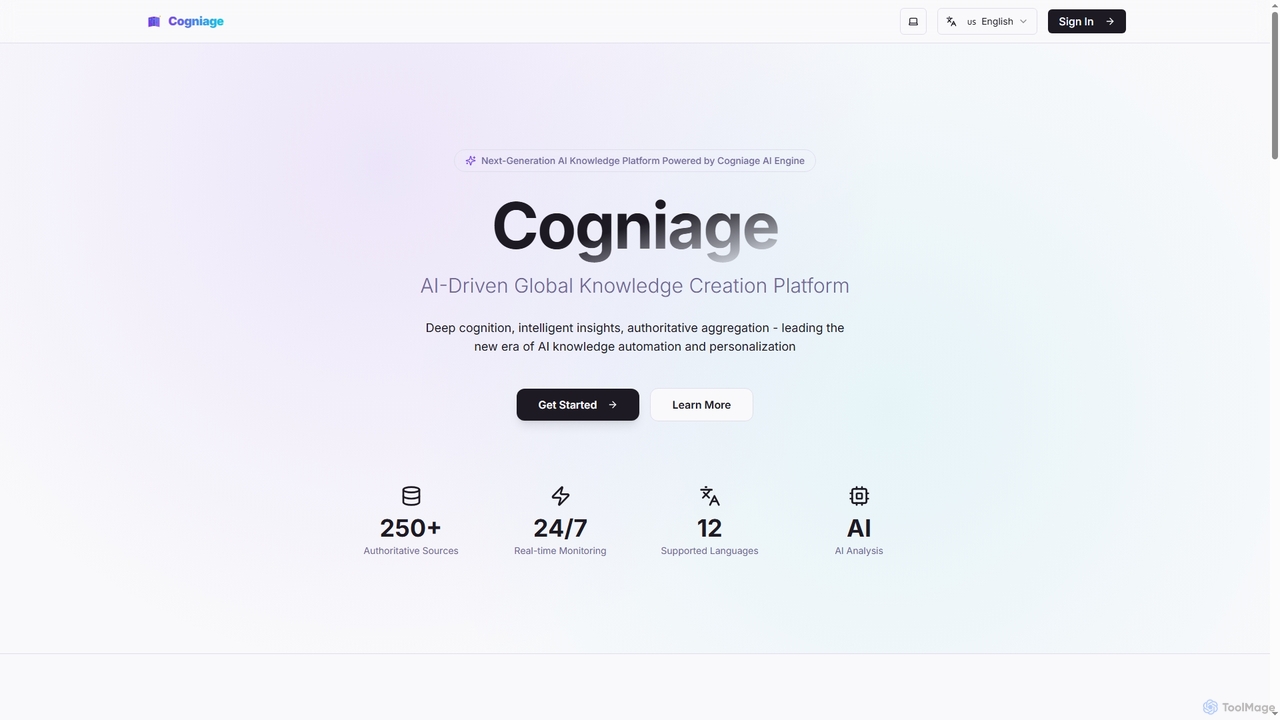
Cogniage is an AI-driven knowledge platform that aggregates, analyzes, and personalizes information from over 250 authoritative global AI sources. It uses its proprietary AI engine to provide deep insights, professional summaries, and trend analysis, helping users stay ahead in the rapidly evolving field of artificial intelligence.

Ai & Tech
Visits 4.8KFavorites 120Likes 126

About Data Aggregation

Data Aggregation tools are AI-powered platforms designed to automatically collect, consolidate, and structure disparate data from various sources into a unified format. These tools leverage advanced algorithms to extract, transform, and load (ETL) information, enabling comprehensive analysis and informed decision-making. They are crucial for businesses and researchers seeking to gain holistic insights from fragmented datasets, streamlining the process of data preparation for further processing within the broader research domain.

Core Features

  • Automated Data Collection: Gathers information from diverse sources like web pages, APIs, databases, and social media without manual intervention.
  • Data Normalization & Standardization: Transforms raw data into a consistent, uniform format, resolving inconsistencies and ensuring compatibility across different datasets.
  • Duplicate Detection & Merging: Identifies and consolidates redundant entries, improving data quality and reducing storage overhead.
  • Real-time Aggregation: Processes and updates aggregated data continuously, providing up-to-the-minute insights for dynamic environments.
  • API & Integration Capabilities: Offers robust APIs and connectors to integrate seamlessly with existing analytics platforms, CRM, ERP, and business intelligence tools.

Applicable Scenarios

Data Aggregation tools are vital for market researchers compiling competitive intelligence from various online sources, financial analysts consolidating market data for trend analysis, and e-commerce businesses gathering product information and customer reviews from multiple platforms. They also support academic researchers in synthesizing large volumes of scientific literature and experimental data.

How to Choose

When selecting a Data Aggregation tool, consider its compatibility with your required data sources, the scalability to handle growing data volumes, the accuracy of its data extraction and transformation processes, and its integration capabilities with your existing analytics infrastructure. Evaluate the level of automation, data quality features, and compliance with data privacy regulations relevant to your industry.

Featured tool rankings

Data Aggregation use cases

1

Consolidate Market Data for Competitive Analysis

Market research teams utilize data aggregation tools to automatically collect pricing, product specifications, customer reviews, and promotional activities from competitor websites, e-commerce platforms, and social media. This consolidated view helps identify market trends, competitive advantages, and strategic opportunities, enabling faster and more accurate competitive intelligence reports.

2

Aggregate Financial Reports for Investment Insights

Investment analysts and portfolio managers employ data aggregation tools to gather financial statements, stock prices, news articles, and economic indicators from various public and private databases. By unifying this diverse financial data, they can perform comprehensive trend analysis, risk assessment, and identify potential investment opportunities more efficiently, supporting data-driven investment decisions.

3

Centralize Product Data from Multiple Vendors

E-commerce businesses often source products from numerous vendors, each with different data formats. Data aggregation tools automatically pull product descriptions, images, SKUs, and inventory levels from vendor APIs and spreadsheets, normalizing and consolidating them into a single product catalog. This streamlines inventory management, product listing, and ensures consistent customer information across all sales channels.

4

Unify Customer Feedback for Sentiment Analysis

Customer experience teams use data aggregation tools to collect customer reviews, social media mentions, support tickets, and survey responses from various channels. By aggregating this unstructured and semi-structured feedback, businesses can then apply AI-driven sentiment analysis to understand customer satisfaction, identify common pain points, and prioritize product or service improvements.

5

Integrate Diverse Scientific Research Datasets

Academic and corporate researchers in fields like biology, chemistry, or social sciences leverage data aggregation tools to combine experimental results, genomic data, clinical trial outcomes, and literature reviews from disparate databases and publications. This integration facilitates meta-analysis, hypothesis generation, and the discovery of novel correlations that would be impossible with isolated datasets.

6

Aggregate Supply Chain Logistics Data

Supply chain managers utilize data aggregation tools to consolidate real-time information on inventory levels, shipping statuses, supplier performance, and demand forecasts from various ERP systems, logistics providers, and IoT sensors. This unified data view enables proactive identification of bottlenecks, optimization of routes, and improved overall supply chain resilience and efficiency.

Data Aggregation FAQ

What are Data Aggregation tools?

Data Aggregation tools are AI-powered software solutions that automatically collect, consolidate, and organize data from multiple, often disparate, sources into a single, unified dataset. They are essential for transforming raw, fragmented information into a structured format suitable for analysis, reporting, and decision-making within the broader context of research and business intelligence.

How do Data Aggregation tools differ from Data Collection tools?

While both involve gathering data, Data Collection tools primarily focus on the initial acquisition of raw data from sources. Data Aggregation tools, on the other hand, go a step further by not only collecting but also processing, cleaning, normalizing, and consolidating that data from multiple sources into a coherent, unified structure. Aggregation emphasizes unification and preparation for analysis, whereas collection is about initial capture.

What are the key benefits of using AI for Data Aggregation?

AI significantly enhances data aggregation by automating complex data extraction from unstructured sources, intelligently identifying and merging duplicate records, and adapting to changes in data formats. AI-driven tools can also perform advanced data quality checks, identify patterns for more efficient normalization, and scale aggregation processes to handle massive volumes of diverse data with greater accuracy and speed than traditional methods.

What factors should I consider when choosing a Data Aggregation tool?

Key factors include the variety of data sources it can connect to (APIs, databases, web scraping), its data transformation and cleaning capabilities, scalability for future data growth, real-time aggregation support, and integration options with your existing analytics or business intelligence platforms. Also, consider data security, compliance features, and the ease of use for your team.

Can Data Aggregation tools handle unstructured data?

Yes, modern Data Aggregation tools, especially those leveraging AI and natural language processing (NLP), are increasingly capable of handling unstructured data. They can extract relevant information from text documents, emails, social media posts, and even images or videos, transforming it into a structured format that can then be aggregated with other datasets for comprehensive analysis.