Writefull
Writefull is an AI-powered writing assistant specifically designed for academic and scientific texts. Using language models trained on …
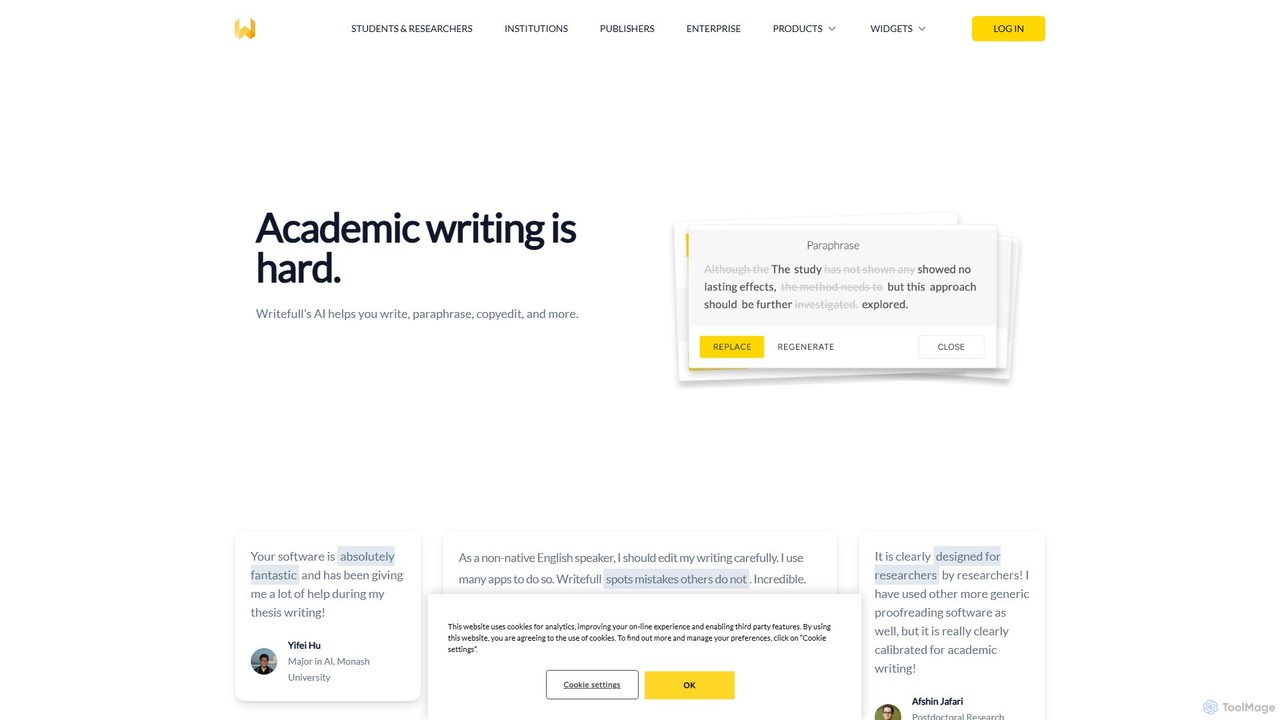
Writefull is an AI-powered writing assistant specifically designed for academic and scientific texts. Using language models trained on millions of journal articles, it provides advanced proofreading, paraphrasing, and copyediting. It integrates directly into Microsoft Word and Overleaf, helping students, researchers, and academics improve their writing, generate titles and abstracts, and ensure their work meets high publication standards.
About Publishing
AI Publishing tools are specialized applications designed to assist researchers and academics in preparing, formatting, and submitting scholarly manuscripts. These tools leverage Natural Language Processing (NLP) and machine learning to automate tedious tasks like citation formatting, adherence to journal-specific guidelines, and language polishing. They streamline the entire publication workflow, from initial draft to final submission, helping to improve manuscript quality and accelerate the dissemination of research findings. This focus on the academic publishing lifecycle distinguishes them within the broader research tool ecosystem.
Core Features
- Manuscript Formatting: Automatically formats text, references, and citations to comply with the specific style guides of thousands of academic journals.
- Journal Recommendation: Analyzes a manuscript's abstract or full text to suggest suitable journals based on scope, impact factor, and audience.
- Academic Language Enhancement: Provides advanced grammar, style, and tone suggestions tailored for formal scientific and academic writing.
- Peer Review Assistance: Helps authors draft structured responses to reviewer comments and assists reviewers in summarizing key points of a paper.
- Originality & Integrity Checks: Scans documents for potential plagiarism and can help identify AI-generated content to ensure academic integrity.
Use Cases
These tools are primarily used by academic researchers, PhD students, and scientists across all disciplines to prepare their work for publication in peer-reviewed journals and conferences. Academic institutions and publishers also utilize them to standardize submissions and streamline the editorial process, ensuring consistency and quality control.
How to Choose
When selecting an AI Publishing tool, consider the breadth of its journal database and the accuracy of its formatting templates. Evaluate the quality of its language suggestions for academic context. Also, check for integrations with your preferred writing software (e.g., Microsoft Word, LaTeX, Google Docs) and consider the pricing model, whether it's subscription-based or pay-per-use.
PublishingUse Cases
Automating Manuscript Formatting for Submission
A PhD student has finished their research paper but needs to submit it to a journal with a completely different citation style (e.g., from APA to Vancouver). Instead of spending hours manually changing every reference and citation, they use an AI Publishing tool. They upload their document, select the target journal, and the tool automatically reformats the entire manuscript, including the bibliography, in-text citations, and title page, within minutes. This ensures full compliance with the journal's guidelines and saves significant time and effort.
Finding the Best-Fit Journal for a Manuscript
A postdoctoral researcher has a manuscript on a niche interdisciplinary topic. They are unsure which journals would be the best fit. Using an AI journal recommender, they paste their abstract and keywords. The tool analyzes the text and compares it against a vast database of academic journals, providing a ranked list of suggestions based on relevance of scope, average review time, impact factor, and open-access options. This helps the researcher make an informed decision and increases the chances of acceptance by targeting the most appropriate outlets.
Polishing Academic English for Non-Native Speakers
A research team from a non-English speaking country has written a groundbreaking paper, but they are concerned about the language quality. They use an AI Publishing tool with advanced academic language enhancement. The tool goes beyond basic grammar checks, suggesting more appropriate academic vocabulary, improving sentence structure for clarity and flow, and ensuring a consistent formal tone throughout the manuscript. This helps them present their research professionally and clearly, removing language as a barrier to publication in top-tier international journals.
Streamlining Responses to Peer Reviewer Comments
An author receives extensive feedback from three peer reviewers. Organizing and addressing each point systematically can be overwhelming. They use an AI Publishing tool that imports the reviewer comments and helps structure a response document. The AI can group similar comments, suggest polite and professional phrasing for rebuttals, and create a checklist to ensure every point is addressed. This organizes the revision process, helps the author craft a more effective response, and demonstrates thoroughness to the journal editor, improving the chances of the revised manuscript being accepted.
Ensuring Academic Integrity with Plagiarism Checks
Before submitting a manuscript, a principal investigator wants to ensure it meets the highest standards of academic integrity, especially with multiple co-authors. They use an AI Publishing tool's integrated originality checker. The tool scans the entire document and compares it against a massive database of published works and online sources. It generates a report highlighting any text segments with high similarity scores, allowing the team to review and properly cite or rephrase them. This pre-submission check helps prevent accidental plagiarism and upholds the research's credibility.
Creating a Lay Summary for Broader Impact
A university's press office needs to communicate a complex scientific breakthrough to the public and funding agencies. The original paper is dense with technical jargon. They use an AI Publishing tool's summarization feature, specifically instructing it to generate a 'lay summary' for a non-expert audience. The AI rephrases complex concepts into simpler terms, focuses on the real-world implications of the research, and creates a concise, accessible summary. This helps the university effectively publicize its research, increasing public engagement and demonstrating the value of its work to stakeholders.