Research Best in category 1 results Search Assistant AI Tool

Popular AI tools in the Search Assistant field of Research include Cove, etc., helping you quickly improve efficiency.

Cove

Cove

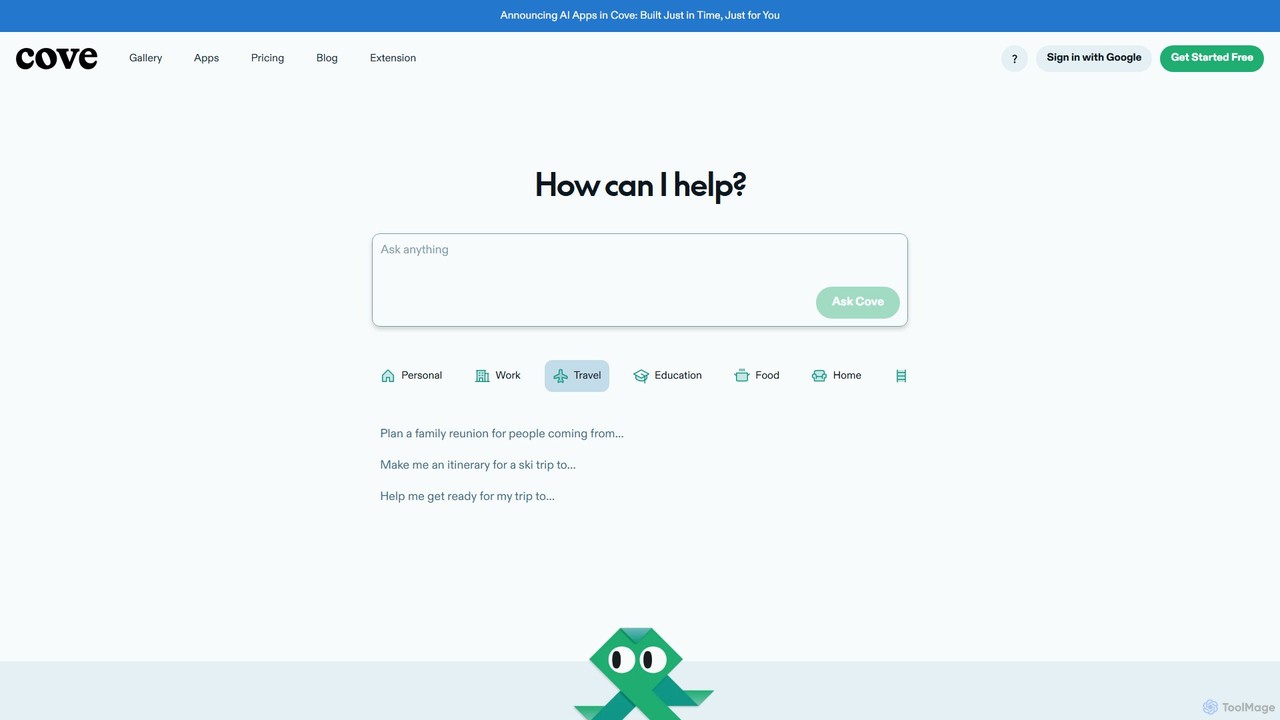
Cove is an AI-powered collaborative workspace that transcends traditional chatbots. It offers a shared, interactive environment where individuals …

19.4K

About Search Assistant

Search Assistant tools are AI-powered applications designed to revolutionize information retrieval and knowledge discovery within the broader Research category. They leverage advanced artificial intelligence, including natural language processing and semantic understanding, to help users efficiently sift through vast amounts of data and pinpoint precise, relevant information. These intelligent assistants go beyond keyword matching, understanding user intent and context to deliver more accurate results, summarize findings, and synthesize complex data, significantly enhancing productivity for researchers, analysts, and content creators.

Core Features

  • Semantic Search: Understands the meaning and context of queries, not just keywords, to deliver highly relevant results.
  • Intelligent Summarization: Automatically condenses lengthy documents, articles, or research papers into concise summaries, highlighting key points.
  • Query Expansion & Refinement: Suggests related terms and concepts to broaden or narrow searches, helping users discover overlooked information.
  • Knowledge Synthesis: Gathers information from multiple sources and presents it in a coherent, structured format, often identifying relationships and patterns.
  • Personalized Results: Learns from user interactions and preferences to tailor search results and recommendations over time.

Use Cases

Professionals across various sectors utilize Search Assistants to streamline their information-gathering processes. For academic researchers, these tools accelerate literature reviews by quickly identifying and summarizing seminal papers. Market analysts employ them to rapidly uncover emerging trends and competitive intelligence from diverse data sources. Content creators leverage Search Assistants to gather factual information, generate topic ideas, and ensure accuracy in their work, significantly reducing manual research time.

How to Choose

When selecting an AI Search Assistant, consider its core search capabilities, such as the depth of semantic understanding and the range of supported data types (text, multimedia). Evaluate its integration potential with existing workflows and platforms, like research databases or content management systems. Assess the accuracy and quality of its summarization and synthesis features. Finally, consider the pricing model and the level of customization or personalization offered to ensure it aligns with your specific research needs and budget.

Search AssistantUse Cases

1

Streamlining Content Research for Bloggers

A content creator needs to write an article on a complex topic, requiring diverse facts, statistics, and expert opinions. Using an AI Search Assistant, they input their topic and specific questions. The tool then aggregates relevant information from academic papers, news articles, and industry reports, providing summarized insights and direct links to sources. This saves hours of manual searching and fact-checking, allowing them to focus on writing and analysis.

2

Accelerating Academic Literature Reviews

Academic researchers often spend countless hours sifting through scientific papers and journals. An AI Search Assistant can quickly identify highly relevant articles based on complex queries, summarize their key findings, and even highlight conflicting theories or gaps in existing research. This allows researchers to rapidly build a comprehensive understanding of a topic, saving significant time in the initial stages of their studies and focusing on critical analysis rather than manual data extraction.

3

Competitive Intelligence for Market Analysts

A market analyst needs to monitor competitor activities, product launches, and market sentiment across various online platforms. An AI Search Assistant can be configured to continuously scan news sites, social media, industry forums, and company press releases. It then aggregates and summarizes key developments, highlighting emerging threats or opportunities. This enables the analyst to quickly identify market shifts and inform strategic business decisions with up-to-date competitive intelligence.

4

Uncovering Market Trends and Competitor Insights

Market analysts and business strategists need to stay ahead of industry shifts and competitor activities. Search Assistants can monitor vast amounts of online data, including news, social media, and industry reports, to detect emerging market trends, analyze competitor strategies, and identify potential opportunities or threats. By synthesizing information from disparate sources, these tools provide actionable intelligence that informs strategic decision-making and helps businesses maintain a competitive edge.

5

Academic Literature Review Acceleration

An academic researcher is conducting a literature review for a new study and needs to identify all relevant papers on a specific methodology. Instead of manually sifting through databases, they use an AI Search Assistant to perform a semantic search across multiple scholarly repositories. The tool identifies key papers, extracts methodologies, and even summarizes findings, significantly accelerating the initial research phase and ensuring comprehensive coverage of existing literature.

6

Enhancing Content Creation and Fact-Checking

Content creators, journalists, and marketers require accurate and up-to-date information to produce high-quality material. An AI Search Assistant can rapidly gather facts, statistics, and background information on any given topic, ensuring the accuracy and credibility of their content. It can also help generate related ideas, expand on specific points, or even identify potential biases in source material, streamlining the content creation workflow from research to final draft.

7

Gathering User Feedback for Product Development

A product manager is planning new features and needs to understand user pain points and feature requests from various channels like forums, social media, and customer support tickets. An AI Search Assistant can be deployed to monitor these sources, identify recurring themes, sentiment, and prioritize common requests. This provides actionable insights directly from the user base, enabling data-driven product development decisions and improving user satisfaction.

8

Streamlining Legal Document Discovery

Legal professionals face the daunting task of reviewing massive volumes of legal documents, contracts, and case files. Search Assistants equipped with legal-specific knowledge can quickly identify relevant clauses, precedents, and key information within these documents. They can perform semantic searches for specific legal concepts, summarize complex agreements, and flag inconsistencies, drastically reducing the time and effort required for legal discovery and due diligence processes.

9

Legal Document Discovery and Analysis

A legal professional needs to review thousands of legal documents, case precedents, and contracts to find specific clauses, patterns, or relevant rulings for a case. Manually, this is a time-consuming and error-prone process. An AI Search Assistant can rapidly scan and analyze these documents, identifying specific legal terminology, relationships between cases, and relevant precedents, significantly reducing discovery time and improving the accuracy of legal research.

10

Personalizing Learning and Knowledge Curation

Students and lifelong learners can leverage Search Assistants to create personalized learning paths and curate knowledge. These tools can understand individual learning goals and preferences, then recommend relevant articles, videos, courses, and books from across the web. They can summarize complex topics, explain difficult concepts in simpler terms, and help organize research materials, making the learning process more efficient, engaging, and tailored to specific needs.

11

Trend Identification for Investment Analysts

An investment analyst needs to identify emerging market trends and potential investment opportunities by sifting through vast amounts of financial news, analyst reports, and economic indicators. An AI Search Assistant can process this unstructured data, identify correlations, sentiment shifts, and early signals of trends that might be missed by human analysis. This allows the analyst to make more informed and timely investment decisions, gaining a competitive edge.

12

Optimizing Internal Knowledge Base Navigation

Large organizations often struggle with employees finding specific information within vast internal knowledge bases, wikis, or document repositories. An AI Search Assistant can provide an intelligent interface, allowing employees to ask natural language questions and receive precise answers or relevant documents, even if the exact keywords aren't present. This significantly improves internal communication, reduces time spent searching for information, and boosts overall operational efficiency.

Search AssistantFrequently Asked Questions