
Free
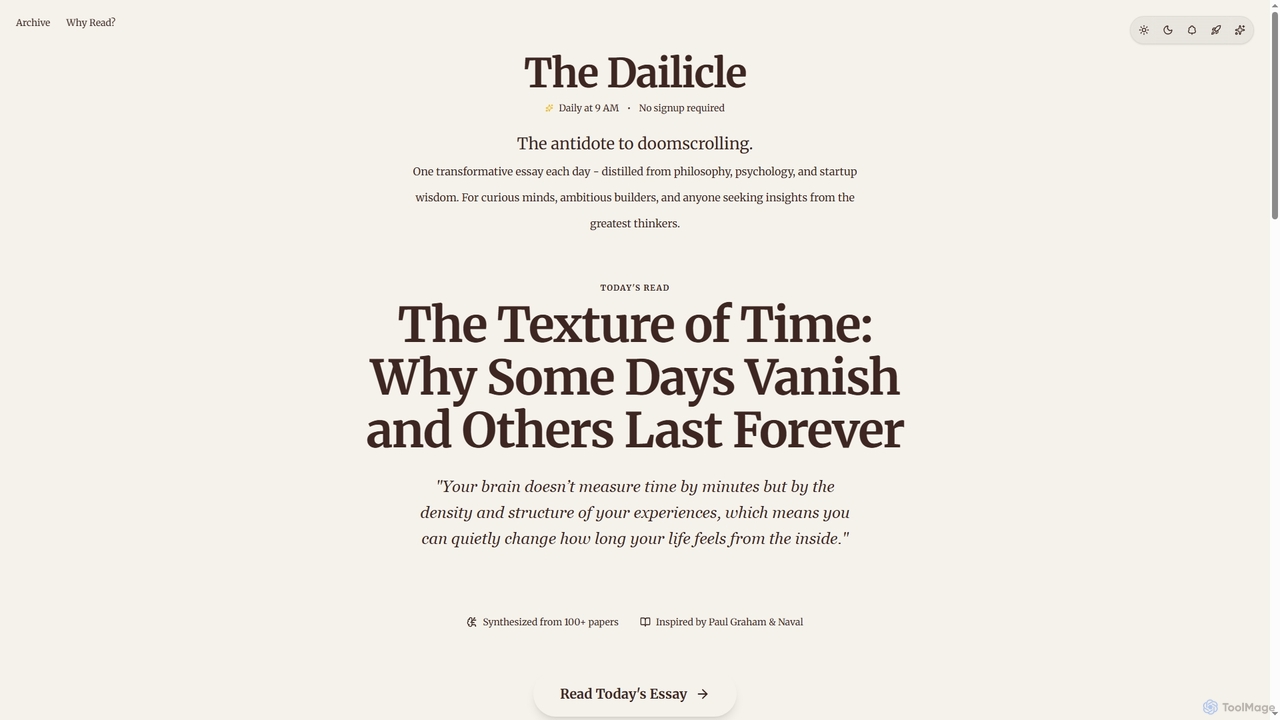
Popular Summarization AI tools in Research include summarizepaper and Dailicle, helping you work more efficiently.
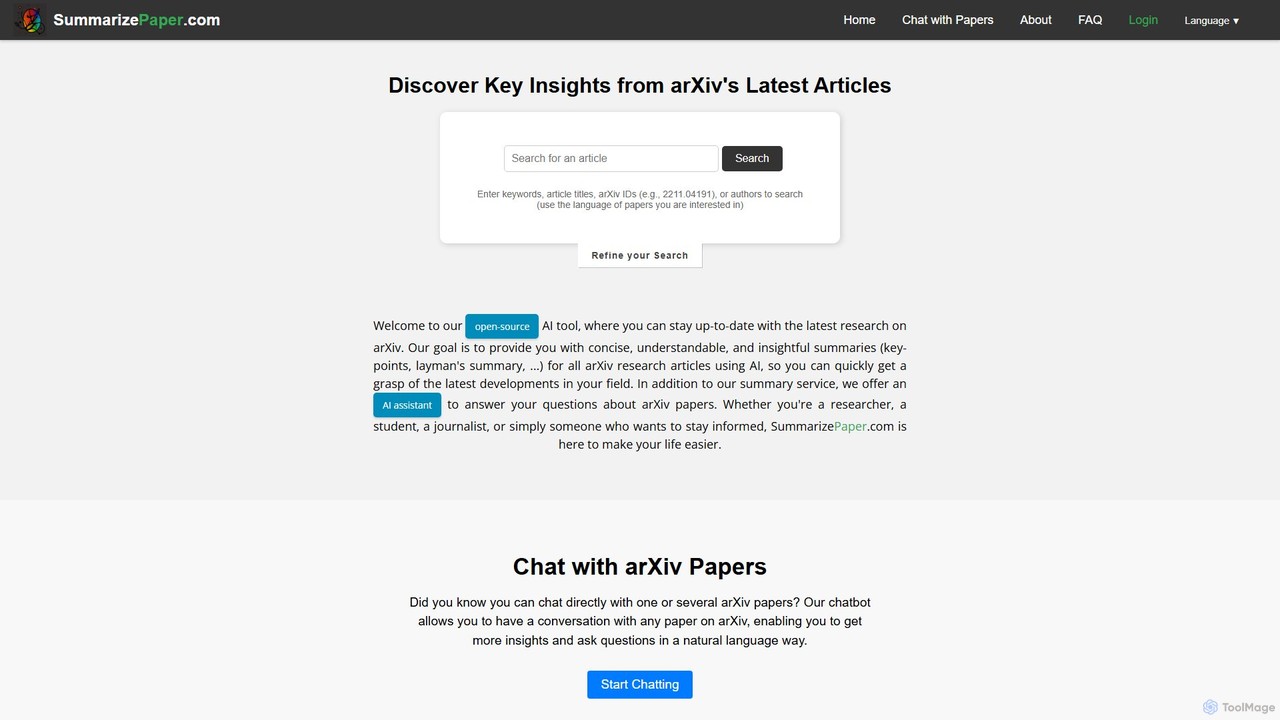
An AI-powered tool for summarizing arXiv research papers. It provides concise summaries, key points, and layman's explanations. Users can also chat with papers via an AI assistant to ask specific questions, making complex scientific research accessible to everyone.
AcademicAI Summarization tools are a class of software designed to automatically condense long-form text into concise and coherent summaries. These tools utilize advanced Natural Language Processing (NLP) models to identify key ideas, arguments, and factual information within documents, articles, or reports. By distilling vast amounts of information into manageable digests, they enable users to quickly grasp the core essence of content without extensive reading. This capability is crucial in research, learning, and business intelligence, significantly accelerating information discovery and analysis.
These tools are invaluable for academic researchers, students, and market analysts who need to review large volumes of literature or reports efficiently. Journalists and content creators use them to quickly understand source materials, while business professionals leverage them to stay informed on industry trends and competitor analysis by summarizing news and internal documents.
When choosing a summarization tool, consider the accuracy and coherence of the generated summaries. Evaluate the range of supported document types and languages. Assess its integration capabilities with your existing workflow, such as browser extensions or API access. Finally, consider the balance between features and pricing models, from free tools for basic tasks to subscription-based platforms for advanced, high-volume use.
A postgraduate researcher preparing a thesis needs to review hundreds of academic papers. Instead of reading each paper in full, they use an AI summarization tool to process the abstracts and introductions of 50 papers per day. The tool generates concise summaries highlighting the methodology, findings, and conclusions of each study. This allows the researcher to quickly triage relevant papers, discard irrelevant ones, and build a comprehensive understanding of the current state of research in their field in a fraction of the time, focusing their deep-reading efforts only on the most critical studies.
A business analyst is tasked with creating a weekly competitive intelligence report. They use a summarization tool to process dozens of sources, including news articles, press releases, financial reports, and industry blogs. By feeding the URLs and documents into the tool, they receive a consolidated summary of key market shifts, competitor product launches, and financial performance highlights. This transforms a multi-hour research task into a process of less than an hour, enabling the analyst to focus on strategic interpretation and delivering timely insights to stakeholders.
A project manager records a one-hour virtual meeting with multiple stakeholders. After the meeting, they upload the audio file or transcript to an AI summarization tool. The tool processes the entire conversation and generates a structured summary that includes: a list of key topics discussed, decisions made, and a clear breakdown of action items assigned to specific team members. This automates the tedious process of creating meeting minutes, ensures accuracy, and allows the manager to distribute a clear, actionable follow-up email within minutes of the meeting's conclusion.
A corporate communications specialist needs to prepare a daily morning brief for the executive team, covering key industry news, stock market movements, and mentions of the company or its competitors. They set up an AI summarizer to monitor a list of 20+ news sites and financial publications. Each morning, the tool automatically fetches new articles and generates a bullet-point summary for each one. The specialist then curates these summaries into a polished email newsletter, reducing a 2-hour manual process to just 30 minutes of review and editing.
A paralegal is working on a case that involves reviewing dozens of lengthy legal documents, such as contracts and court filings, to find relevant precedents and clauses. Using an AI summarization tool that supports PDF uploads, they can quickly generate summaries of each document. This allows them to rapidly identify which documents require a detailed, manual review and which can be set aside. The tool highlights key terms, obligations, and dates, significantly reducing the initial screening time and helping the legal team build their case strategy more efficiently.
A product manager needs to understand user sentiment from various channels, including support tickets, app store reviews, and survey responses. They export this raw text data and feed it into a multi-document summarization tool. The AI analyzes hundreds of individual comments and generates a thematic summary, identifying the most common feature requests, recurring bug reports, and overall positive or negative feedback points. This provides the product team with a high-level, actionable overview of user feedback, enabling them to prioritize their development roadmap effectively.
AI Summarization tools are applications that use artificial intelligence, specifically Natural Language Processing (NLP), to automatically create short, accurate summaries of long texts. They work by analyzing the content to understand its main ideas and structure. These tools can produce two main types of summaries: extractive, which pulls key sentences directly from the source, and abstractive, which generates new sentences to capture the core meaning. They are widely used by researchers, students, and professionals to save time and quickly digest large amounts of information.
The key difference lies in how the summary is created. Extractive summarization works like a highlighter, selecting the most important sentences or phrases from the original text and combining them to form a summary. It's fast and ensures factual accuracy since it uses the source text verbatim. Abstractive summarization is more advanced; it interprets the source text and then generates new, unique sentences to express the main ideas, much like a human would. This can result in more fluent and coherent summaries but carries a small risk of misinterpreting the original context.
When selecting an AI summarization tool, consider these factors:
Yes, modern AI summarization tools, especially those built on large language models (LLMs), are increasingly capable of handling complex, domain-specific texts. They are trained on vast datasets that include scientific papers, legal documents, and technical reports. However, their effectiveness can vary. For highly specialized or nuanced content, the summary might miss subtle but critical details. It is best practice to use AI summaries as a first-pass tool to quickly assess a document's relevance and key points, rather than as a complete substitute for expert human reading and analysis.
Summarization tools are a critical component of the initial 'discovery' and 'triage' phases of the research process. In a workflow that involves sifting through vast amounts of information, these tools act as a powerful filter. They allow a researcher to quickly determine the relevance of dozens or hundreds of sources without reading them in full. This saves significant time, enabling the researcher to focus their deep analysis and critical thinking on a smaller, more relevant set of documents. They are not a replacement for in-depth study but an accelerator for the information-gathering stage that precedes it.