Export Reader
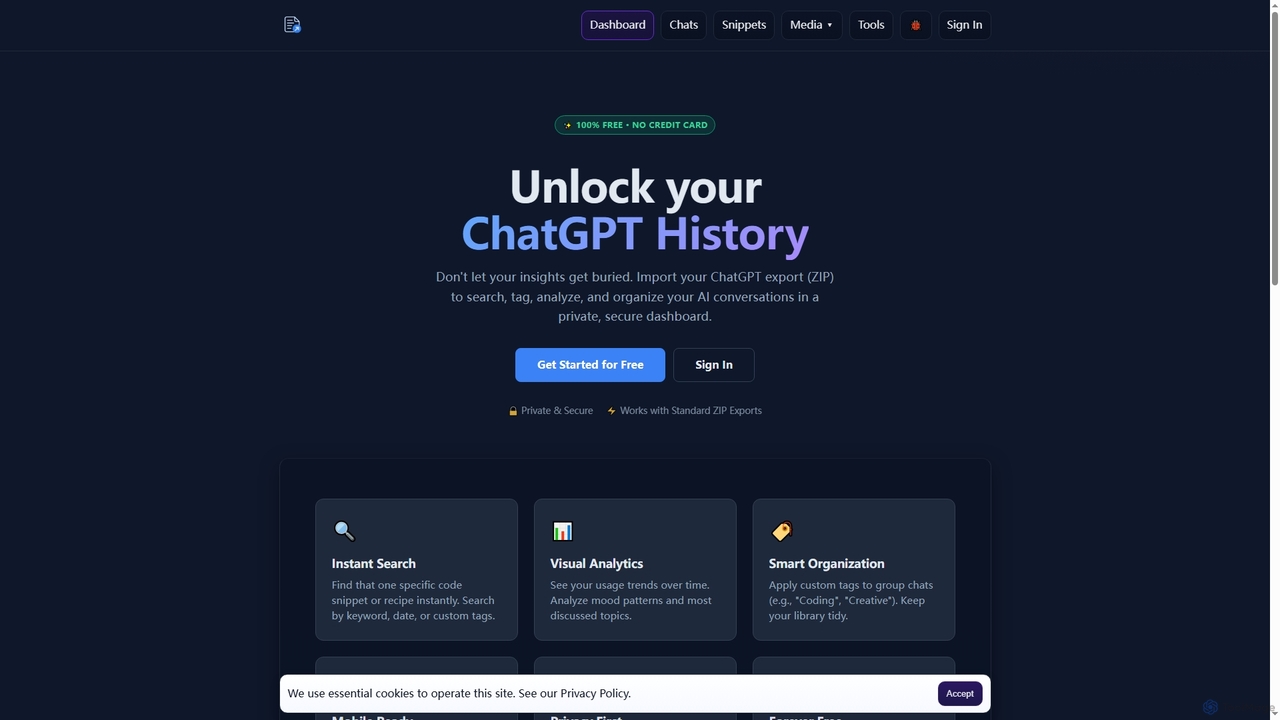
Export Reader is a free, private, and secure tool designed to help users manage their ChatGPT conversation history. …
Export Reader is a free, private, and secure tool designed to help users manage their ChatGPT conversation history. It allows you to import your ChatGPT data export (ZIP file) to easily search, tag, analyze, and organize your AI interactions within a responsive dashboard.
About Data Organization
Data Organization tools are AI-powered solutions designed to intelligently structure, categorize, clean, and manage information, transforming raw data into accessible and actionable insights. Leveraging advanced algorithms, these tools automate complex data processing tasks, ensuring accuracy and consistency across various datasets. As a specialized segment within the broader Utilities category, they empower individuals and businesses to overcome data chaos, streamline workflows, and enhance decision-making by making data more usable and valuable.
Core Features
- Automated Classification: Automatically tags and categorizes data based on content, context, or predefined rules.
- Data Cleaning & Deduplication: Identifies and corrects errors, removes duplicates, and standardizes formats for improved data quality.
- Intelligent Structuring: Transforms unstructured data (e.g., text, images) into structured formats for easier analysis and integration.
- Metadata Generation: Automatically creates descriptive metadata to enhance searchability and understanding of data assets.
- Semantic Search & Retrieval: Enables users to find relevant information quickly through natural language queries, understanding context and meaning.
Use Cases
These tools are invaluable for professionals dealing with large volumes of diverse data. Marketing teams use them to segment customer data for targeted campaigns, while researchers apply them to organize vast datasets for analysis. Businesses leverage data organization tools to maintain clean CRM records, ensuring accurate customer interactions and personalized service delivery. They are crucial for anyone needing to transform chaotic information into a well-ordered, easily retrievable resource.
How to Choose
When selecting a Data Organization tool, consider its compatibility with your existing data sources and systems, the types of data it can process (structured, unstructured, semi-structured), and its scalability to handle growing data volumes. Evaluate the accuracy of its AI classification and cleaning capabilities, the ease of integration with other business applications, and the level of customization offered for specific organizational needs. User-friendliness and robust security features are also critical for effective and secure data management.

Data OrganizationUse Cases
Automating Customer Data Segmentation
Marketing analysts often face the challenge of segmenting large customer databases for personalized campaigns. Data Organization tools automatically classify customer profiles based on demographics, purchase history, and engagement patterns. This allows marketers to quickly identify target groups, tailor messaging, and launch highly effective campaigns, significantly improving conversion rates and reducing manual data preparation time.
Streamlining Document Management for Legal Firms
Legal professionals handle vast amounts of unstructured documents, including contracts, case files, and emails. AI-powered Data Organization tools can automatically categorize these documents, extract key entities (e.g., dates, parties, clauses), and generate searchable metadata. This drastically reduces the time spent on document retrieval and review, enhancing efficiency in legal research and case preparation.
Enhancing E-commerce Product Catalog Management
E-commerce businesses manage extensive product catalogs with varying descriptions, images, and specifications. Data Organization tools help standardize product data, automatically enrich listings with relevant attributes, and identify duplicate entries. This ensures a consistent, accurate, and easily searchable product catalog, improving customer experience and reducing operational errors.
Organizing Research Data for Scientific Studies
Scientists and researchers collect diverse datasets from experiments, surveys, and literature reviews. Data Organization tools assist in structuring this heterogeneous information, cleaning inconsistencies, and classifying data points according to research parameters. This facilitates more efficient data analysis, hypothesis testing, and the identification of patterns, accelerating scientific discovery.
Improving Financial Record Keeping and Compliance
Financial institutions and accounting departments deal with complex transaction data, invoices, and regulatory documents. Data Organization tools can automatically categorize financial records, extract relevant figures, and ensure data consistency for auditing and compliance purposes. This reduces manual errors, speeds up reporting, and helps maintain regulatory adherence with greater accuracy.
Centralizing and Cleaning HR Employee Data
HR departments manage extensive employee records, including personal details, performance reviews, and training histories. Data Organization tools can centralize this information, clean up outdated or inconsistent entries, and categorize data for easier access and analysis. This supports efficient talent management, compliance reporting, and strategic workforce planning, ensuring data integrity across the employee lifecycle.