Cygnus AI
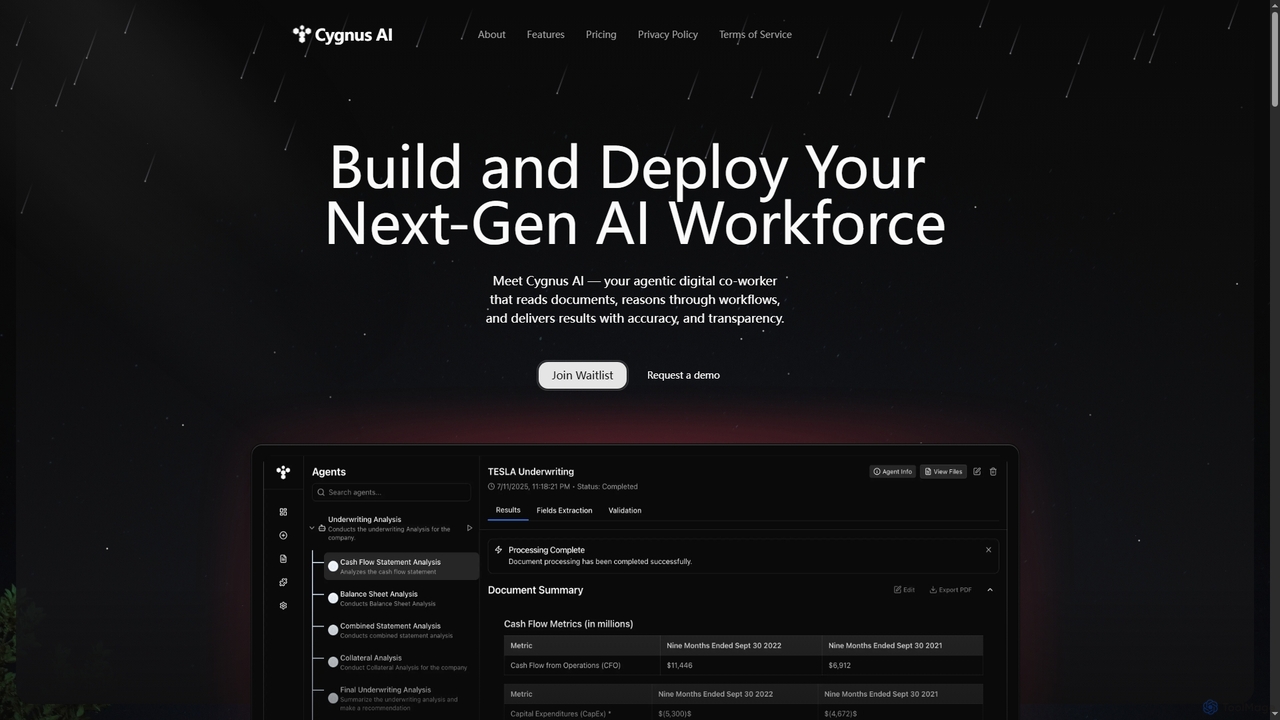
Cygnus AI is a platform for building and deploying an agentic digital workforce. Create AI agents that read …
Cygnus AI is a platform for building and deploying an agentic digital workforce. Create AI agents that read documents, reason through complex workflows, and execute tasks autonomously with accuracy and transparency, all through a no-code interface.
AutoGLM
AutoGLM is an autonomous AI agent by Zhipu AI that simulates human thought processes to tackle complex, open-ended …
AutoGLM is an autonomous AI agent by Zhipu AI that simulates human thought processes to tackle complex, open-ended questions. It independently researches, analyzes multi-source data, and generates comprehensive, structured reports, acting as a powerful assistant for in-depth research and problem-solving.
Mica AI
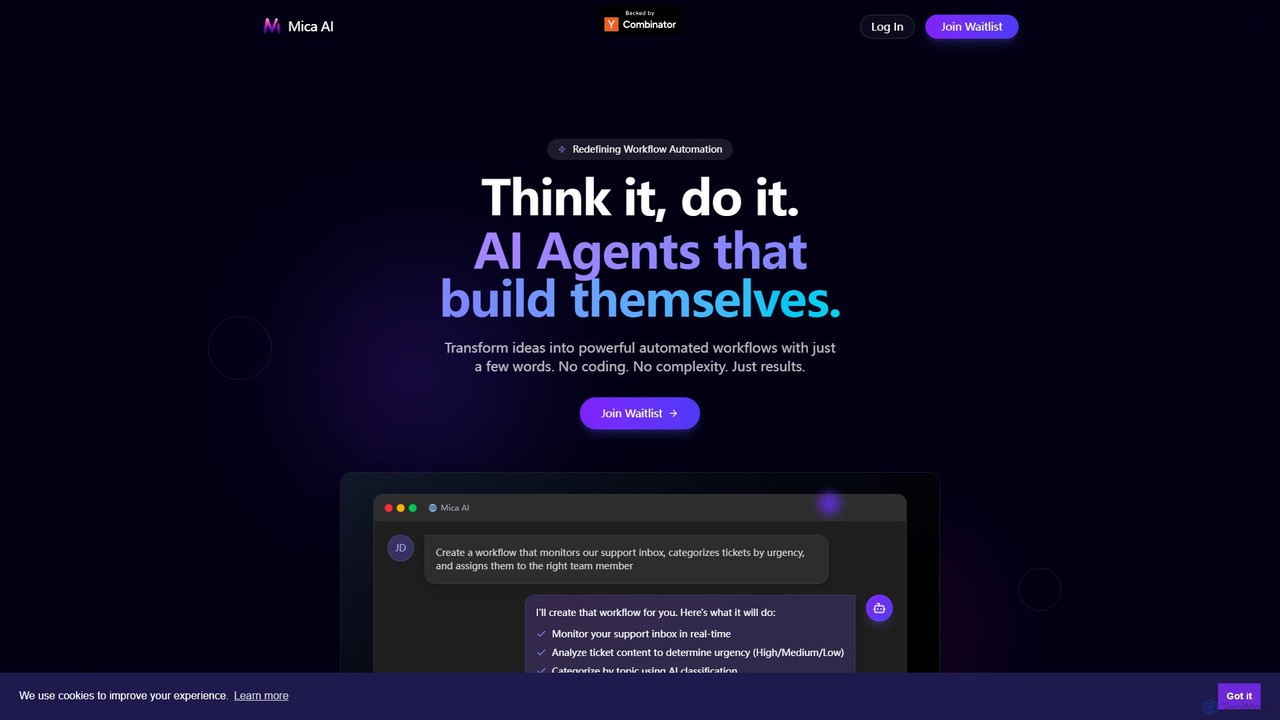
Mica AI is a no-code platform that transforms natural language descriptions into powerful, automated workflows. It deploys self-building …
Mica AI is a no-code platform that transforms natural language descriptions into powerful, automated workflows. It deploys self-building AI agents that integrate with your existing tech stack, automating tasks and providing real-time insights across departments like sales, marketing, and engineering without any coding.
About Autonomous Agents
Autonomous Agents are a sophisticated class of AI tools designed to independently perceive their environment, make decisions, and execute complex, multi-step tasks to achieve a specified goal. They operate by breaking down a high-level objective into a series of actionable sub-tasks, which they then carry out sequentially without constant human supervision. This capability allows them to handle intricate workflows, such as conducting market research, writing code, or planning detailed projects. Their key advantage lies in their ability to adapt and self-correct based on the outcomes of their actions, making them powerful for automating complex processes from start to finish.
Core Features
- Goal-Oriented Planning: Decomposes a high-level user objective into a detailed, step-by-step execution plan.
- Autonomous Execution: Carries out planned tasks, such as browsing websites, writing to files, and interacting with APIs, without manual intervention.
- Self-Correction: Analyzes the results of its actions to identify errors or inefficiencies and adjusts its plan accordingly.
- Environment Interaction: Utilizes tools like web browsers and code interpreters to gather information and perform actions in digital environments.
- Long-Term Memory: Retains context and information from past actions to inform decisions in long-running, complex tasks.
Use Cases
Autonomous Agents are particularly valuable for developers, researchers, marketers, and business analysts. They excel at tasks like automated software development, where an agent can write, debug, and test code based on a feature request. In market research, they can autonomously gather competitor data, analyze trends, and generate comprehensive reports. They are also used for personal productivity, such as planning a detailed travel itinerary by researching flights, accommodations, and activities.
How to Choose
When selecting an Autonomous Agent, first consider the complexity of the tasks you need to automate and the specific tools (web access, code execution) it needs to interact with. Evaluate its integration capabilities with other platforms and APIs. Assess the level of control and oversight offered, including the ability to approve critical steps before execution. Finally, consider the security model and safeguards in place to prevent unintended actions, especially when granting access to sensitive systems or data.

Autonomous AgentsUse Cases
Automated Market Research and Report Generation
A market analyst needs to create a comprehensive report on the top five competitors for a new SaaS product. Instead of spending days manually searching, the analyst provides an autonomous agent with the goal: "Analyze the competitive landscape for a project management SaaS targeting small businesses." The agent then plans and executes a series of tasks: it identifies key competitors via web searches, scrapes their websites for features and pricing, analyzes customer reviews from various platforms, and synthesizes all findings into a structured report, complete with a SWOT analysis. The result is a data-rich report generated in a fraction of the time, allowing the analyst to focus on strategic interpretation rather than data collection.
Complex Code Generation and Debugging
A software developer is tasked with creating a new API endpoint that fetches user data, processes it, and integrates with a third-party service. They provide an autonomous agent with a high-level prompt: "Create a Node.js API endpoint at '/users/profile' that retrieves user data from MongoDB, enriches it with data from the Clearbit API, and returns a consolidated JSON object." The agent writes the initial code, sets up the API route, writes the database query, and implements the external API call. It then runs tests, identifies a bug in error handling, corrects the code, and re-tests until the endpoint functions as specified. This process transforms a multi-hour coding session into a supervised, automated workflow.
Personalized Travel Itinerary Planning
A user wants to plan a 10-day trip to Italy covering Rome, Florence, and Venice, with a focus on history and cuisine. They give an autonomous agent the goal: "Plan a 10-day trip to Italy for two adults on a mid-range budget, including historical sites and food tours." The agent researches and compares flight and train options, finds well-reviewed hotels within the budget, identifies top-rated historical attractions and culinary experiences in each city, and constructs a day-by-day itinerary. It presents a complete plan with booking links, estimated costs, and travel times, saving the user hours of research across dozens of websites.
Automated Social Media Campaign Management
A social media manager needs to launch a campaign for a new product. They instruct an autonomous agent: "Create a one-week social media launch campaign for our new 'Eco-Mug' on Twitter and Instagram." The agent begins by researching trending topics related to sustainability and eco-friendly products. Based on this, it generates a content calendar with post ideas, drafts compelling copy and suggests relevant hashtags for each platform. It can even be authorized to schedule the posts using a connected social media management tool. This allows the manager to focus on high-level strategy and community engagement, while the agent handles the time-consuming task of content creation and scheduling.
Scientific Research and Literature Review
An academic researcher is starting a new project on 'graphene-based biosensors'. To get up to speed, they task an autonomous agent with: "Find and summarize the most cited research papers on graphene-based biosensors published in the last three years." The agent accesses academic databases like Google Scholar and arXiv, searches for relevant papers, filters them by citation count and publication date, and then reads and synthesizes the abstracts. It produces a concise summary document listing the key papers, their main findings, and common research trends, dramatically accelerating the initial literature review phase of the project.
E-commerce Competitor Price Monitoring
An e-commerce manager wants to maintain competitive pricing for their top 20 products. They set up an autonomous agent with a recurring task: "Every 24 hours, check the prices of these 20 products on our three main competitor websites and log any changes to a Google Sheet." The agent autonomously navigates to the specified product pages, extracts the current price information, compares it to the previous day's data in the spreadsheet, and updates the sheet with the new price and a timestamp if a change is detected. This provides the manager with a real-time dashboard of competitive pricing without any manual daily checks, enabling faster and more informed pricing strategy adjustments.