Arcade
Arcade is an AI tool-calling platform for developers, enabling AI agents to securely perform actions on behalf of …
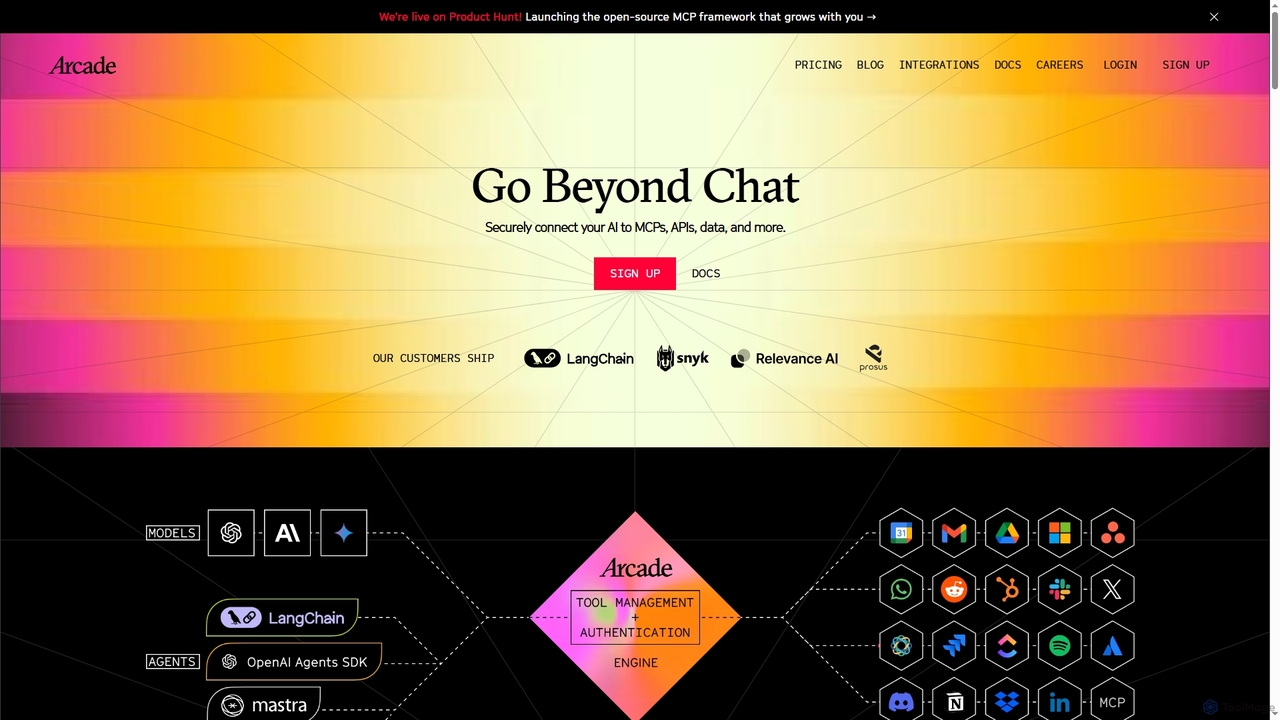
Arcade is an AI tool-calling platform for developers, enabling AI agents to securely perform actions on behalf of users. It connects AI to services like Gmail, Slack, and APIs through pre-built connectors and a custom SDK, handling complex authentication (OAuth) automatically. This allows developers to build assistants that go beyond chat to execute real-world tasks.
About Framework
AI Agent Frameworks are foundational toolkits and libraries used to build, manage, and deploy autonomous AI agents. They provide structured, reusable components for core agent capabilities such as planning, memory management, and tool integration. This approach accelerates development by abstracting complex logic, allowing developers to focus on creating sophisticated, task-oriented agents. These frameworks often support multiple Large Language Models (LLMs) and external APIs, enabling the creation of highly versatile and powerful applications.
Core Features
- Modular Architecture: Simplifies the construction of complex agents by combining reusable components and chains.
- LLM Integration: Offers standardized connectors for various LLMs like GPT, Claude, and Llama.
- Tool & API Connectivity: Enables agents to interact with external data sources, calculators, and other software APIs.
- State & Memory Management: Provides mechanisms for agents to retain context and remember past interactions.
- Debugging & Observability: Includes tools for tracing agent execution steps to understand and optimize performance.
Use Cases
These frameworks are primarily used by developers, AI engineers, and researchers. Common applications include building custom enterprise chatbots that connect to internal databases, creating automated research assistants that can browse the web and synthesize information, and developing complex multi-agent systems for workflow automation.
How to Choose
When selecting an AI Agent Framework, consider the primary programming language (e.g., Python, TypeScript), the level of abstraction versus control, and the strength of the community and documentation. Also, evaluate its specific strengths, such as its capabilities for Retrieval-Augmented Generation (RAG), multi-agent orchestration, or ease of integration with your existing tech stack.

FrameworkUse Cases
Building a Custom Customer Support Agent
A developer at an e-commerce company uses an AI agent framework to create a sophisticated support bot. The framework connects a large language model to the company's internal order database via an API and to a vector database containing product FAQs. This allows the agent to handle complex queries like 'Where is my latest order?' or 'What is the return policy for electronics?' by retrieving real-time, accurate information. The result is an intelligent agent that provides personalized, context-aware support 24/7, significantly reducing the workload on human agents.
Developing a Research & Data Analysis Assistant
A data scientist uses a framework to build an automated research assistant. This agent is designed with multiple tools: a web search tool to gather articles, a PDF reader to extract text from academic papers, and a code interpreter (like a Python REPL) to perform statistical analysis. The framework orchestrates these tools, allowing the agent to receive a research question, find relevant sources, summarize key findings, and generate initial data visualizations. This automates the most time-consuming parts of the research process, enabling the scientist to focus on higher-level interpretation and insight generation.
Creating Multi-Agent Workflow Automation
An enterprise architect designs a complex workflow automation system using a multi-agent framework. The system simulates a team of specialized agents for a new employee onboarding process. One agent (the 'HR Coordinator') communicates with the new hire to collect information. Another agent (the 'IT Provisioner') uses this information to create accounts and order hardware via internal APIs. A final agent (the 'Manager Notifier') tracks progress and sends updates to the hiring manager. The framework manages the communication and task handoffs between these agents, creating a robust, autonomous system that streamlines a previously manual and error-prone process.
Prototyping and Testing LLM-Powered Applications
An AI engineer at a startup needs to quickly build and validate a new product idea. They use an agent framework to rapidly assemble a proof-of-concept (PoC). The framework's pre-built components for prompt templating, LLM integration, and output parsing allow them to create a functional prototype in days instead of weeks. Furthermore, the framework's built-in debugging and tracing tools are invaluable for understanding why the agent makes certain decisions, helping them iterate on the prompt and logic to improve performance and reliability before a full-scale build-out.
Building a Retrieval-Augmented Generation (RAG) System
A knowledge management specialist needs to create a chatbot that answers questions based on a large, private repository of company documents. They use a framework specifically designed for RAG, like LlamaIndex or LangChain. The framework provides tools to ingest various document formats (PDFs, DOCX), chunk them into manageable pieces, create vector embeddings, and store them in a vector database. When a user asks a question, the framework's retrieval component finds the most relevant document chunks and passes them to an LLM as context, ensuring the answers are accurate and grounded in the company's own data, effectively preventing hallucinations.
Automating Software Development and Code Generation
A software developer uses an agent framework to build a 'coding co-pilot' agent. This agent is equipped with tools to read the existing codebase from the file system, write new code to files, and execute terminal commands to run tests. The developer can give it a high-level task like 'Add a new API endpoint for user profiles and write a unit test for it.' The framework helps the agent plan the steps: create the file, write the function, write the test file, and run the test suite. This automates repetitive coding tasks, allowing the developer to focus on more complex architectural decisions and problem-solving, thereby increasing overall productivity.