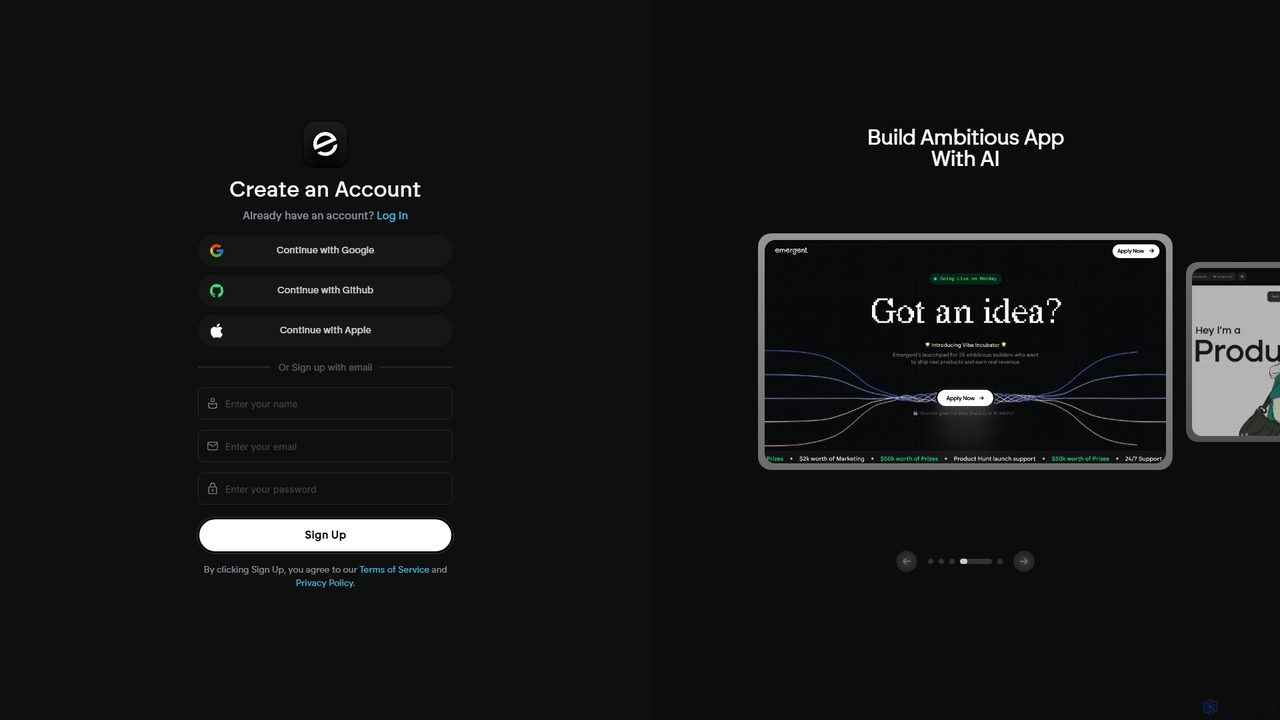
Emergent
Emergent is the world's first agentic vibe-coding platform, designed to build ambitious full-stack applications using AI. It translates …
Emergent is the world's first agentic vibe-coding platform, designed to build ambitious full-stack applications using AI. It translates natural language descriptions and intent into functional code, empowering developers and teams to prototype, build, and iterate on software faster than ever before.
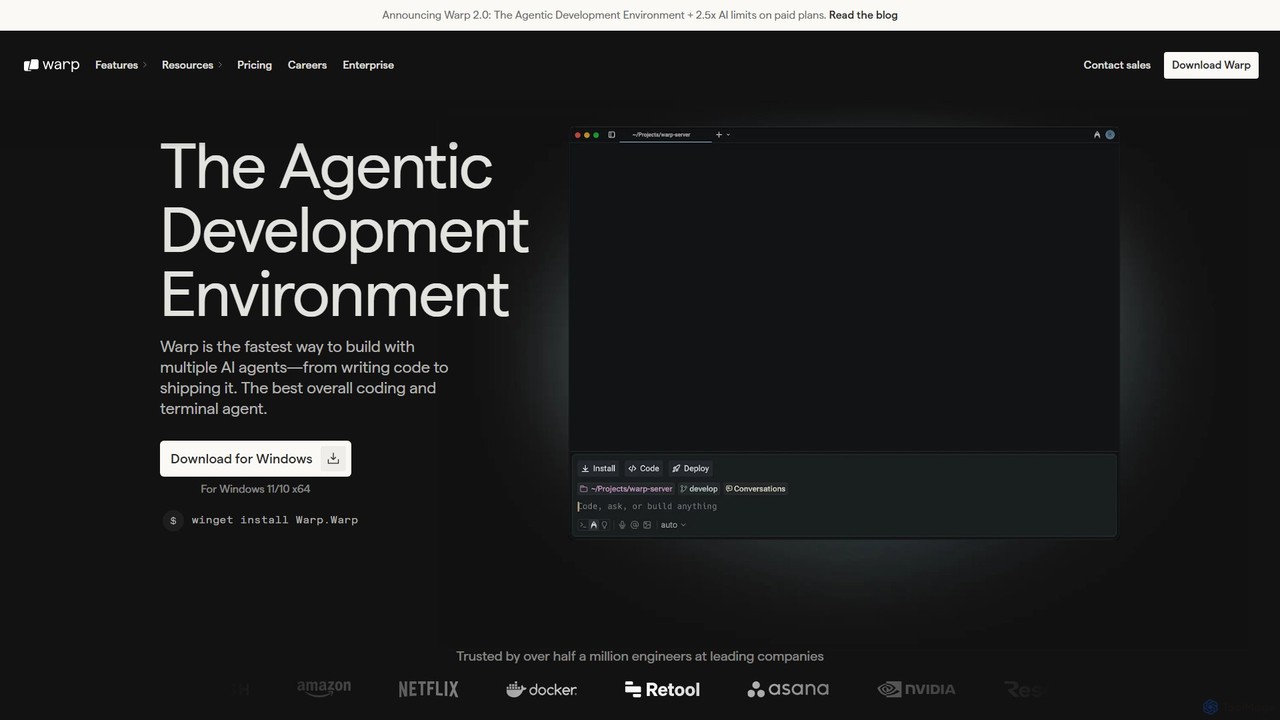
Warp
Warp is an AI-powered, Rust-based terminal reimagined as an Agentic Development Environment (ADE). It enables developers to use …
Warp is an AI-powered, Rust-based terminal reimagined as an Agentic Development Environment (ADE). It enables developers to use natural language to command AI agents for coding, debugging, and deployment. Warp combines a blazingly fast terminal with multi-threaded agent management, allowing you to build, test, and ship software faster by running multiple development tasks in parallel.
smolagents
smolagents is a minimalist, open-source AI agent framework developed by Hugging Face. It empowers developers to build and …
smolagents is a minimalist, open-source AI agent framework developed by Hugging Face. It empowers developers to build and deploy powerful, code-first AI agents with minimal Python code. By focusing on simplicity and efficiency, it enables Large Language Models (LLMs) to interact with tools and the real world seamlessly, supporting a wide range of models and secure execution environments.
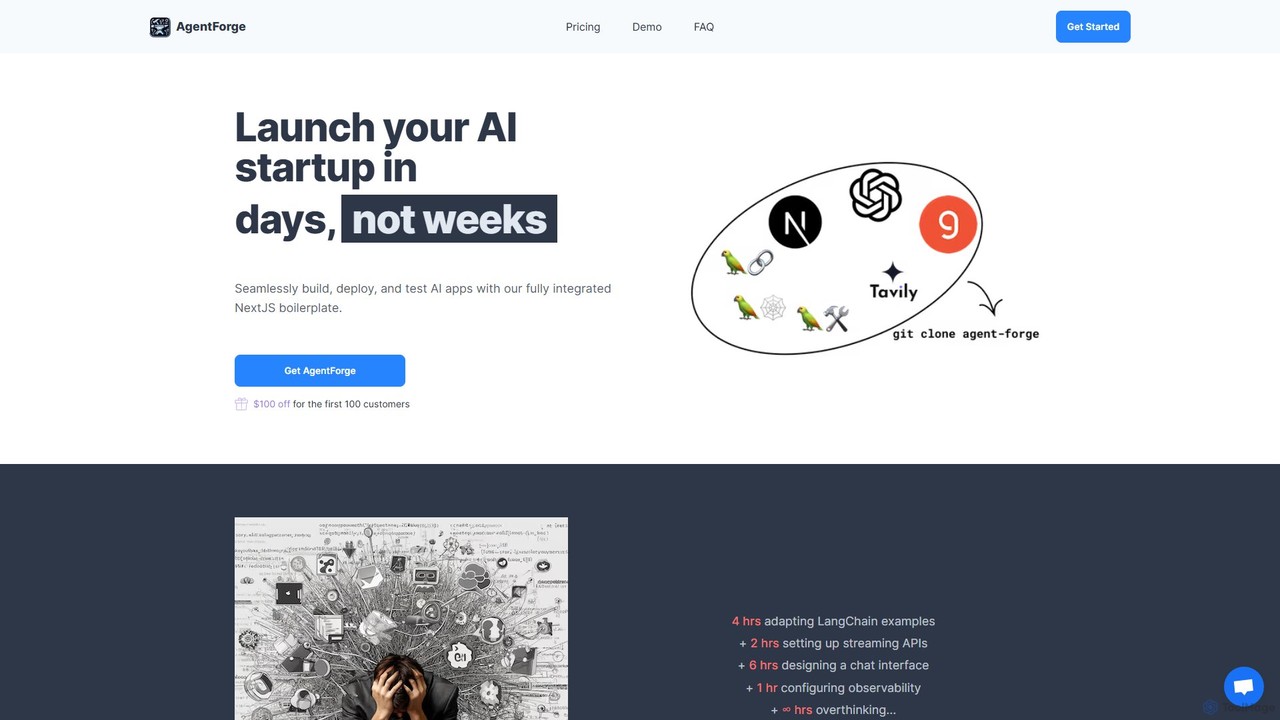
AgentForge
AgentForge is a fully integrated NextJS boilerplate designed to accelerate AI application development. It provides developers with pre-built …
AgentForge is a fully integrated NextJS boilerplate designed to accelerate AI application development. It provides developers with pre-built AI agents, customizable workflows using LangGraph, and reusable UI components. Seamlessly integrate with LangChain, OpenAI, Groq, and more to launch your AI startup in days, not weeks, saving significant development time and effort.
About Development
AI Agent Development tools are specialized frameworks and platforms for building, deploying, and managing autonomous AI agents. These tools provide structured components for integrating Large Language Models (LLMs), connecting to external APIs, and managing memory or state. They enable developers to create sophisticated agents capable of complex reasoning, planning, and task execution. This significantly accelerates the development of custom AI assistants, automated workflows, and intelligent systems.
Core Features
- Agent Frameworks & SDKs: Provide pre-built architectures and libraries (like LangChain or AutoGen) to structure agent logic, tool usage, and decision-making processes.
- LLM Integration: Offer seamless connectors to various foundation models from providers like OpenAI, Google, and Anthropic, allowing for model flexibility.
- Tool & API Orchestration: Enable agents to interact with external software and data sources by calling APIs, running code, or accessing databases.
- Memory Management: Include systems for short-term and long-term memory, allowing agents to recall past interactions and maintain context over time.
- Debugging & Observability: Offer tools to trace an agent's thought process, monitor its actions, and analyze performance for easier troubleshooting.
Use Cases
These tools are primarily used by software developers, AI engineers, and researchers. They are applied in building custom customer service chatbots that can access user data, creating data analysis agents that autonomously query databases, and developing personal assistants that manage schedules and emails. They are also essential for prototyping complex multi-agent systems for research and enterprise automation.
How to Choose
When selecting an AI Agent Development tool, consider the programming language and ecosystem compatibility (e.g., Python, TypeScript). Evaluate the level of abstraction—whether you need a low-level library for full control or a high-level platform for speed. Check the range of supported LLMs and the robustness of its tool integration capabilities. Finally, assess the quality of documentation and community support, as these are critical for complex projects.
DevelopmentUse Cases
Build a Custom Customer Service Agent
A developer at an e-commerce company uses an agent development framework to create a sophisticated support agent. They connect a powerful LLM to the company's internal knowledge base and its Shopify API. The resulting agent can understand complex customer queries, provide accurate order status updates by fetching real-time data, process return requests automatically, and escalate issues to a human agent when necessary. This automates over 60% of routine support inquiries, freeing up the human team to handle more complex cases.
Develop a Data Analysis & Reporting Agent
A data analyst wants to automate weekly reporting. Using a low-code agent platform, they create an agent that connects to their company's PostgreSQL database and Google Sheets. Each week, the agent autonomously runs predefined SQL queries to gather sales data, performs basic analysis like calculating growth percentages, formats the results into a structured report, and populates a new tab in a Google Sheet. This saves the analyst several hours of manual data pulling and report formatting each week, allowing them to focus on deeper strategic insights.
Create a Personal Automation Agent
A software developer uses an open-source agent framework to build a personal assistant. The agent is given access to their Google Calendar, Gmail, and a to-do list app's API. The developer programs it to perform tasks like: automatically scheduling meetings based on email requests and calendar availability, summarizing unread important emails at the start of the day, and creating tasks in the to-do app from messages marked as actionable. This agent acts as a central hub, streamlining personal productivity and reducing manual administrative work.
Prototype a Multi-Agent Research System
An AI research team is exploring collaborative problem-solving. They use an agent development framework to quickly prototype a system with three distinct agents: a 'Researcher' agent that scours the web for information using a search API, an 'Analyst' agent that processes the gathered text to identify key insights, and a 'Writer' agent that synthesizes the insights into a coherent summary. The framework's observability tools allow the team to visualize the communication flow and decision-making process between agents, enabling rapid iteration on their collaborative strategies.
Build an In-App AI Assistant for a SaaS Product
A SaaS company wants to improve user onboarding and feature discovery. Their engineering team integrates an agent development SDK into their web application. They create an AI assistant that can understand user questions in natural language, access the product's documentation, and provide step-by-step guidance by highlighting UI elements. For example, a user can ask, 'How do I create an invoice?' and the agent will walk them through the process directly within the app, significantly improving user experience and reducing support tickets.
Automate Code Generation and Review
A DevOps team builds a coding assistant agent to streamline their development workflow. They configure the agent with access to their codebase on GitHub and internal coding standards documentation. Developers can now ask the agent to 'generate a Python boilerplate for a new REST API endpoint' or 'review this pull request for potential security vulnerabilities'. The agent uses its LLM's coding capabilities and tool access to perform these tasks, reducing repetitive work and helping to maintain high code quality across the team.