ToolMage
Sign in

Best 1 Chatbot AI tools for Ai Agent

Popular Chatbot AI tools in Ai Agent include Code Snippets AI, helping you work more efficiently.

Code Snippets AI
Freemium

Code Snippets AI

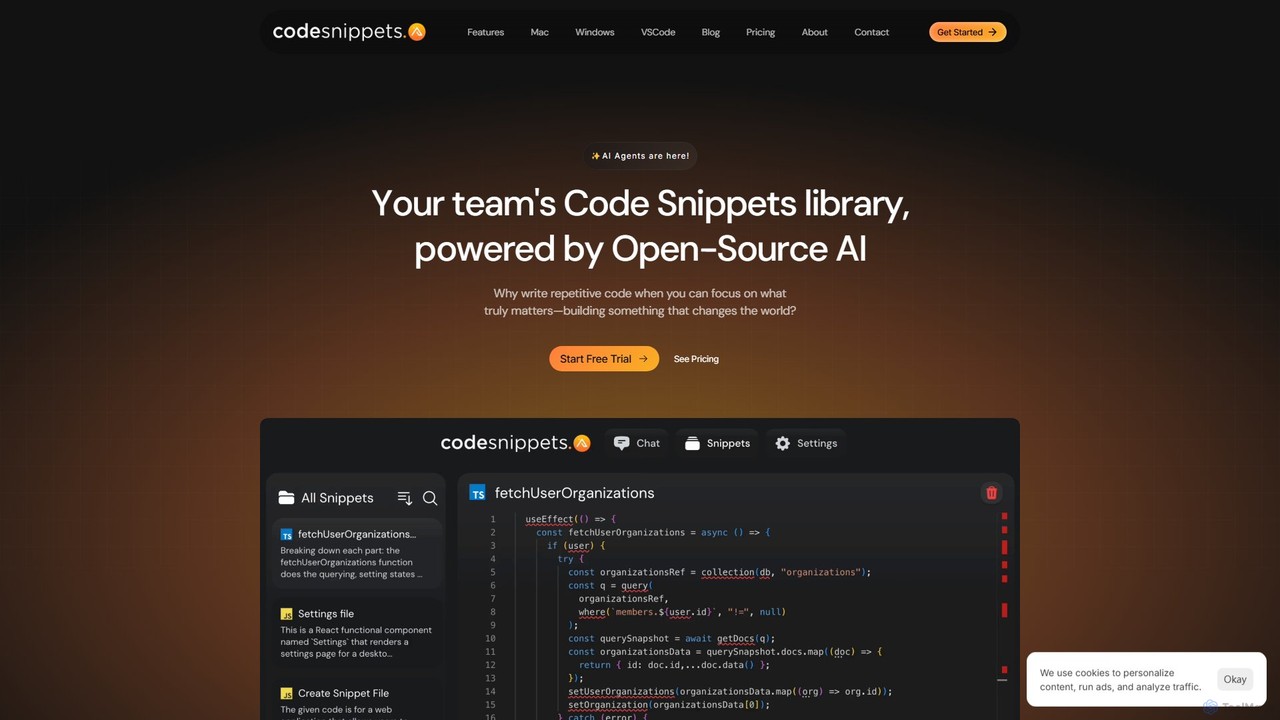
Code Snippets AI is an AI-powered code snippet library for development teams. It centralizes code management, allowing users to save, share, and collaborate on snippets. Leveraging both open and closed-source LLMs, it helps generate, refactor, debug, and document code with full codebase context, streamlining workflows and boosting productivity.

Chatbot
Visits 9.4KFavorites 102Likes 101

About Chatbot

Chatbot are a specialized category of AI-powered tools designed to simulate human conversation through text or voice interfaces. As a focused application within the broader AI Agent domain, they leverage natural language processing (NLP) and machine learning to understand user intent, provide relevant information, and automate interactions. These tools significantly enhance customer service, streamline information access, and improve operational efficiency across various sectors.

Core Features

  • Natural Language Understanding (NLU): Interprets and comprehends user input, including slang, typos, and complex sentences.
  • Intent Recognition: Identifies the underlying goal or purpose behind a user's query to route it correctly.
  • Context Management: Maintains conversational flow by remembering previous interactions and user preferences.
  • Multi-channel Deployment: Integrates seamlessly across websites, messaging apps, social media, and voice assistants.
  • Integration Capabilities: Connects with CRM, ERP, and other business systems to access and update information.

Applicable Scenarios

Chatbots are widely adopted in customer support for handling FAQs, processing routine requests, and guiding users through processes. They are also crucial in sales and marketing for lead qualification, personalized product recommendations, and automating outreach. Internally, chatbots assist employees with HR queries, IT support, and accessing company knowledge bases, significantly reducing the workload on human teams.

How to Choose

When selecting a chatbot, consider its NLP accuracy and language support for your target audience. Evaluate its integration capabilities with your existing business systems (CRM, helpdesk). Assess the ease of customization for conversation flows and branding, and look for robust analytics to monitor performance. Finally, scalability and security features are vital for growing businesses.

Featured tool rankings

Chatbot use cases

1

Automating Customer Service Inquiries

Customer service departments can deploy chatbots to handle a high volume of routine inquiries, such as order status checks, password resets, or basic troubleshooting. The chatbot quickly understands the user's intent, retrieves relevant information from a knowledge base or integrated system, and provides instant, accurate responses 24/7, freeing human agents to focus on complex issues and improving overall response times.

2

Generating and Qualifying Sales Leads

Marketing and sales teams utilize chatbots on websites to engage visitors, answer initial product questions, and collect contact information. The chatbot can ask qualifying questions based on predefined criteria, identify potential leads, and even schedule demos or connect high-value prospects directly with a sales representative, streamlining the lead generation process and increasing conversion rates.

3

Providing Internal HR Support

HR departments can implement chatbots to assist employees with common queries regarding company policies, benefits, leave requests, or payroll information. Employees can get immediate answers without waiting for HR staff, improving employee satisfaction and reducing the administrative burden on HR teams, allowing them to focus on strategic initiatives.

4

Personalized Product Recommendations

E-commerce businesses use chatbots to offer personalized shopping experiences. A chatbot can interact with a customer, understand their preferences, budget, and needs, and then recommend suitable products or services. This interactive guidance helps customers discover relevant items, enhances their shopping journey, and can lead to increased sales and customer loyalty.

5

Streamlining Booking and Appointment Scheduling

Service-based businesses, such as clinics, salons, or consultants, can use chatbots to automate the booking process. Users can interact with the chatbot to check availability, select preferred times, and confirm appointments directly through the conversational interface. This reduces manual administrative tasks, minimizes booking errors, and provides a convenient experience for clients.

6

Delivering Instant Technical Support

IT support teams leverage chatbots to provide immediate assistance for common technical issues, such as network connectivity problems, software installation guides, or system error messages. The chatbot can guide users through diagnostic steps, provide links to relevant documentation, or escalate complex problems to a human technician, ensuring faster resolution and reduced downtime.

Chatbot FAQ

What are AI Chatbots?

AI Chatbots are computer programs that simulate and process human conversation (written or spoken) using artificial intelligence. Unlike traditional rule-based chatbots, AI chatbots leverage Natural Language Processing (NLP) and machine learning to understand context, interpret user intent, and provide more human-like, dynamic, and personalized responses. They are designed to automate interactions and provide instant support across various digital channels.

How do AI Chatbots differ from general AI Agents?

While AI Chatbots are a specific type of AI Agent, their primary focus is on conversational interaction. AI Agents are broader, encompassing any AI system designed to perceive its environment and take actions to achieve goals, which could include data analysis, robotic control, or complex decision-making without direct conversation. Chatbots specialize in understanding and generating human language to facilitate communication and task completion through dialogue.

What are the key benefits of using a Chatbot for business?

Businesses benefit from chatbots through 24/7 customer availability, instant response times, and significant cost reductions in customer service operations. Chatbots can handle a large volume of inquiries simultaneously, improve lead qualification, and offer personalized user experiences. They also collect valuable data on customer interactions, which can be used to refine services and products.

What should I consider when integrating a Chatbot into my website?

When integrating a chatbot, consider its compatibility with your existing website platform and CRM systems. Ensure it can be easily customized to match your brand's tone and visual identity. Plan for robust analytics to track performance and identify areas for improvement. Crucially, define clear use cases and train the chatbot with relevant data to ensure it effectively addresses user needs and provides accurate information.

Can Chatbots handle complex customer issues?

Modern AI chatbots are increasingly capable of handling complex issues by understanding nuanced language and accessing vast knowledge bases. However, for highly sensitive, unique, or emotionally charged situations, they are typically designed to seamlessly escalate the conversation to a human agent. The goal is to automate routine tasks while ensuring human intervention is available when truly needed, creating a hybrid support model.