
ToolMage
Sign in

Best 1 Data Generation AI tools for Ai Infrastructure

Popular Data Generation AI tools in Ai Infrastructure include Datacurve, helping you work more efficiently.

Datacurve
Paid

Datacurve

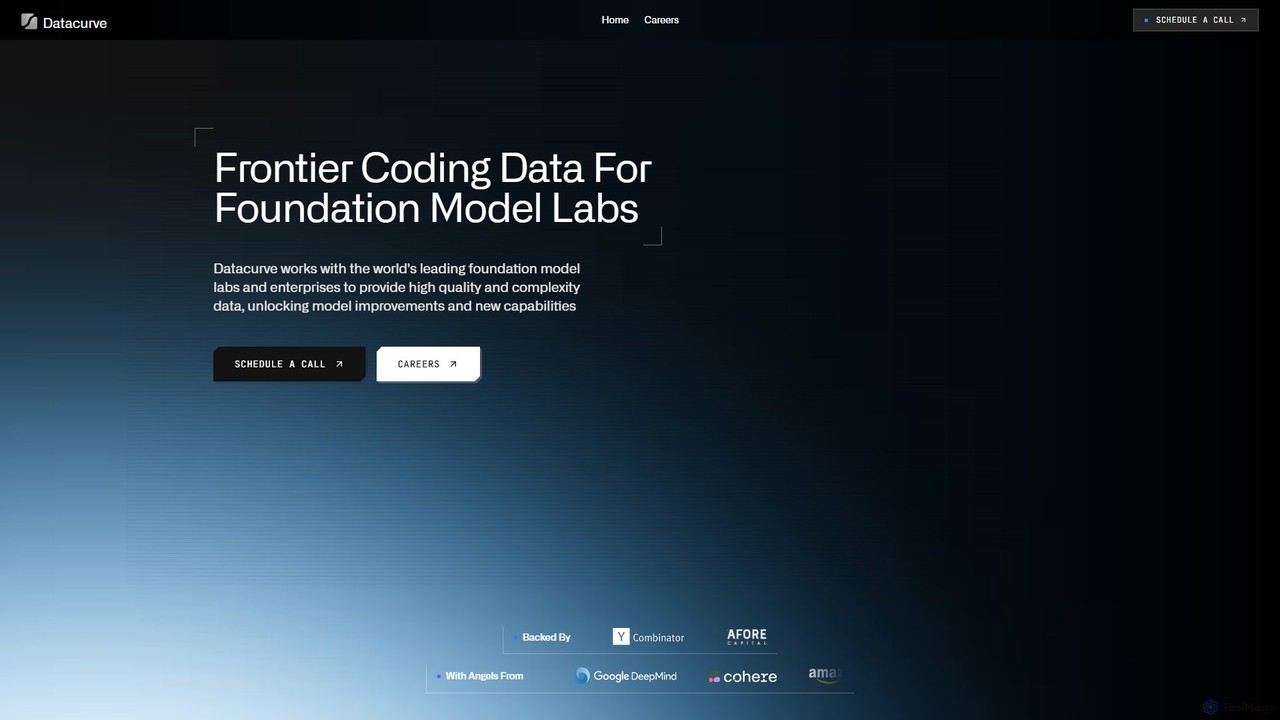
Datacurve provides high-quality, complex coding data for training and evaluating advanced AI foundation models. Specializing in formats like SFT, RLHF, and agentic workflow traces, they leverage a gamified platform with over 14,000 engineers to generate frontier data. Their service is designed for leading AI labs and enterprises seeking to unlock new model capabilities and improve performance through superior data quality, scale, and speed.

Data Generation
Visits 98KFavorites 77Likes 86

About Data Generation

Data Generation tools are a class of AI systems designed to create new, synthetic data that statistically mirrors real-world information. These tools leverage advanced models like Generative Adversarial Networks (GANs) or Variational Autoencoders (VAEs) to produce high-fidelity datasets from scratch or based on existing samples. Their primary value lies in solving data scarcity, protecting privacy, and enabling robust system testing where real data is unavailable or sensitive. As a key component of AI Infrastructure, they provide the foundational raw material needed to train, validate, and deploy other AI models effectively.

Core Features

  • Synthetic Data Creation: Generates structured (tabular, CSV) and unstructured (images, text, audio) data that mimics the patterns and correlations of a source dataset.
  • Data Anonymization: Creates privacy-preserving datasets by replacing personally identifiable information (PII) with realistic synthetic equivalents, aiding compliance with regulations like GDPR.
  • Data Augmentation: Expands small or imbalanced datasets by generating new, diverse samples, particularly useful for training models on rare events.
  • Controllable Generation: Allows users to define specific parameters, distributions, and conditions to generate data for targeted testing or simulation scenarios.
  • Fidelity and Utility Metrics: Provides tools to assess the statistical similarity between synthetic and real data, ensuring the generated data is useful for its intended purpose.

Use Cases

Data Generation tools are crucial in industries like finance for training fraud detection models without using sensitive customer data, in healthcare for creating anonymous patient data for research, and in software development for generating large-scale, realistic data for load testing applications. They are also widely used by machine learning engineers to balance datasets and improve model robustness.

How to Choose

When selecting a Data Generation tool, consider the type of data you need to generate (e.g., tabular, image, time-series). Evaluate the trade-off between data fidelity (how closely it resembles real data) and privacy guarantees (like differential privacy). Assess its scalability for handling large datasets and its ease of use—whether it's a developer-focused library or a no-code platform. Finally, check its integration capabilities with your existing data pipelines and machine learning frameworks.

Featured tool rankings

Data Generation use cases

1

Training a Fraud Detection Model

A financial technology company is developing an AI model to detect fraudulent transactions. Their real-world dataset is highly imbalanced, with very few examples of fraud, which hinders model accuracy. Using a data generation tool, their data science team creates a large volume of realistic, synthetic fraudulent transaction data. This synthetic data captures the complex patterns of real fraud without exposing any sensitive customer information. By augmenting their training set with this data, they successfully balance the dataset, leading to a model that can identify fraudulent activities with significantly higher precision and recall.

2

Generating Realistic Data for Software Load Testing

A software development team is preparing to launch a new e-commerce platform. To ensure the system can handle peak traffic, they need to perform extensive load testing. Creating a sufficiently large and realistic test dataset manually is impractical. The team uses a data generation tool to create millions of synthetic user profiles, product listings, and transaction histories. This allows them to simulate various scenarios, such as a Black Friday sales rush, and identify performance bottlenecks in the database and application servers before the platform goes live, ensuring a stable and reliable user experience.

3

Anonymizing Healthcare Data for Research Collaboration

A medical research institute possesses a valuable dataset of patient records but cannot share it directly with external collaborators due to strict privacy regulations like HIPAA. To facilitate research, they use a data generation tool to create a synthetic version of the dataset. The tool learns the statistical distributions and correlations from the real data and generates a new, artificial dataset that is structurally and statistically identical. This synthetic dataset contains no real patient information, allowing them to share it safely with partner institutions, accelerating medical discoveries without compromising patient privacy.

4

Creating Diverse Faces for AI Bias Auditing

An AI ethics team is tasked with auditing a facial recognition system for demographic bias. The available real-world datasets lack diversity, particularly for underrepresented ethnic groups. To conduct a thorough audit, the team uses a generative AI tool to create a large, balanced dataset of synthetic faces. They can specify attributes such as ethnicity, age, gender, and even lighting conditions. This allows them to systematically test the recognition system across a wide spectrum of demographics, identify specific weaknesses and biases, and provide actionable recommendations to the development team for improving fairness and equity.

5

Generating Text Data for Niche Chatbot Training

A startup is building a specialized chatbot for the legal industry, but publicly available legal conversation data is scarce. To train their Natural Language Processing (NLP) model effectively, they need a large corpus of relevant text. Using a data generation tool, they define patterns and entities specific to legal queries (e.g., contract types, legal statutes, case citations). The tool then generates thousands of synthetic user questions and corresponding legal explanations. This generated text allows them to pre-train their model on domain-specific language, significantly improving the chatbot's ability to understand and respond to real user queries accurately from day one.

6

Simulating Customer Behavior for Market Analysis

A retail company wants to test a new pricing strategy without risking real revenue. Their marketing analytics team uses a data generation tool to create a synthetic population of customers. This population mirrors the demographic and purchasing behavior of their actual customer base. They can then run simulations on this synthetic data, modeling how different customer segments might react to price changes, promotions, or new product introductions. This allows the company to forecast potential outcomes, refine their strategy, and make data-driven decisions with greater confidence before implementing them in the real market.

Data Generation FAQ

What is AI Data Generation?

AI Data Generation is the process of using artificial intelligence models, such as GANs or VAEs, to create new, synthetic data that mimics the characteristics of real-world data. It's not about copying existing data, but about learning its underlying statistical patterns and generating entirely new data points that adhere to those patterns. This is used to solve problems like data scarcity (when you don't have enough data), privacy concerns (to avoid using sensitive information), and data imbalance (to create more examples of rare events for training AI models).

How to choose the right Data Generation tool?

Choosing the right tool depends on your specific needs. Consider the following factors:

  • Data Type: Does the tool support the data you work with? This could be tabular data (like CSVs), images, text, or time-series data.
  • Fidelity vs. Privacy: Determine your priority. Some tools excel at creating highly realistic (high-fidelity) data, while others focus on providing strong mathematical privacy guarantees, like differential privacy.
  • Scalability: Can the tool handle the volume of data you need to generate? Check its performance on large datasets.
  • Ease of Use: Is it a code-based library for data scientists (e.g., Python libraries) or a user-friendly, no-code platform for business analysts? Choose one that matches your team's technical skills.
What's the difference between Data Generation and Data Augmentation?

Data Generation and Data Augmentation are related but distinct concepts. Data Augmentation typically refers to creating new data points by making small, realistic modifications to existing data. For example, rotating an image, slightly changing the wording of a sentence, or adding noise to an audio file. It expands a dataset but relies on having an initial dataset to modify.

Data Generation is a broader term. It can include data augmentation, but it also refers to creating entirely new, synthetic datasets from scratch, often based only on statistical models learned from real data. This allows for creating data even when no initial dataset is available for modification, or for generating data with specific, controlled properties for testing.

Why use synthetic data instead of real data?

There are several key reasons to use synthetic data. First is privacy; synthetic data contains no personally identifiable information (PII), making it safe to share and use without violating regulations like GDPR or HIPAA. Second is data access and availability; real data can be scarce, expensive, or time-consuming to collect, especially for rare events like financial fraud. Synthetic data can be generated on-demand in large quantities. Third is control and balance; you can generate perfectly balanced datasets to train fairer AI models or create specific edge-case scenarios to make software testing more robust. This level of control is often impossible with real-world, collected data.

Is synthetic data as good as real data for training AI?

High-quality synthetic data can be as effective, and sometimes even more effective, than real data for training AI models. The quality is key. A good synthetic dataset successfully captures the complex statistical patterns, correlations, and distributions of the real data it's modeled after. When this is achieved, it can lead to models with performance comparable to those trained on real data. In cases where real data is noisy, incomplete, or heavily imbalanced, a clean, balanced synthetic dataset can actually result in a more robust and fairer model. However, the effectiveness should always be validated by testing the final model on a holdout set of real data.