Ai Infrastructure Best in category 1 results Data Pipelines AI Tool

Popular AI tools in the Data Pipelines field of Ai Infrastructure include Airbyte, etc., helping you quickly improve efficiency.

Airbyte

Airbyte

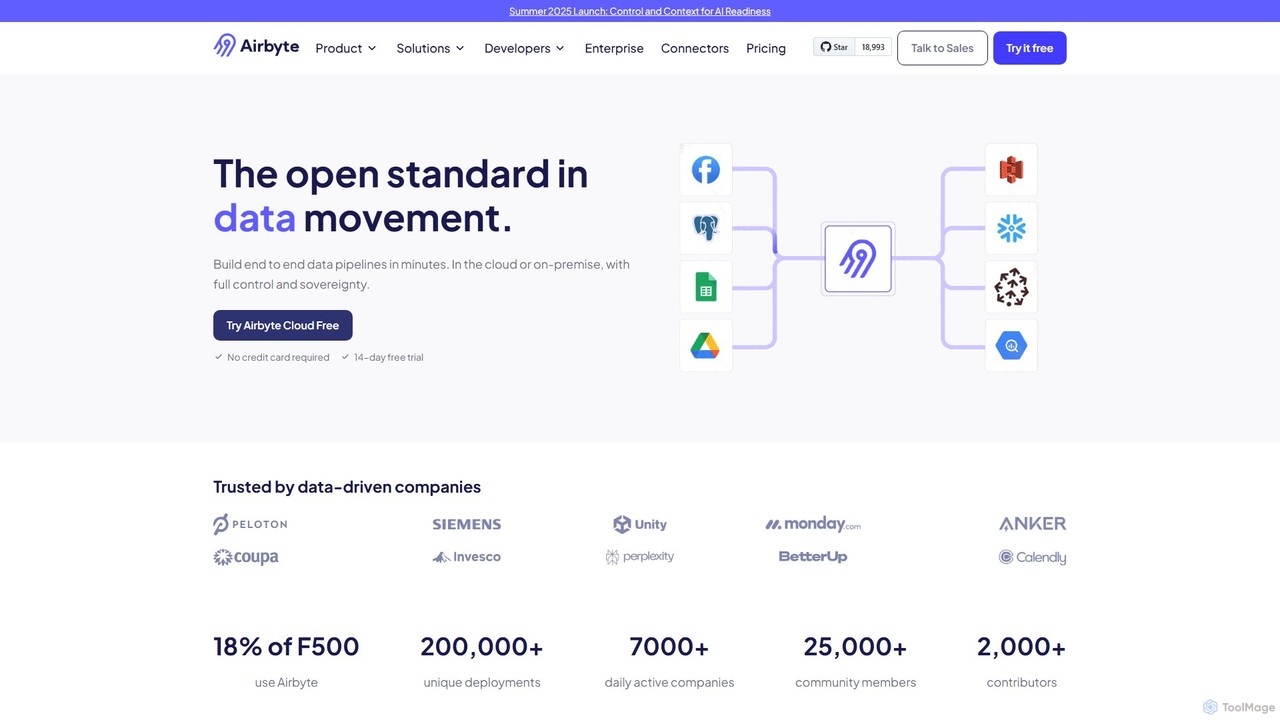
Airbyte is an open-source data integration platform that simplifies building and managing data pipelines. It enables you to …

220.5K

About Data Pipelines

Data Pipelines are automated workflows that move and transform data from various sources to a destination for analysis or storage. These tools manage the entire data lifecycle, orchestrating processes like extraction, transformation, and loading (ETL/ELT). They ensure that data scientists, analysts, and machine learning models have access to clean, consistent, and timely data. Many modern data pipeline tools leverage AI to optimize data flows, detect anomalies, and automate schema management, forming a critical component of the AI infrastructure.

Core Features

  • Data Extraction & Ingestion: Connects to diverse sources (APIs, databases, files) to pull raw data efficiently.
  • Data Transformation & Enrichment: Cleans, formats, standardizes, and enriches data to make it ready for analysis or model training.
  • Workflow Orchestration: Allows users to design, schedule, and monitor complex, multi-step data processing sequences.
  • Real-time & Batch Processing: Supports both processing large volumes of data on a schedule (batch) and processing data as it arrives (real-time).
  • Data Quality Monitoring: Includes features to automatically validate data, detect anomalies, and alert users to potential issues.

Use Cases

Data Pipelines are essential for data engineers, machine learning engineers, and business intelligence analysts. They are used to build reliable data feeds for BI dashboards, consolidate customer data into a single platform (CDP), and prepare large-scale datasets for training AI models. Industries like finance, e-commerce, and manufacturing rely on them for everything from fraud detection to supply chain optimization.

How to Choose

When selecting a Data Pipeline tool, consider the variety of data connectors you need. Evaluate whether you require real-time streaming or if batch processing is sufficient. Assess the tool's scalability to handle future data volume growth. Finally, consider the user interface—whether your team prefers a low-code, visual builder or a code-centric, developer-focused environment.

Data PipelinesUse Cases

1

Powering Business Intelligence Dashboards

A business intelligence analyst needs to create a unified performance dashboard. They use a data pipeline tool to automatically pull sales data from Salesforce, marketing campaign data from Google Ads, and customer support tickets from Zendesk. The pipeline consolidates, cleans, and loads this data into a data warehouse like BigQuery every hour. This provides executives with a near real-time, comprehensive view of business health, enabling faster and more informed decision-making without manual data collection.

2

Real-time Fraud Detection System

A financial technology company aims to prevent fraudulent transactions. They implement a streaming data pipeline that ingests transaction data from their payment gateway in real-time. The pipeline immediately processes each transaction, enriches it with historical user data, and feeds it into a machine learning model for scoring. If a transaction is flagged as high-risk, the pipeline triggers an alert and can automatically block the payment, all within milliseconds. This significantly reduces financial losses and protects customers.

3

Preparing Datasets for Machine Learning Models

A machine learning engineer is developing a product recommendation engine. They set up a data pipeline to collect user interaction data (clicks, views, purchases) from the company's website and mobile app. The pipeline cleans the raw data, handles missing values, transforms categorical features into numerical formats (one-hot encoding), and aggregates user behavior into feature vectors. The final, processed dataset is stored in a data lake, ready to be used for training and retraining the recommendation model, ensuring the model's accuracy and relevance.

4

Synchronizing Data for a Customer Data Platform (CDP)

A marketing operations team wants a 360-degree view of their customers. They use a data pipeline tool to sync data from multiple systems into their CDP. The pipeline extracts customer profiles from the CRM, transaction history from the e-commerce platform, and email engagement from their marketing automation tool. By unifying this data, the marketing team can create highly personalized campaigns, improve customer segmentation, and accurately measure the impact of their marketing efforts across all channels.

5

Processing IoT Data for Predictive Maintenance

A manufacturing company uses sensors to monitor its factory machinery. A data pipeline is set up to ingest high-volume, high-velocity sensor data (temperature, vibration, pressure) into a cloud platform. The pipeline processes this streaming data, aggregates it into time-series formats, and feeds it to a predictive maintenance model. This allows the company to forecast equipment failures before they happen, schedule maintenance proactively, and minimize costly production downtime.

6

Cloud Data Migration and Modernization

An enterprise IT team is tasked with migrating a legacy on-premise SQL database to a cloud data warehouse like Snowflake. They use a data pipeline tool to manage this complex process. The tool extracts data in batches from the old database, transforms the schema to fit the new cloud-native format, and reliably loads terabytes of data into Snowflake. The pipeline's monitoring and error-handling features ensure data integrity throughout the migration, accelerating the company's move to a modern data stack.

Data PipelinesFrequently Asked Questions