Ai Infrastructure Best in category 1 results Dataset Management AI Tool

Popular AI tools in the Dataset Management field of Ai Infrastructure include Unitlab, etc., helping you quickly improve efficiency.

Unitlab

Unitlab

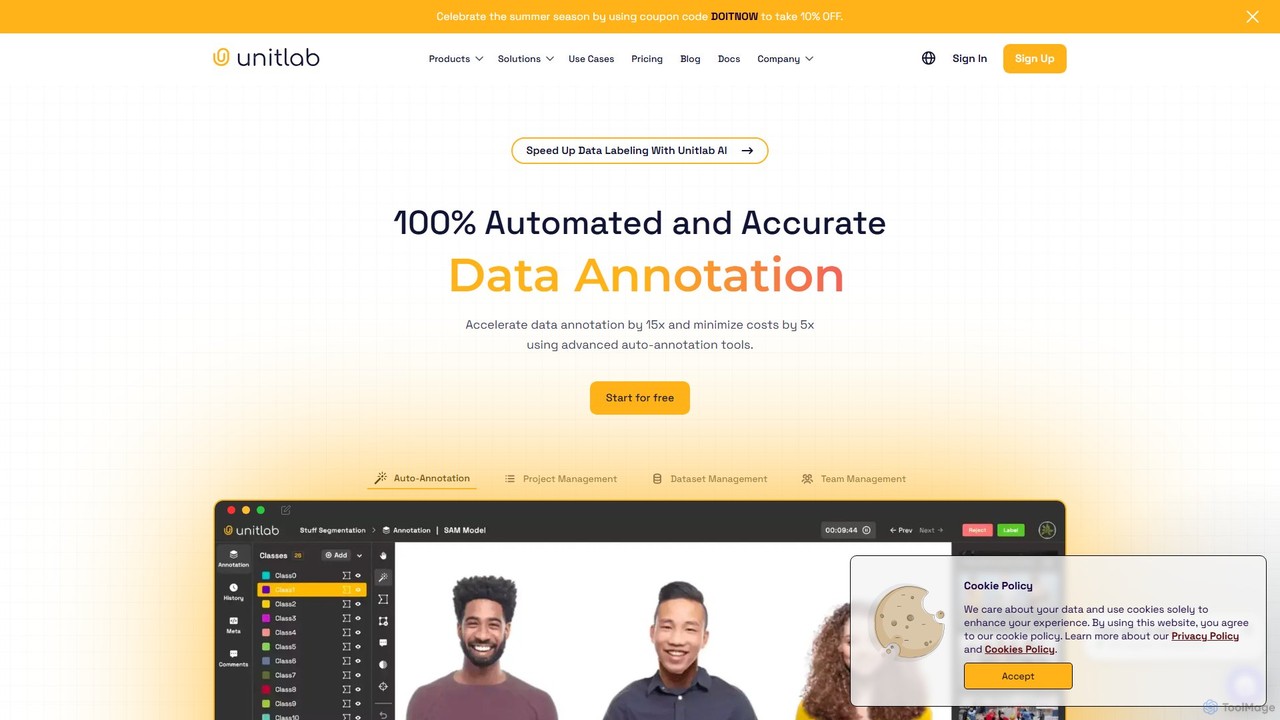
Unitlab is a streamlined data annotation platform designed for computer vision projects. It provides a comprehensive suite of …

7.1K

About Dataset Management

Dataset Management tools are specialized platforms for organizing, versioning, and preparing large-scale data collections for AI model training. They function as a central hub for data, enabling features like data exploration, quality control, and the creation of reproducible data pipelines. This ensures data consistency, traceability, and accessibility, which are critical for developing robust and reliable AI systems. As a key component of AI Infrastructure, these tools bridge the gap between raw data and machine learning models, accelerating the MLOps lifecycle.

Core Features

  • Data Versioning: Tracks changes to datasets like code, allowing for full reproducibility and easy rollbacks.
  • Data Exploration & Visualization: Provides interfaces to search, filter, and understand data distributions and quality issues.
  • Automated Data Pipelines: Automates preprocessing, transformation, and splitting of data for training, validation, and testing.
  • Collaboration & Access Control: Manages team permissions and facilitates collaborative data curation and review workflows.
  • Data Quality Assurance: Offers tools to detect anomalies, imbalances, duplicates, and errors within datasets before training.

Use Cases

These tools are primarily used by Machine Learning Engineers, Data Scientists, and AI research teams. They are essential in fields like computer vision for managing image and video datasets, NLP for handling text corpora, and autonomous driving for curating vast amounts of sensor data.

How to Choose

When selecting a Dataset Management tool, consider its support for your specific data modalities (e.g., images, text, 3D sensor data). Evaluate its integration capabilities with cloud storage (S3, GCS), annotation tools, and ML frameworks. Also, assess its scalability to handle your data volume and the robustness of its collaboration features for team-based projects.

Dataset ManagementUse Cases

1

Curating Sensor Data for Autonomous Driving Models

An ML engineer at an autonomous vehicle company uses a dataset management platform to handle petabytes of sensor data from LIDAR, radar, and cameras. The tool allows them to version entire collections of driving logs, query for specific scenarios (e.g., 'find all night-time clips with pedestrians'), and visualize data distributions. This process is crucial for creating balanced and diverse training sets, which directly improves the perception model's accuracy and safety by ensuring it's trained on a wide range of real-world conditions.

2

Building a Reproducible Medical Imaging Dataset

A data science team at a research hospital uses a dataset management tool to organize thousands of anonymized patient scans (e.g., MRIs, CTs) for developing a diagnostic AI. The platform versions each dataset split used for an experiment, linking it directly to a trained model's results. This traceability is vital for regulatory compliance (e.g., FDA submissions) and scientific reproducibility. It allows researchers to precisely track which data was used to achieve a specific outcome, facilitating peer review and debugging of model performance issues.

3

Collaborative Curation of a Text Corpus for NLP

A university NLP research group uses a dataset management tool to build a large, high-quality text corpus from multiple sources like web scrapes and public documents. The tool provides a central workspace where multiple researchers can collaboratively clean, filter, and deduplicate the data. All changes are tracked, preventing conflicting edits and creating a clear audit trail. This collaborative environment accelerates the creation of clean, analysis-ready datasets, which is often the most time-consuming part of NLP research projects.

4

Managing Visual Inspection Data in Manufacturing

A quality control team in a factory uses a dataset management system to organize images of products from an assembly line. The system helps them categorize images of 'defective' and 'non-defective' items, query for specific defect types (e.g., 'scratches', 'misalignments'), and ensure the dataset is balanced. This curated dataset is then used to train an AI model for automated visual inspection, which significantly increases the speed and consistency of quality control compared to manual inspection, reducing production errors and waste.

5

Analyzing Drone Imagery for Precision Agriculture

An AgriTech company processes thousands of drone images of farmland daily. A dataset management tool is used to catalog these images by GPS location, date, and crop type. It allows data scientists to efficiently query and sample images to build datasets for training models that detect crop diseases, estimate yield, or identify irrigation issues. The platform's ability to handle large volumes of geospatial data and version the datasets ensures that model improvements can be reliably tracked and validated over time.

6

Versioning Datasets for E-commerce Recommender Systems

An e-commerce data scientist needs to retrain a product recommendation model weekly with new user interaction data. A dataset management tool automatically versions the dataset each time the model is trained. If a new model shows a sudden drop in performance, the scientist can easily roll back and compare the exact datasets used for the new and old models. This helps them quickly identify if the issue was caused by a data quality problem (e.g., corrupted data ingestion) or a flaw in the model itself, ensuring the reproducibility and reliability of the MLOps pipeline.

Dataset ManagementFrequently Asked Questions