Ai Infrastructure Best in category 1 results Developer Tools AI Tool

Popular AI tools in the Developer Tools field of Ai Infrastructure include Coder, etc., helping you quickly improve efficiency.

Coder

Coder

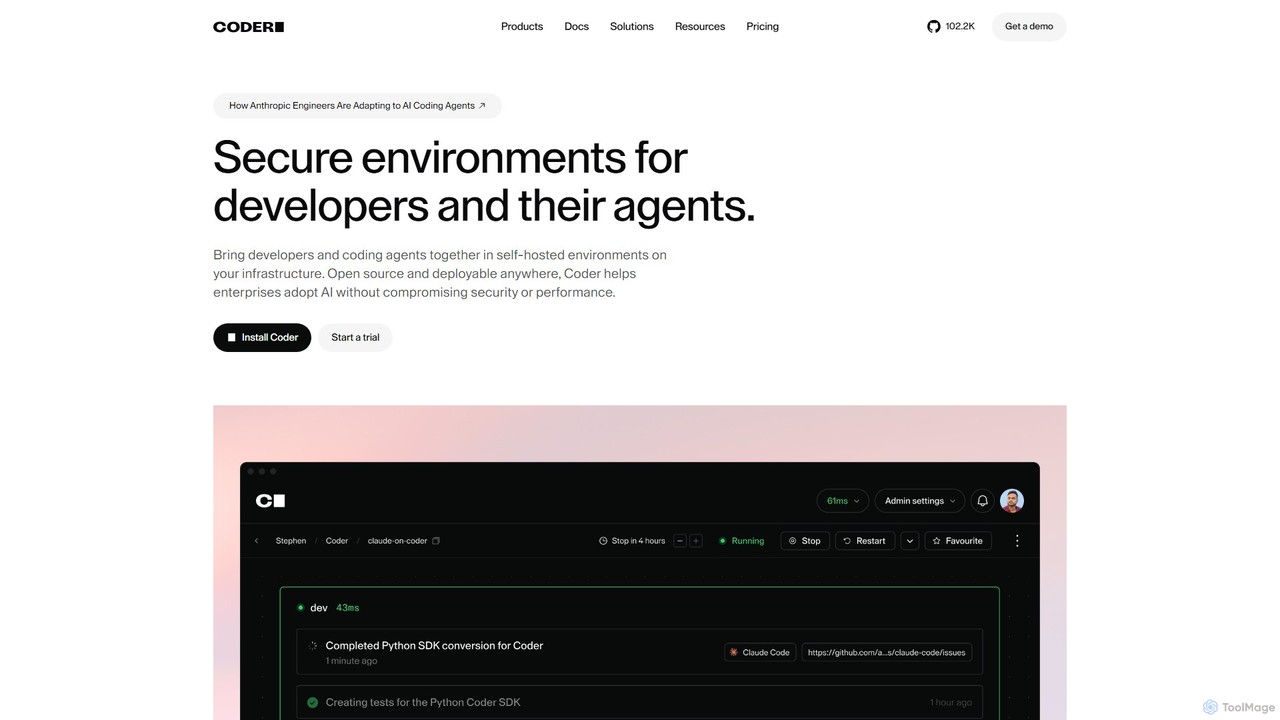
Coder is a self-hosted, open-source platform for creating secure and scalable Cloud Development Environments (CDEs). It empowers enterprises …

224.6K

About Developer Tools

Developer Tools are AI-powered solutions designed to streamline and enhance the entire artificial intelligence development lifecycle. These tools leverage AI to automate complex tasks, from code generation and model training to deployment and debugging. They significantly boost developer productivity, accelerate innovation, and facilitate the efficient creation and management of AI applications within the broader AI infrastructure.

Core Features

  • AI-Powered Code Generation: Automatically generates code snippets, functions, or even entire modules based on natural language prompts or existing code.
  • Automated Model Deployment: Simplifies the process of deploying trained AI models to various environments, including cloud, edge, or on-premise.
  • Intelligent Debugging & Optimization: Uses AI to identify errors, suggest fixes, and recommend performance optimizations for AI models and related code.
  • API Management for AI Services: Facilitates the creation, management, and integration of AI APIs, enabling seamless connectivity between different AI components.
  • Data Annotation & Preprocessing: Provides AI-assisted tools for labeling data, cleaning datasets, and preparing them for model training.

Applicable Scenarios

AI Developer Tools are indispensable for software engineers, data scientists, and MLOps professionals. They are used in scenarios such as rapidly prototyping new AI features, automating repetitive coding tasks, and ensuring the smooth operation and scaling of AI models in production environments.

How to Choose

When selecting AI Developer Tools, consider the breadth of their functionality (e.g., code generation, deployment, monitoring), their compatibility with your existing tech stack and cloud providers, the level of automation they offer, and the ease of integration with your MLOps pipelines. Evaluate the learning curve and community support, as well as pricing models that align with your project scale.

Developer ToolsUse Cases

1

Accelerating AI Model Prototyping

Data scientists and AI researchers can use AI developer tools to rapidly experiment with different model architectures and algorithms. By leveraging AI-powered code generation and automated data preprocessing, they can quickly build, train, and evaluate multiple prototypes, significantly reducing the time from concept to a working model. This allows for faster iteration and exploration of innovative AI solutions.

2

Streamlining MLOps Workflows

MLOps engineers utilize AI developer tools to automate the continuous integration, delivery, and deployment of machine learning models. These tools facilitate version control for models, automated testing, and seamless integration into existing CI/CD pipelines. This ensures that models are consistently updated, monitored, and perform optimally in production, reducing manual overhead and potential errors.

3

Automating API Integration for AI Services

Software developers building applications that consume AI services (e.g., natural language processing, computer vision APIs) can leverage AI developer tools to automate the integration process. These tools can generate client-side code, handle authentication, and manage API versioning, significantly reducing the boilerplate code and potential integration errors. This allows developers to focus on core application logic rather than complex API interactions.

4

Enhancing Code Quality with AI-Powered Analysis

Software engineers can use AI developer tools to perform advanced code analysis, identifying potential bugs, security vulnerabilities, and performance bottlenecks in their AI-related codebases. These tools go beyond traditional static analysis by understanding the semantic context of the code, offering intelligent suggestions for refactoring, and ensuring adherence to best practices. This leads to more robust, secure, and efficient AI applications.

5

Simplifying Data Annotation for AI Training

Data engineers and annotators can leverage AI developer tools to accelerate the often time-consuming process of labeling large datasets for machine learning models. These tools offer AI-assisted annotation features, such as pre-labeling suggestions, active learning, and quality control mechanisms. This significantly reduces manual effort, improves annotation consistency, and speeds up the preparation of high-quality training data for AI projects.

6

Optimizing AI Model Performance and Resource Usage

AI developers can use specialized tools to analyze and optimize the performance of their machine learning models. These tools provide insights into model inference speed, memory consumption, and computational efficiency, often suggesting modifications to model architecture or deployment strategies. By fine-tuning models with these insights, developers can achieve better performance, reduce operational costs, and ensure their AI applications run efficiently on target hardware.

Developer ToolsFrequently Asked Questions