Nebius
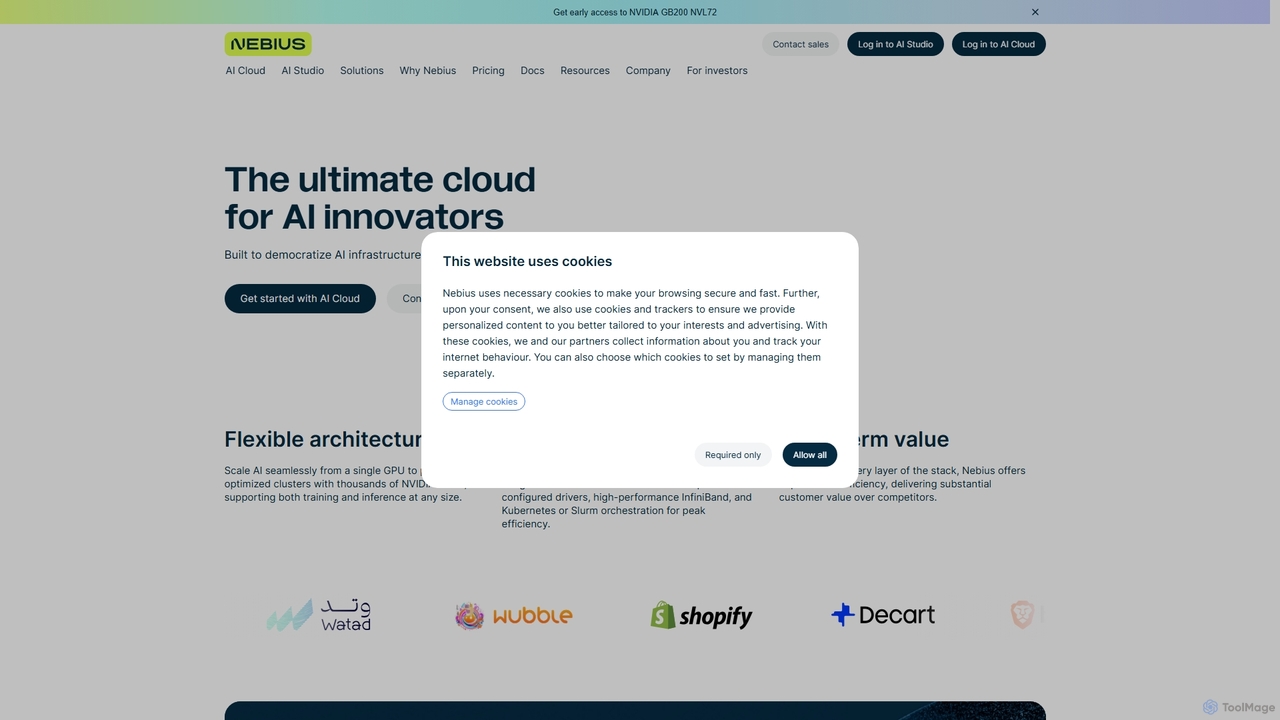
Nebius is a high-performance cloud platform specifically engineered for demanding AI and Machine Learning workloads. It provides scalable …
Nebius is a high-performance cloud platform specifically engineered for demanding AI and Machine Learning workloads. It provides scalable access to the latest NVIDIA GPUs, from single instances to massive clusters, complemented by a suite of managed services and an integrated AI Studio to streamline the entire ML lifecycle from training to inference.
About Gpu Cloud
GPU Cloud refers to a specialized cloud computing service that provides on-demand access to powerful Graphics Processing Units (GPUs). As a critical component of AI infrastructure, these platforms leverage high-performance GPUs to accelerate computationally intensive tasks. They enable users to run complex AI model training, data processing, and scientific simulations with significantly reduced execution times. GPU Cloud offers scalable, flexible, and cost-effective resources, allowing businesses and researchers to access cutting-edge hardware without substantial upfront investment.
Core Features
- On-Demand GPU Access: Instantly provision and scale GPU resources as needed, paying only for what you use.
- Diverse GPU Types: Access a wide range of NVIDIA, AMD, or other specialized GPUs optimized for various workloads, from deep learning to graphics rendering.
- Scalable Infrastructure: Easily scale up or down GPU clusters to match fluctuating computational demands, ensuring optimal resource utilization.
- Pre-configured Environments: Many providers offer pre-built images with popular AI frameworks (TensorFlow, PyTorch) and drivers, simplifying setup.
- Global Availability: Deploy GPU instances in various geographical regions to minimize latency and comply with data residency requirements.
Applicable Scenarios
GPU Cloud is indispensable for fields requiring massive parallel processing capabilities. It serves AI researchers and data scientists for deep learning model training, enabling rapid experimentation and iteration. Game developers and animation studios utilize it for high-fidelity 3D rendering and complex visual effects. Additionally, it supports scientific computing for simulations in physics, chemistry, and bioinformatics, where large datasets and intricate calculations are common.
How to Choose
Selecting a GPU Cloud provider involves evaluating several factors. Consider the specific GPU types offered and their suitability for your workload (e.g., V100 for training, A100 for large models). Assess the pricing model, including on-demand rates, reserved instances, and spot instances, to optimize costs. Evaluate the ease of integration with your existing workflows and preferred AI frameworks. Finally, check for geographical availability to ensure low latency and data compliance, alongside the quality of technical support.

Gpu CloudUse Cases
Accelerating Deep Learning Model Training
AI researchers and data scientists leverage GPU Cloud to train large, complex deep learning models (e.g., LLMs, computer vision models) in a fraction of the time compared to CPU-only systems. By provisioning multiple high-end GPUs, they can run parallel computations, rapidly iterate on model architectures, and achieve faster convergence, significantly shortening development cycles and enabling more ambitious research projects.
High-Performance Scientific Simulations
Researchers in fields like physics, chemistry, and biology use GPU Cloud for computationally intensive simulations, such as molecular dynamics, climate modeling, or fluid dynamics. The parallel processing power of GPUs allows them to simulate complex systems with higher fidelity and speed, generating vast amounts of data for analysis and accelerating scientific discovery without the need for expensive on-premise supercomputers.
Scalable 3D Rendering and Visual Effects
Animation studios, game developers, and architectural visualization firms utilize GPU Cloud for rendering high-resolution 3D scenes and complex visual effects. Instead of relying on limited local workstations, they can burst render jobs to hundreds or thousands of cloud GPUs, drastically reducing rendering times from days to hours, meeting tight deadlines, and producing stunning visual content efficiently.
Real-time AI Inference and Deployment
Businesses deploying AI models for real-time applications, such as recommendation engines, fraud detection, or natural language processing, use GPU Cloud for scalable inference. By hosting trained models on cloud GPUs, they can handle high volumes of concurrent requests with low latency, ensuring responsive user experiences and efficient operation of AI-powered services as user demand fluctuates.
Big Data Analytics and Machine Learning
Data engineers and analysts process massive datasets and perform complex machine learning tasks using GPU Cloud. GPUs accelerate data preprocessing, feature engineering, and model training on large datasets that would be impractical or too slow on traditional CPU clusters. This enables faster insights, more robust predictive models, and efficient handling of growing data volumes.
Cloud Gaming and Virtual Workstations
Gaming companies and remote workforces benefit from GPU Cloud by delivering high-fidelity cloud gaming experiences or powerful virtual workstations. Users can stream graphically intensive games or run demanding professional software (CAD, video editing) from any device, with the heavy lifting performed by powerful GPUs in the cloud, offering flexibility and accessibility without local hardware constraints.