Ai Infrastructure Best in category 1 results Gpu AI Tool

Popular AI tools in the Gpu field of Ai Infrastructure include Ratio1, etc., helping you quickly improve efficiency.

Ratio1

Ratio1

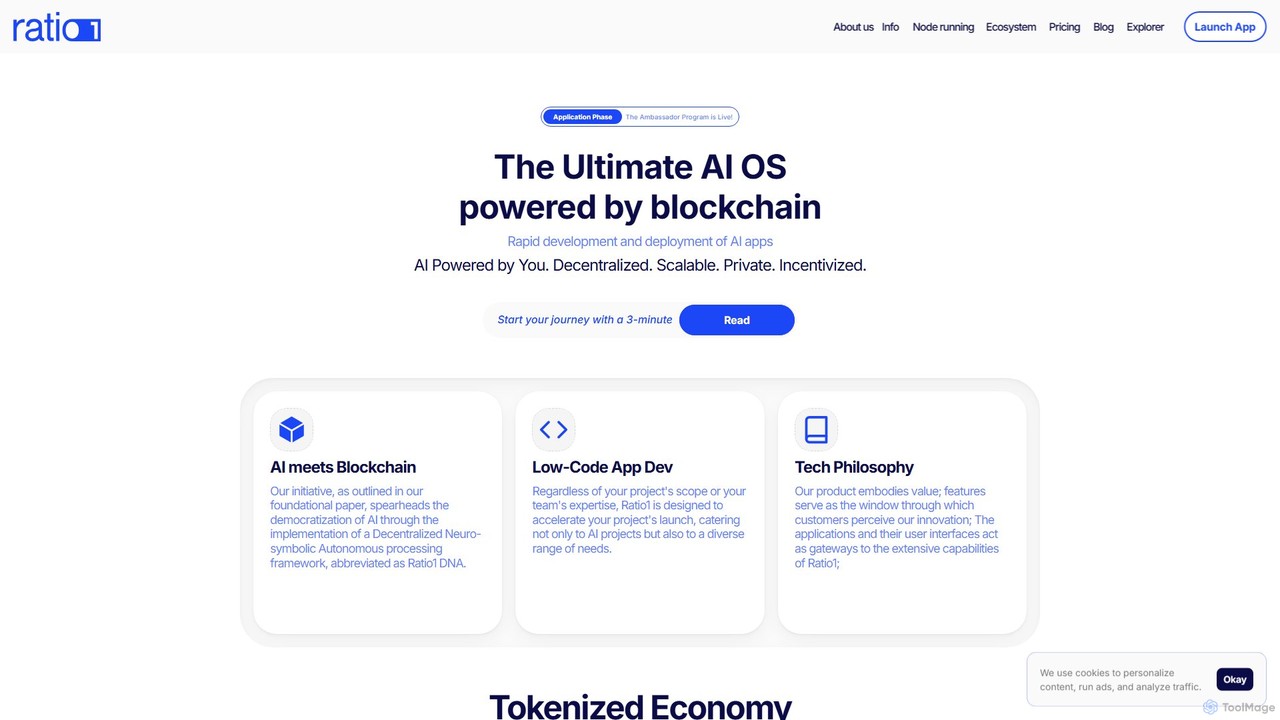
Ratio1 is a decentralized AI operating system powered by blockchain. It creates a global supercomputer by connecting idle …

2.6K

About Gpu

GPU (Graphics Processing Unit) services provide on-demand access to powerful parallel processors, a cornerstone of modern AI infrastructure. These services leverage the unique architecture of GPUs, which contain thousands of cores, to accelerate computationally intensive tasks like training deep learning models. By offering scalable, pay-as-you-go access to high-end hardware, they enable developers and researchers to tackle complex AI challenges without the significant upfront investment in physical hardware. This model democratizes access to supercomputing capabilities for AI development and deployment.

Core Features

  • Massive Parallel Processing: Execute thousands of simultaneous computations, ideal for the matrix and vector operations common in neural networks.
  • High-Performance Hardware: Access to specialized AI-optimized GPUs like NVIDIA's A100, H100, and RTX series, featuring high VRAM and Tensor Cores.
  • On-Demand Scalability: Instantly scale computing resources up or down, from a single GPU to a large cluster, based on workload demands.
  • Pre-configured Environments: Start projects quickly with ready-to-use environments that include drivers, CUDA libraries, and popular AI frameworks like TensorFlow and PyTorch.

Use Cases

GPU services are essential for AI researchers, machine learning engineers, and data scientists. They are widely used for training large language models (LLMs), developing complex computer vision algorithms, and running scientific simulations in fields like bioinformatics and climate science. Enterprises also use them for AI-powered data analysis and deploying inference endpoints at scale.

How to Choose

When selecting a GPU service, consider the specific GPU models offered and their performance metrics (e.g., VRAM, TFLOPS). Evaluate the pricing structure—on-demand, reserved instances, or spot instances—to match your budget and usage patterns. Also, assess the ease of use, the availability of pre-configured software stacks, and the quality of network infrastructure for data transfer.

GpuUse Cases

1

Training a Large Language Model (LLM)

A machine learning engineer at a startup is tasked with training a custom language model on a proprietary dataset of 500GB. Instead of purchasing expensive hardware, they rent a cloud server with eight NVIDIA A100 GPUs. Using a pre-configured environment with PyTorch and distributed training libraries, they are able to complete the training in two weeks, a process that would have taken several months on CPUs. This allows them to quickly iterate and deploy their AI-powered product.

2

Accelerating Scientific Simulations

A university research team is studying protein folding using molecular dynamics simulations. These simulations are computationally expensive. By using a cloud GPU service, they can access the necessary computing power on demand. They run hundreds of parallel simulations on NVIDIA Tesla V100 GPUs, reducing the time to get results from months to days. This acceleration allows them to test more hypotheses and publish their findings faster.

3

Developing Computer Vision Models

An AI developer is building an object detection model for an autonomous vehicle system. Training the model requires processing millions of high-resolution images. They use a GPU instance with high VRAM (e.g., an NVIDIA RTX A6000) to handle large batch sizes, which is crucial for model stability and performance. The GPU's processing power allows them to experiment with different network architectures and hyperparameters, leading to a more accurate and reliable model in a shorter timeframe.

4

AI Art and High-Resolution Image Generation

A digital artist uses AI models like Stable Diffusion to create concept art for a video game. Generating high-resolution (4K) images with complex prompts is time-consuming on their local machine. By renting a cloud GPU like an NVIDIA RTX 4090 by the hour, they can generate dozens of variations in minutes instead of hours. This rapid iteration cycle allows for greater creative exploration and helps them meet tight project deadlines without investing in a top-tier personal workstation.

5

Backtesting Financial Trading Models

A quantitative analyst at a hedge fund needs to backtest a new trading algorithm against 20 years of historical market data. A CPU-based approach would take days to complete a single run. By porting the simulation code to run on a GPU, they can leverage parallel processing to test thousands of parameter combinations simultaneously. Using a cloud GPU service, they complete the entire backtesting process overnight, enabling faster strategy validation and deployment.

6

Cloud Gaming and Virtual Desktop Infrastructure (VDI)

An IT administrator for a design firm needs to provide remote employees with access to graphics-intensive applications like CAD software. Instead of issuing expensive workstations to each employee, they set up a VDI solution using cloud GPUs. Each user gets a virtual desktop powered by a dedicated GPU slice, allowing them to run demanding software smoothly from any device. This approach centralizes management, enhances security, and reduces hardware costs significantly.

GpuFrequently Asked Questions