Paragon
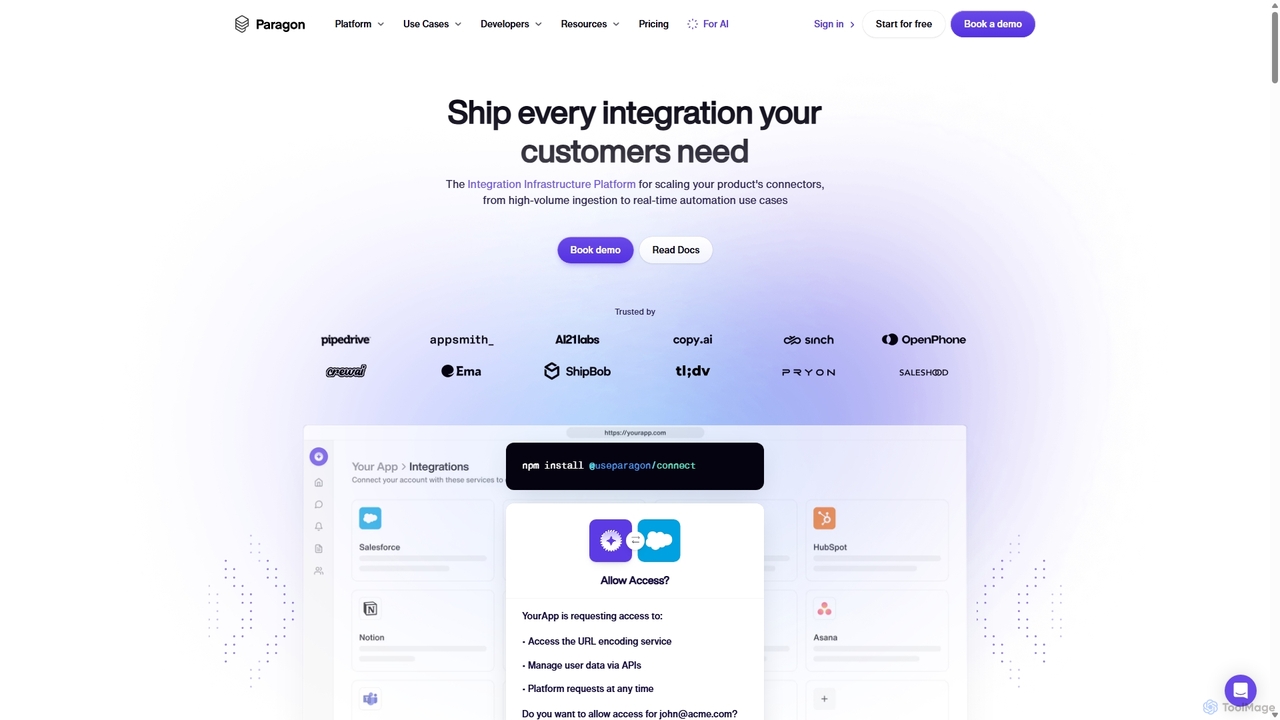
Paragon is an embedded integration platform for developers, designed to help SaaS and AI companies quickly build and …
Paragon is an embedded integration platform for developers, designed to help SaaS and AI companies quickly build and scale product integrations. It provides a unified infrastructure with pre-built connectors, managed authentication, and purpose-built tools for various use cases like high-volume data ingestion for RAG, real-time actions for AI agents, and event-driven workflows. This allows developers to ship any integration their customers need, 10x faster.
Klavis
Klavis is a developer platform that provides open-source Model Context Protocol (MCP) integrations, enabling AI applications to securely …
Klavis is a developer platform that provides open-source Model Context Protocol (MCP) integrations, enabling AI applications to securely and scalably connect with thousands of external tools and APIs like Salesforce, Gmail, and Slack. It simplifies authentication, enhances security, and accelerates the development of powerful AI agents.
About Integration Platform
Integration Platforms are AI-powered tools designed to seamlessly connect and orchestrate various AI models, data sources, and applications. These platforms act as a central hub, enabling complex AI workflows by automating data flow, managing APIs, and ensuring interoperability between disparate systems. They empower businesses to build, deploy, and scale sophisticated AI solutions efficiently, transforming raw data into actionable intelligence across the enterprise.
Core Features
- API Management: Centralized control and orchestration of AI model APIs and external service APIs.
- Data Orchestration: Automated collection, transformation, and routing of data to and from AI models.
- Workflow Automation: Designing and executing multi-step AI processes across different tools and services.
- Model Deployment & Monitoring: Streamlined deployment of AI models and continuous performance tracking.
- Pre-built Connectors: Ready-to-use integrations with popular AI services, databases, and business applications.
Applicable Scenarios
Integration Platforms are crucial for organizations looking to operationalize AI at scale. They are used by data scientists, MLOps engineers, and enterprise architects to connect AI components with existing IT infrastructure, automate complex analytical pipelines, and deliver AI-driven insights directly into business applications like CRM, ERP, and marketing automation systems.
How to Choose
When selecting an Integration Platform, consider its compatibility with your existing AI models and data infrastructure, the breadth of its pre-built connectors, and its scalability to handle growing data volumes and AI workloads. Evaluate its security features, ease of use for workflow design, and the level of support for custom integrations to ensure it meets your specific enterprise needs.

Integration PlatformUse Cases
Automating AI-Powered Customer Service Workflows
A customer service department integrates an AI chatbot with their CRM system, knowledge base, and ticketing platform. The integration platform orchestrates the flow: customer query -> chatbot (AI) -> knowledge base (data) -> CRM (customer context) -> ticketing system (if escalation needed). This ensures seamless handoffs, personalized responses, and automated issue resolution, significantly reducing agent workload and improving response times.
Orchestrating Multi-Modal Content Generation
A marketing team needs to generate diverse content (text, images, video scripts) for campaigns. An integration platform connects an AI text generator, an AI image generator, and an AI video script generator. Users input a campaign brief, and the platform automatically triggers each AI model in sequence, feeding outputs from one to the next, to produce a complete set of multi-modal content assets, accelerating content creation cycles.
Real-time Fraud Detection in Financial Services
A financial institution uses an integration platform to connect real-time transaction data streams with an AI-powered fraud detection model. The platform continuously ingests transaction data, preprocesses it, feeds it to the AI model for anomaly detection, and then triggers alerts or automated blocking actions in the core banking system if fraud is suspected. This enables immediate response to potential threats, minimizing financial losses.
Streamlining AI Model Deployment and Updates
An MLOps team manages numerous AI models across different business units. An integration platform automates the entire CI/CD pipeline for AI models: pulling new data for retraining, triggering model training on a cloud AI service, validating model performance, and deploying the updated model to production endpoints. This ensures models are always current and perform optimally with minimal manual intervention.
Personalized Product Recommendation Engine Integration
An e-commerce platform wants to offer highly personalized product recommendations. An integration platform connects customer browsing history, purchase data, and inventory information with an AI recommendation engine. It continuously feeds updated user behavior data to the AI model and then pushes the generated personalized recommendations to the website's front-end, email marketing system, and mobile app, enhancing user experience and sales.
Connecting IoT Data for Predictive Maintenance
A manufacturing company uses an integration platform to collect sensor data from machinery (IoT devices) and feed it into an AI predictive maintenance model. The platform handles data ingestion, cleansing, and routing to the AI model. When the AI model predicts a potential equipment failure, the platform automatically creates a maintenance ticket in the ERP system and notifies relevant personnel, preventing costly downtime.