PromptPoint
A collaborative, no-code platform for teams to design, test, deploy, and monitor LLM prompts. It offers automated testing, …
A collaborative, no-code platform for teams to design, test, deploy, and monitor LLM prompts. It offers automated testing, versioning, and multi-LLM support to ensure high-quality, predictable AI outputs.
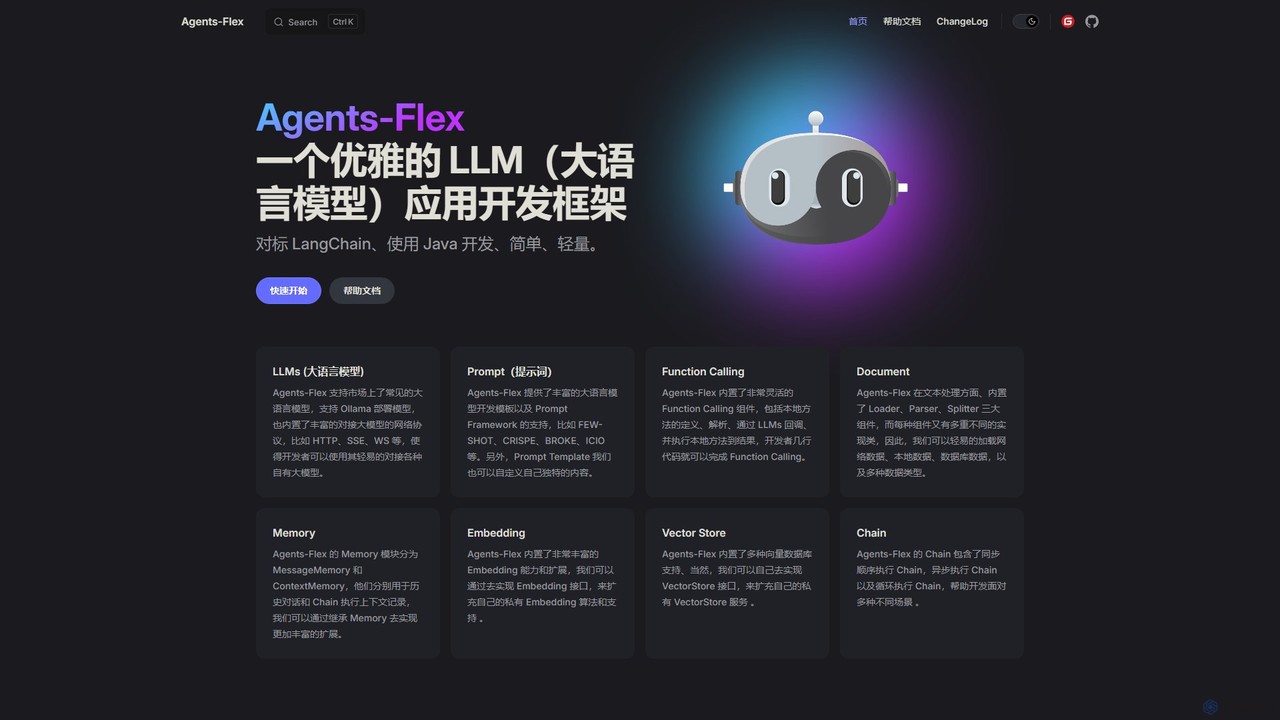
Agents-Flex
Agents-Flex is an open-source Java framework for building LLM-powered applications. As a lightweight and elegant alternative to LangChain, …
Agents-Flex is an open-source Java framework for building LLM-powered applications. As a lightweight and elegant alternative to LangChain, it simplifies development with a highly extensible architecture. It supports a wide range of LLMs, vector databases, and advanced features like function calling, RAG, and agent orchestration. Its framework-agnostic nature and low JDK requirement (8+) make it a versatile choice for any Java developer.
LangChain
LangChain is a comprehensive framework and developer platform for building, deploying, and managing production-grade LLM applications. It provides …
LangChain is a comprehensive framework and developer platform for building, deploying, and managing production-grade LLM applications. It provides a full suite of tools, including LangChain framework, LangGraph for agent orchestration, and LangSmith for observability, enabling developers to create sophisticated, reliable, and scalable AI agents.
About Llm Ops
Llm Ops (Large Language Model Operations) tools are a specialized category of AI infrastructure designed to manage the complete lifecycle of large language models. They provide a systematic approach for developing, deploying, and maintaining LLM-powered applications at scale. These platforms address unique LLM challenges like prompt engineering, fine-tuning, cost management, and monitoring for issues such as hallucinations. By streamlining these complex processes, Llm Ops enables teams to build reliable and efficient AI products.
Core Features
- Model Deployment & Serving: Provides optimized infrastructure for hosting LLMs with low latency and high throughput.
- Performance Monitoring: Tracks key metrics like token usage, cost, latency, and output quality to ensure reliability.
- Prompt Management: Offers tools for creating, versioning, testing, and deploying prompts as part of a CI/CD workflow.
- Fine-tuning & Experimentation: Facilitates the process of adapting pre-trained models with custom data and tracking experiment results.
- Data & Vector Management: Manages data pipelines for Retrieval-Augmented Generation (RAG) and other data-intensive LLM tasks.
Use Cases
Llm Ops is critical for technology companies building generative AI applications, enterprises integrating custom chatbots, and development teams managing multiple LLM-based microservices. For instance, a SaaS company can use it to monitor their AI writing assistant's API costs, while a financial firm can ensure their internal Q&A bot remains secure and accurate.
How to Choose
When selecting an Llm Ops tool, evaluate its support for different model providers (e.g., OpenAI, Anthropic, open-source), its integration capabilities with your existing MLOps stack, and its observability features for debugging and performance analysis. Also consider the platform's scalability for handling production traffic and its pricing model based on usage.
Llm OpsUse Cases
Deploying and Monitoring a Custom Support Chatbot
A customer support team fine-tunes an open-source LLM on their company's knowledge base to create a specialized chatbot. They use an Llm Ops platform to deploy this model on a scalable infrastructure. The platform continuously monitors the chatbot's response accuracy, latency, and operational costs. It alerts the team to performance degradation or spikes in 'I don't know' answers, allowing them to quickly retrain the model with new support articles to maintain high-quality service.
Managing Costs for Third-Party LLM APIs
A startup building a content generation application relies on multiple third-party LLM APIs like GPT-4 and Claude. An Llm Ops tool provides a centralized dashboard to track token consumption and costs across all models and environments (development, staging, production). It implements smart caching to avoid redundant API calls for identical prompts and sets up budget alerts to prevent unexpected expenses, ensuring the application remains profitable.
Streamlining Prompt Engineering and A/B Testing
A marketing tech company develops prompts for generating ad copy. Using an Llm Ops platform, their prompt engineers can create and manage a version-controlled library of prompts. They can run A/B tests on different prompt variations directly in production, comparing metrics like click-through rates or user engagement. This data-driven approach allows them to systematically optimize prompts for maximum marketing impact without manual tracking.
Implementing a Reliable RAG System for Internal Knowledge
An enterprise wants to provide employees with a reliable way to query internal documents. They use an Llm Ops solution to build and maintain a Retrieval-Augmented Generation (RAG) system. The tool manages the entire pipeline: from ingesting and vectorizing new documents into a vector database to monitoring the retriever's performance and the LLM's final answer generation. This ensures employees always receive accurate, up-to-date answers based on the latest company information.
Ensuring LLM Security and Compliance
A healthcare organization deploys an LLM-powered tool for summarizing patient notes. Llm Ops tools are essential for security and compliance. They implement guardrails to detect and redact personally identifiable information (PII) from both inputs and outputs. The platform also logs all interactions for auditing purposes and monitors for any anomalous behavior or potential data leakage, helping the organization meet strict HIPAA regulations.
Managing the Fine-tuning Lifecycle for Specialized Models
A legal tech firm needs to create a highly specialized LLM for contract analysis. Their data science team uses an Llm Ops platform to manage the entire fine-tuning process. The platform helps them prepare and version datasets, launch and track multiple fine-tuning experiments with different hyperparameters, and compare model performance on a standardized evaluation set. Once the best model is identified, it can be seamlessly promoted to production through the same platform.