LangSearch
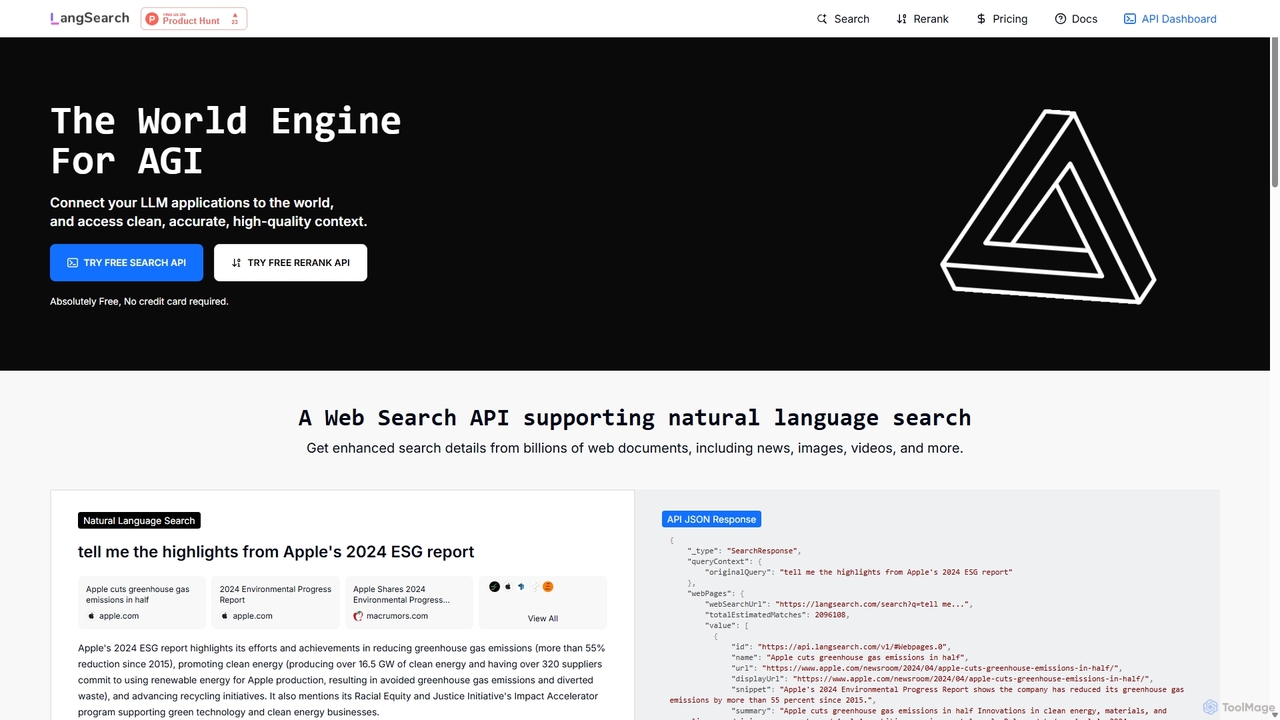
LangSearch provides free Web Search and Semantic Rerank APIs designed to connect LLM applications with clean, accurate, real-world …
LangSearch provides free Web Search and Semantic Rerank APIs designed to connect LLM applications with clean, accurate, real-world context. It supports natural language queries, hybrid search, and offers a highly efficient reranker to improve result accuracy for AI agents, chatbots, and RAG systems.
supermemory
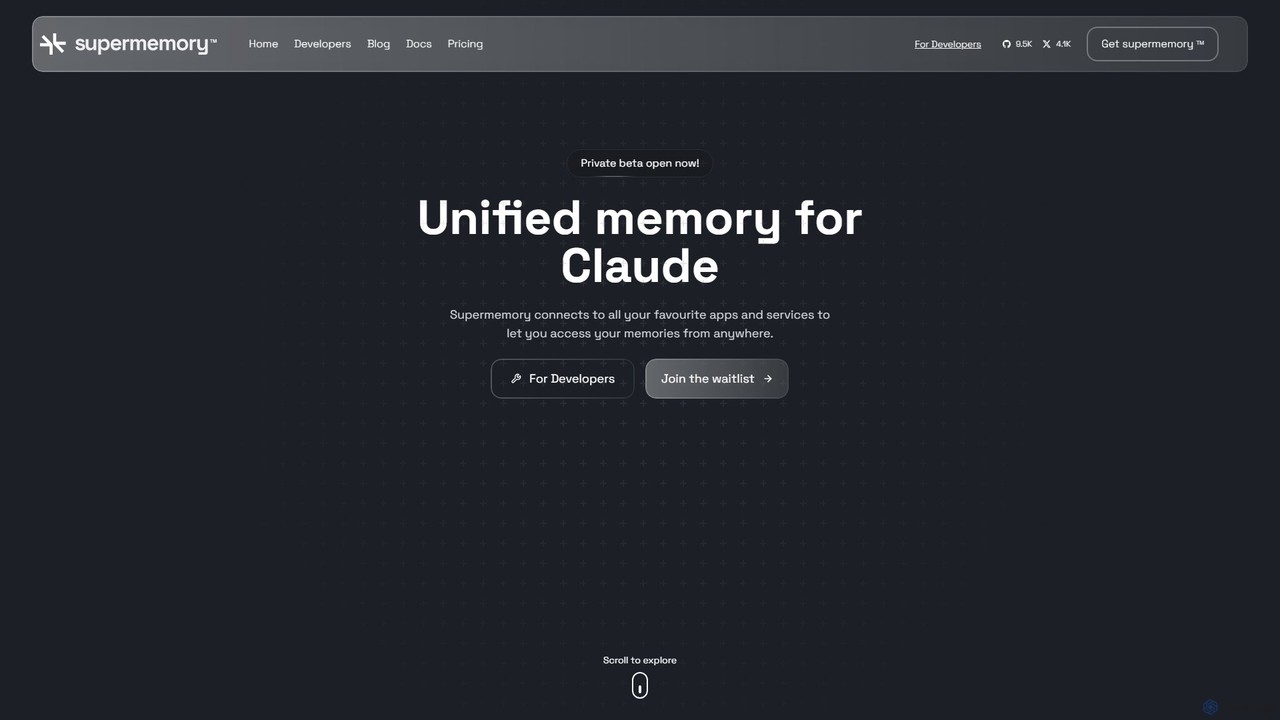
supermemory is a memory API and infrastructure for the AI era, designed for developers to build LLMs with …
supermemory is a memory API and infrastructure for the AI era, designed for developers to build LLMs with long-term, persistent memory. It overcomes the finite context window limitation, enabling the creation of intelligent, context-aware AI agents, chatbots, and applications that remember past interactions and information across various platforms.
About Llm
Large Language Models (LLMs) are a type of artificial intelligence trained on vast amounts of text data to understand, generate, and interact with human language. These models utilize complex deep learning architectures, such as the Transformer, to recognize context, grammar, and nuanced meanings. Their primary value lies in powering a wide range of applications, from conversational AI and content creation to code generation and data analysis. The key strength of LLMs is their versatility, allowing them to perform diverse language-based tasks with minimal task-specific training.
Core Features
- Natural Language Understanding (NLU): The ability to comprehend and interpret the intent, sentiment, and context of human language input.
- Text Generation: Creating coherent and contextually relevant text, including articles, emails, summaries, and creative writing.
- Code Generation: Writing, completing, and debugging code in various programming languages based on natural language prompts.
- Few-Shot Learning: Adapting to new tasks with only a few examples, without requiring extensive retraining.
- Information Retrieval and Synthesis: Extracting and summarizing key information from large volumes of unstructured text.
Applicable Scenarios
LLMs are foundational technology for developers building AI-powered applications, content creators automating writing workflows, and businesses integrating advanced conversational AI. They are used to power customer service chatbots, generate marketing copy, assist in software development, and analyze qualitative data from customer feedback or research reports.
How to Choose
When selecting an LLM, consider the model's size and performance characteristics, as larger models are often more capable but costlier. Evaluate its fine-tuning capabilities for adapting to specific domains. Assess the quality of API documentation, pricing models (e.g., per-token costs), and rate limits. Finally, consider deployment options, including cloud-based APIs versus open-source models for self-hosting.

LlmUse Cases
Automated Customer Support Chatbot
An e-commerce business owner can integrate an LLM via an API into their website's chat widget to handle high volumes of customer queries. The model is fine-tuned with company-specific FAQs, product details, and return policies. When a customer asks 'Where is my order?' or 'How do I return an item?', the LLM understands the intent and provides an accurate, instant response by accessing order data or policy information. This results in 24/7 support availability, a reduction in support ticket volume by over 60%, and allows human agents to focus on more complex, high-value customer interactions.
Content Ideation and First Draft Generation
A content marketer needs to produce a steady stream of blog posts and social media updates. They use an LLM-powered writing tool by providing a topic or a set of keywords like 'benefits of remote work for startups'. The LLM generates several potential blog post outlines, title suggestions, and a complete first draft of the article. It can also create multiple variations of social media captions for different platforms. This process accelerates content creation, helps overcome writer's block, and allows the marketer to focus their time on editing, adding unique insights, and strategic planning rather than starting from a blank page.
Code Generation and Debugging Assistant
A software developer working on a new feature can use an LLM integrated into their code editor. Instead of manually writing boilerplate code for a database connection, they can type a comment like 'create a function to connect to a PostgreSQL database'. The LLM instantly generates the required code snippet, complete with error handling. Later, when encountering a cryptic error message, they can paste it into the LLM assistant and ask for an explanation. The model breaks down the error's cause and suggests several potential solutions, significantly speeding up the development and debugging cycle.
Market Research Data Summarization
A market analyst is tasked with analyzing thousands of customer reviews from various online platforms to identify key trends. Instead of manually reading each review, they use an application powered by an LLM. They upload the raw text data and prompt the model to 'summarize the top 5 complaints and top 5 praises about Product X'. The LLM processes the text, identifies recurring themes, and generates a concise, bulleted summary. This transforms a week-long manual task into a process that takes only a few minutes, enabling the analyst to quickly derive actionable insights for product improvement.
Multilingual Content Localization
A global marketing manager needs to adapt a new product launch campaign for Spanish, German, and Japanese markets. Using a sophisticated LLM, they can go beyond simple translation. They provide the original English marketing copy and prompt the model: 'Translate this for a Spanish audience, making the tone more informal and including a local cultural reference'. The LLM generates a translation that is not only linguistically accurate but also culturally resonant. This ensures consistent brand messaging while adapting to local nuances, achieving higher engagement than standard machine translation services.
Interactive Educational Tutoring System
An EdTech platform developer aims to create a personalized AI tutor for high school physics. They use an LLM fine-tuned on a vast corpus of physics textbooks, academic papers, and problem sets. When a student struggles with a concept like 'Newton's Second Law', they can ask the AI tutor questions in their own words, such as 'Why does a heavier ball fall at the same speed as a light one?'. The LLM provides a detailed, step-by-step explanation, uses analogies, and can even generate new practice problems on the spot. This creates a scalable, on-demand learning assistant that adapts to each student's individual learning pace and style.